



ISLAMABAD: Chaudhry Parvez Elahi, a candidate backed by ousted Prime Minister Imran Khan, on Wednesday took oath as chief minister of Punjab, hours after Pakistan’s top court ruled to hand control of the country’s most populous province to him.
A three-member bench headed by Chief Justice Umar Ata Bandial on Tuesday ruled that Elahi had been wrongfully denied victory in a vote last week by the speaker of the Punjab assembly, who disregarded votes caste in Elahi’s favor on the basis of them being against party line and handed victory to the candidate of the ruling coalition, outgoing CM Hamza Shahbaz.
The court overturned the speaker’s decision.
It was well past 1am on Wednesday when Pakistani media showed Elahi taking oath at the presidency.
Prime Minister Shehbaz Sharif called the court’s verdict a “blow to the expectations of the legal community, citizens, the media and to the people.”
“The constitution has mandated all the institutions to work within the specified limits. No institution can interfere in another’s jurisdiction.
“There will be no compromise on the supremacy of the constitution and parliament,” Sharif added.
“The decision has not been accepted by the people, we will decide our future line of action after consulting coalition partners,” Marriyum Aurangzeb, federal minister for information, told reporters on Tuesday night.
Ex-PM Khan, however, lauded the court’s ruling and his supporters came out in celebration in cities across the country.
“I appreciate our SC [Supreme Court] judges for standing firm & upholding the Constitution & law, against all manner of threats & abuse,” Khan said on Twitter.
In the July 22 election for Punjab CM, Elahi, backed by Khan’s Pakistan Tehreek-e-Insaf (PTI) and it’s ally, the Pakistan Muslim League-Quaid (PML-Q), had bagged 186 votes, while the Pakistan Muslim League-Nawaz (PML-N) nominee Hamza Shahbaz had secured 179 votes in the provincial house of 371. Shahbaz is the son of PM Sharif.
However, Deputy Speaker Dost Muhammad Mazari rejected 10 PML-Q votes on the basis of a recent Supreme Court verdict that endorsed the idea of disqualifying legislators for voting against party lines. Mazari quoted a letter written to him by PML-Q chief Chaudhry Shujaat Hussain, asking his party’s lawmakers to support Shahbaz instead of Elahi.
In its 11-page verdict, the Supreme Court ruled that the deputy speaker’s ruling was “void, without lawful authority and of no legal effect.”
“In consequence of the above … Chaudhry Parvez Elahi is declared as the duly elected Chief Minister, Punjab,” Chief Justice of Pakistan Umar Ata Bandial announced in the high-profile case.
The court directed the Punjab chief secretary to “immediately and forthwith” issue a notification to declare Elahi as the elected chief minister of the province. Likewise, the court declared that the oath of the office administered to Hamza Shehbaz “was and is without lawful authority and of no legal effect.”
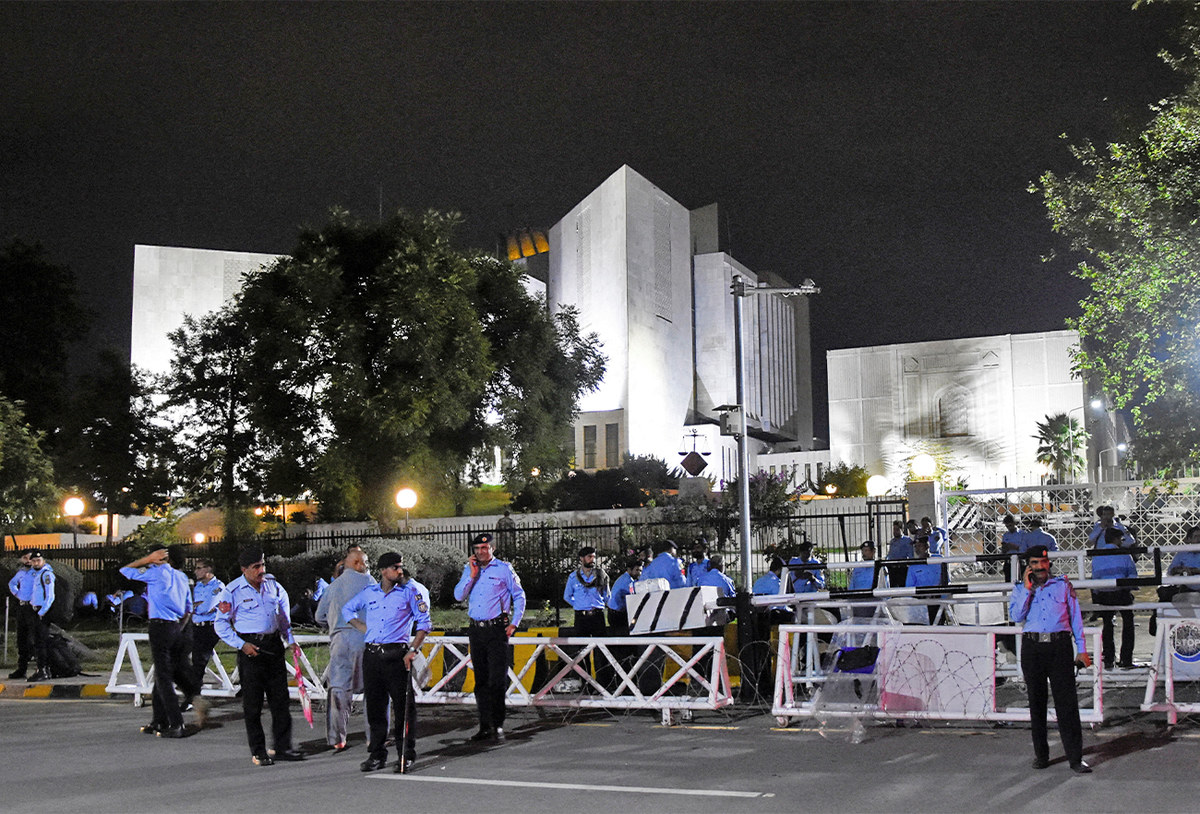
Police officers stand guard as people celebrate after court ordered that backed by former Prime Minister Imran Khan, candidate for Punjab's chief minister, Chaudhry Parvez Elahi, to be installed as the province's premier, outside the Supreme Court of Pakistan in Islamabad, Pakistan July 26, 2022. (REUTERS)
Elahi’s election will give Khan’s campaign for early elections a shot in the arm. General elections are scheduled for August next year.
The tug of war between Khan and his opponents comes while the coalition government struggles to restart a tough IMF bailout program and as Pakistan faces falling foreign exchange reserves, a widening current account deficit and a sharply depreciating currency.
The July 22 election was held on the directions of the Supreme Court after 25 members of former premier Imran Khan’s PTI party were disqualified for voting for the rival PML-N candidate, Shahbaz, in an April election for the same post.
In a unanimous decision in May, the Election Commission of Pakistan (ECP) had said the PTI dissidents were being de-seated for defecting from the party under Article 63-A. The Supreme Court of Pakistan, in its interpretation of Article 63-A, has said votes cast against the party direction “cannot be counted and must be disregarded.”
According to Article 63-A of the constitution, a parliamentarian can be disqualified on grounds of defection if he or she “votes or abstains from voting in the House contrary to any direction issued by the parliamentary party to which he belongs, in relation to election of the prime minister or chief minister; or a vote of confidence or a vote of no-confidence; or a money bill or a Constitution (amendment) bill.”


