Pakistan’s ruling coalition demands full court hearing of Punjab chief minister’s election

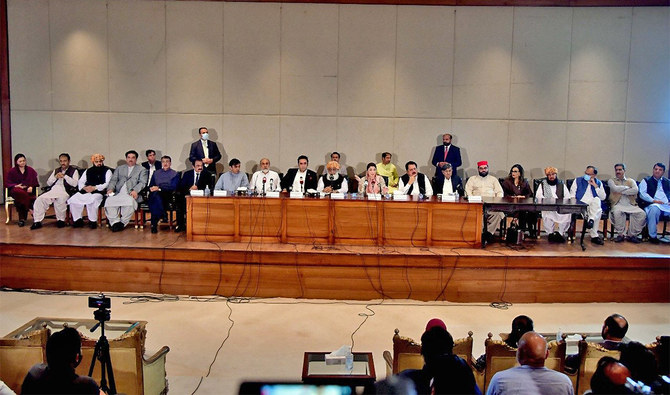
Leaders of Pakistan’s ruling coalition hold a joint press conference in Islamabad, Pakistan, on July 25, 2022. (APP)
Short Url
Updated 25 July 2022
Follow

Pakistan’s ruling coalition demands full court hearing of Punjab chief minister’s election

  • Bilawal Bhutto-Zardari says ‘it is not possible that only three people determine the future of the country’
  • Maryam Sharif questions Supreme Court’s description of Hamza Shehbaz as Punjab’s ‘trustee chief minister’

ISLAMABAD: Leaders of Pakistan’s ruling coalition on Monday demanded a full court bench to hear a high-profile case related to the recent election of the Punjab chief minister while holding a joint news conference in the federal capital.

The election, which was held on Friday, went in favor of Hamza Shehbaz, the candidate for the ruling coalition and son of Prime Minister Shehbaz Sharif, after the deputy speaker of the Punjab Assembly invalidated 10 votes cast against him by the provincial lawmakers belonging to the Pakistan Muslim League-Quaid (PML-Q) party.

The deputy speaker, Dost Mohammad Mazari, said his ruling was based on a recent Supreme Court verdict which endorsed the idea of disqualifying legislators for voting against party line.

Mazari gave his ruling in the matter soon after the voting in the chief minister’s election, quoting a letter written to him by the top PML-Q leader, Chaudhry Shujaat Hussain, which asked his party lawmakers to support Shehbaz instead of his rival and Hussain’s cousin, Chaudhry Pervaiz Elahi.

Speaking at the news conference, leaders of the ruling coalition claimed some judges of the top court had a soft corner for former prime minister Imran Khan and his Pakistan Tehreek-e-Insaf (PTI) party.

They also maintained there were only handful of judges hearing petitions related to significant political developments, adding some of them had also given verdicts against them in the past.

“It is not possible that only three people determine the future of the country,” Pakistan Peoples Party (PPP) chairman Bilawal Bhutto-Zardari said while emphasizing a full court hearing of the case.

The ruling Pakistan Muslim League-Nawaz (PML-N) vice president, Maryam Sharif, spoke at length about recent Supreme Court rulings, saying she was stopped from publicly taking up such issues by several people ahead of the news conference, though she added it was important for people’s representatives to think beyond their self-interest and protect the rights of others.

“I can write an essay in praise of the judiciary,” she said, “but one wrong [court] verdict will undermine the whole argument.”
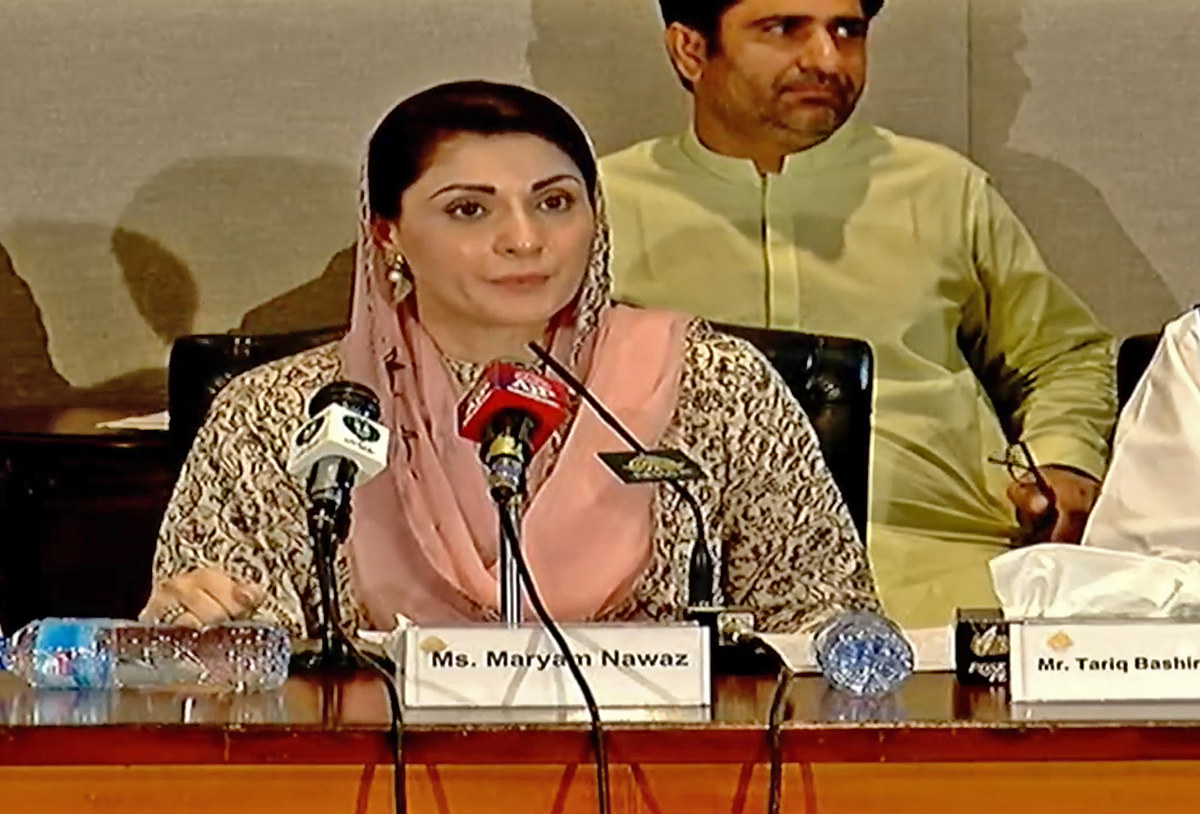


Pakistan Muslim League-Nawaz (PML-N) vice president, Maryam Sharif, addresses a press conference in Islamabad, Pakistan, on July 25, 2022. (Screengrab from the video posted on @pmln_org)

She also questioned the top court’s description of Shehbaz as the “trustee chief minister” of Punjab.

As the country’s apex court prepared to look into the case related to the election of the Punjab chief minister, a 37-member provincial cabinet was sworn in at a ceremony held at the Governor House in Lahore on Sunday evening.

The top leader of Pakistan Democratic Movement (PDM) alliance, Maulana Fazlur Rehman, endorsed Sharif’s criticism of the court, saying the ruling coalition did not expect justice from the bench hearing the case while calling for a full bench.

“Don’t take people to a point where they begin to rebel against state institutions,” he said.


Pakistan arrests woman suspected of planning suicide attack in northwest

Updated 6 sec ago
Follow

Pakistan arrests woman suspected of planning suicide attack in northwest

  • Police say suspect had training and links to a banned militant organization
  • Arrest comes amid a renewed surge in militant violence in Khyber Pakhtunkhwa

ISLAMABAD: Pakistan’s counterterrorism police announced the arrest of a young female suicide bomber in the northwestern Khyber Pakhtunkhwa (KP) province on Saturday, saying they have seized a pistol, communication devices and other materials from her possession.

The arrest was made in Dera Ismail Khan district amid a renewed surge in militant violence in KP, where security forces have faced frequent attacks in recent years. Islamabad has blamed the spike on cross-border militancy from neighboring Afghanistan, accusing the administration in Kabul of “facilitating” assaults against civilians and security personnel.

The allegation has been denied by the Afghan Taliban.

The Counter-Terrorism Department (CTD) said it acted on intelligence in the Sheikh Yousaf tent settlement area of the district, where a special weapons and tactics team conducted a raid and detained the suspect.

“The arrested suicide attacker was the right-hand woman of the deceased khariji Shah Wali, also known as Tariq Kochi, and had continued to receive training from him,” the CTD said in a statement.

“The equipment and target for the suicide attack were to be provided by khariji commander Asim, according to the alleged confession of the suspected female suicide attacker,” it added.

Pakistani authorities refer to Tehreek-e-Taliban Pakistan (TTP) militants as “khariji,” a term drawn from Islamic history for an extremist sect that rebelled against authority and declared other Muslims apostates.

The statement, which identified the suspect only by the initial “Z,” said she was a resident of Waziristan.

The CTD said a pistol with ammunition, two mobile phones, a tablet device, a power bank and other materials were recovered from the site.

It added that information extracted from the suspect’s mobile phones indicated contact with a proscribed group and preparations linked to a potential suicide bombing.

Female suicide bombers are relatively rare in Pakistan, though separatist militants in Balochistan have used women in recent attacks, including coordinated gun and bomb assaults across multiple districts in the southwestern province last month.

Recent attacks in KP have included suicide bombings, assaults on security checkpoints, police stations and paramilitary facilities, as well as kidnappings of government officials.