KARACHI: Former Pakistani pacer Shoaib Akhtar says the story of his life has not been covered fully and his biopic, ‘Rawalpindi Express – Running against the odds,’ will feature “a lot more that needs to be told” about his rise to fame across the cricketing world.
Directed and produced by Dubai-based filmmaker Muhammad Faraz Qaiser under the banner of Q Film Productions, the biopic is the “first foreign film about a Pakistani sportsman” as Akhtar puts it. The movie will release on November 16, 2023.
The legendary pacer on Monday shared a teaser of ‘Rawalpindi Express – Running against the odds’ on Instagram, telling his fans “you’re in for a ride you’ve never taken before.”
“It’s my story which I personally feel that has only been told 20 percent in my book. There’s a lot more that needs to be told and will be shown in this [biopic],” Akhtar told Arab News on Monday.
“I am not going to be playing myself of course. There may just be a twist though which you will find out later. The film goes on floors in December and will be shot in four countries.”
Born in Rawalpindi in August 1975, Akhtar was the first bowler to be recorded bowling at 100 miles per hour, a feat he achieved twice in his career. He scored 178 Test wickets, 247 one-day and 19 Twenty-20 wickets in his career.
The former pacer said he would be teaching balling techniques to the actor playing his role in the flick.
“It’s been 10 years, I’ve been requested separately by different directors and production houses from Pakistan, India and other places,” Akhtar said.
“So, the idea was there, I was just waiting for the right script and potential execution. Faraz [Qaiser] reached out to me not just with the idea, but actual working on the project.”
Qaiser, who has been working on the project since 2016, presented his research to Akhtar in 2019. Since then, the two have been working together to develop the script.
“My father, Qaiser Nawaz, is the writer of the film and he came up with the idea in 2016,” the director told Arab News.
“I have studied films and I only wanted to do biographies. My father told me I should work on this one and then I watched one of Shoaib Akhtar’s interviews on YouTube.”
Qaiser, who is a film graduate, has directed and produced short films that have made it to the international film circuit. However, ‘Rawalpindi Express’ is going to be his first feature film.
“I approached Shoaib Akhtar in 2019 and we had our first meeting where I showed him my presentation comprising 150 slides,” Qaiser said.
“He (Akhtar) started crying and said that he loved it. I still remember him saying ‘Bismillah Karen (let’s start)’ and I think that was the moment for me.”
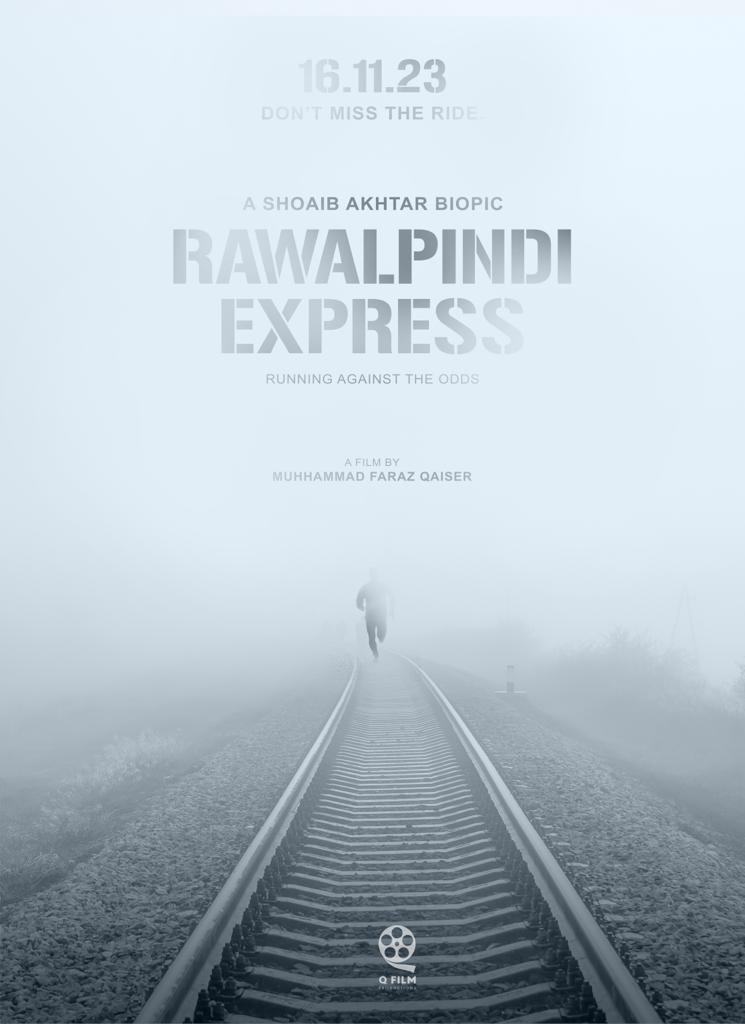
This photo shows the poster of Pakistani pacer Shoaib Akhtar's biopic ‘Rawalpindi Express – Running against the odds.’
Though the COVID-19 pandemic put a halt to the film’s advancement and the investors also backed out at one point, Qaiser continued accompanying Akhtar to his gym and tracks in Pakistan as well as meeting the former pacer’s college friends and batch-mates. He finished the script and presented the final document to Akhtar in 2021.
“We struggled a lot while locking the script because there were so many spicy elements that we were afraid we don’t end up making a six-hour long film. While writing it we wanted to make sure it is not a cricket film; there are about two to three matches in the film,” the director said.
“Rawalpindi Express is going to be about how he broke the world record. We are making it for a very generic audience; it will have Shoaib Akhtar’s life story.”
The biopic is currently in the pre-production phase. The film’s crew comprises people from Dubai, Canada and Pakistan, while the cast will have actors from Pakistan and Dubai.
Qaiser, however, refrained from revealing the cast as yet. He said 60 percent of the film will be shot in Pakistan, while the rest will be shot in Dubai, Australia and might as well in New Zealand.