Australia’s COVID-19 hospital admissions, deaths rise as variant surges

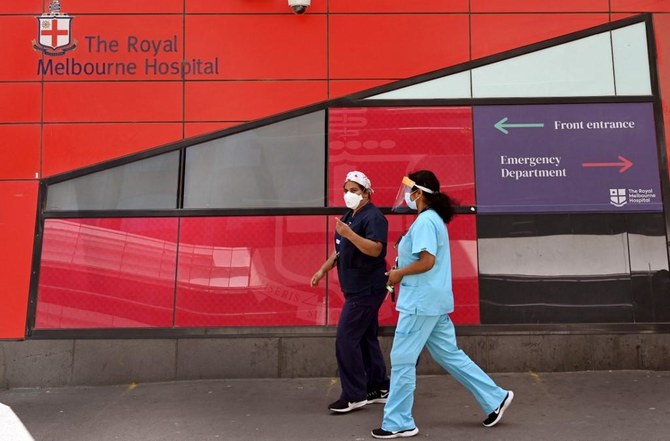
Nearly 5,600 patients infected with COVID-19 are in hospital. (File/AFP)
Short Url
Updated 26 July 2022
Follow

Australia’s COVID-19 hospital admissions, deaths rise as variant surges

  • The COVID-19 flare-up is being driven by the highly infectious BA.4/5 omicron sub-variant, and it is putting severe pressure on hospitals and retirement homes

SYDNEY: Hospital admissions for COVID-19 in Australia have reached a new high for a second straight day, data showed on Tuesday, while the daily death toll rose to its second-highest as an outbreak fueled by a coronavirus sub-variant sweeps the country.
Nearly 5,600 patients infected with COVID-19 are in hospital while 100 new deaths were reported, just short of a record 102 deaths on Saturday.
Nearly 330,000 infections have been reported over the last seven days but authorities say the real numbers could be double that.
“It’s time to come together again and fight: get vaccinated, use a mask in crowds and indoors, and stay home if you’re sick,” said the premier of hard-hit Queensland state, Annastacia Palaszczuk.
The COVID-19 flare-up is being driven by the highly infectious BA.4/5 omicron sub-variant, and it is putting severe pressure on hospitals and retirement homes.
Queensland, battling its worst outbreak in the pandemic, expects its patient numbers to peak in around late August, modelling from the state’s health department showed.
Along with rising hospitalizations, many front-line workers are off sick or in isolation, worsening the crisis.
Hospitals will add beds and shift more staff to front-line duties, Palaszczuk said.
In Victoria state, more than 8 percent of staff in the health sector, or about 10,000 employees, are off sick, Premier Daniel Andrews told reporters.
Like many countries, Australia has ditched its toughest coronavirus precautions and has been living with the virus since early this year.
Authorities are resisting the pressure to reinstate them, including calls from some doctors to make masks mandatory indoors.
Instead, they have urged businesses to let staff work from home and recommended people to get booster shots urgently.
About 71 percent of the eligible population have had boosters compared with 95 percent who had two shots.
In all, the country of nearly 26 million people has reported about 9.2 million COVID-19 cases and 11,300 deaths.


Afghanistan launches retaliatory attacks on Pakistan as tensions escalate

Updated 28 February 2026
Follow

Afghanistan launches retaliatory attacks on Pakistan as tensions escalate

  • At least 66 Afghans have been killed by Pakistan’s strikes, Afghan authorities say
  • Afghanistan has called for dialogue while Pakistan ruled out any talks with Kabul 

KABUL: Afghanistan has launched new attacks on Pakistan’s military bases, the Afghan defense ministry said on Saturday, as cross-border clashes escalated between the neighbors after months of tension. 

The latest flare-up erupted after Pakistan’s airstrikes on Afghan territory last weekend triggered a retaliatory offensive from Afghanistan along the border on Thursday. 

The two countries have engaged in tit-for-tat attacks since, marking the most serious development in ongoing tensions between the two countries, which agreed to a ceasefire last October following a week of deadly clashes. 

Afghanistan’s Air Force has “once again launched airstrikes on Pakistani military bases” in Miranshah and Spinwam, the Afghan Ministry of National Defense said on X on Saturday, claiming that the strikes caused “severe damage and heavy casualties.”

“These successful operations were conducted in response to repeated aerial aggressions by the Pakistani military regime,” the ministry said. 

Afghan forces also launched similar strikes against military targets in Islamabad and Abbottabad on Friday, which the ministry said was in retaliation of aerial attacks by Pakistani forces in Kabul, Kandahar and Paktia.

At least 66 Afghan civilians, mostly women and children, have been killed in Pakistani strikes, with another 59 others wounded, according to Hamdullah Fitrat, deputy spokesman for the Afghan government. 

Pakistan has maintained that it is targeting only military targets to avoid any civilian casualties, in compliance with international law. 

Pakistani officials said its forces have killed more than 330 Afghan fighters and targeted 37 military locations across Afghanistan.

Zabihullah Mujahid, chief spokesperson for the Afghan government, earlier called for talks to resolve the crisis. 

“We have always emphasized peaceful resolution, and now too we want the issue to be resolved through dialogue,” he said on Friday. 

However, Pakistan has ruled out any talks with Kabul. 

“There won’t be any talks, there is nothing to talk about. There’s no negotiation. Terrorism from Afghanistan has to end,” Mosharraf Zaidi, spokesperson for Pakistan’s prime minister, said on Friday. 

Pakistan is accusing the Afghan Taliban of sheltering fighters from the banned Tehreek-e-Taliban Pakistan and allowing them to stage cross-border attacks — a charge Afghanistan denies, saying it does not allow its territory to be used against other countries. 

As international calls for mediation grow amid the escalating hostility, Afghans across the country are growing fearful of the violence. 

“Everyone heard the jets. This is the first time since the withdrawal of US invaders that we have heard such a horrible noise and news of damage. It is not good for us,” said Kandahar resident Shahid Zamari. 

“We had forgotten the US war and its bad impact on us, on our families, on our children. And now this has come upon us again — by Pakistan, and in the holy month of Ramadan.” 

When the strikes hit Kabul at around 1:30 a.m. on Friday, Saleema Wardak moved quickly to wake up her six children and escape outside, assuming the strong jolt that shook her house was an earthquake. 

“While standing in the yard, my husband told me it was not an earthquake but an explosion. Then we heard the crazy sounds of planes, and shooting from the mountains against the planes,” she told Arab News. 

“We hid inside, worried another bomb would fall on us. People say Pakistan is targeting civilians on purpose to increase pressure on the Taliban. So we hid … The world is unjust … They do not value the blood of the poor.” 

For Sabawoon, a 23-year-old student from eastern Kunar province’s Asadabad city, the coming days are filled with uncertainties. 

“What to do? Where to go? We have to stay and find our way to survive,” he told Arab News. “God willing, nothing bad will happen to us. If they are bombing us, what can we do?”