Palestinian lawyers hold rare protest against Abbas’s ‘rule by decree’

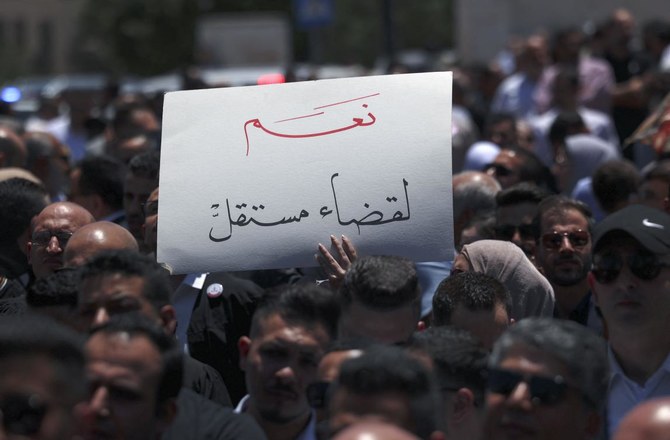
A demonstrator raises a placard, which reads ‘Yes to an independent judiciary,’ during a rally by Palestinian lawyers, Ramallah, West Bank, July 25, 2022. (AFP)
Short Url
Updated 25 July 2022
Follow

Palestinian lawyers hold rare protest against Abbas’s ‘rule by decree’

  • The Palestinian Legislative Council has been inactive since 2007, meaning Abbas has led without a functioning parliament for nearly all of his tenure as president
  • Riot police prevented the demonstrators, clad in their black robes, from marching to the nearby office of PM Mohammad Shtayyeh

RAMALLAH, Palestinian Territories: Hundreds of Palestinian lawyers held a rare street protest Monday against what they described as the Palestinian Authority’s “rule by decree,” condemning president Mahmoud Abbas for governing without a parliament.
The Palestinian Legislative Council — created under the Oslo Peace Accords with Israel — has been inactive since 2007, meaning Abbas has led without a functioning parliament for nearly all of his tenure as president.
But a new leadership at the Palestinian Bar Association has sought to pressure the PA.
The association’s president, Suheil Ashour, told AFP at the protest that his body would stand firm against legislation delivered by presidential decree that curbed Palestinian “rights and freedoms.”
“Our demand is either to stop their implementation now or to cancel” a raft of restrictive laws, said Ashour, who pushed for reforms when he was elected association president earlier this year.
The draft Palestinian constitution allows for presidential decrees “if necessary,” in cases where the PLC cannot act, but lawyers said Abbas has gone too far.
Riot police prevented the demonstrators, clad in their black robes, from marching to the nearby office of Prime Minister Mohammad Shtayyeh.
Farhan Abu Aisha, a protester, accused Abbas of making decisions “under the cover of darkness.”
“The legislative authority is absent in Palestine, and the judicial authority is completely marginalized,” he said.
Abbas was elected Palestinian president in 2005, following the death of iconic leader Yasser Arafat.
Hamas, bitter rivals of Abbas’s secular Fatah movement, swept to victory in the 2006 Palestinian legislative elections.
Fallout from that vote helped spark a split in Palestinian governance, with Fatah retaining control of the Israeli-occupied West Bank and Hamas running Gaza since 2007.
According to estimates by Palestinian legal experts, Abbas has issued some 400 presidential decrees while in office.
He officially dissolved the PLC in 2018 and moves to hold new elections have faced pushback.
Abbas had set dates for presidential and legislative elections to be held last year across the Palestinian territories, with Hamas’s participation, but canceled the polls citing Israel’s refusal to allow voting in annexed east Jerusalem.
Public demonstrations against Abbas and the PA have been on the rise in the West Bank, notably following the death in Palestinian custody of activist and Abbas critic Nizar Banat last year. The top Palestinian prosecutor has accused 14 security force members of beating Banat to death.


Refugees, migrants in Lebanon find rare sanctuary from Israeli strikes in Beirut church 

Updated 07 March 2026
Follow

Refugees, migrants in Lebanon find rare sanctuary from Israeli strikes in Beirut church 

  • Beirut church offers safe haven for displaced migrants, refugees
  • Many refugees lived through 2024 war, but are now more vulnerable

BEIRUT: When Israeli strikes began pummelling Beirut’s southern suburbs early on Monday, Sudanese refugee Ridina Muhammad and her family ​had no choice but to flee home on foot, eventually reaching the only shelter that would accept them: a church.
Eight months pregnant, Muhammad, 32, walked with her husband and three children for hours in the dark streets until they found a car to take them to the St. Joseph Tabaris Parish, which has opened its doors to refugees and migrants.
They are among 300,000 people displaced across Lebanon this week by heavy Israeli strikes, launched in response to a rocket and drone attackinto Israel by the Lebanese armed group Hezbollah.
Just 100,000 of the displaced are in government shelters. Others are staying ‌with relatives ‌or sleeping in the streets. But migrants and refugees say government ​shelters ‌were ⁠never an option ​for ⁠them, saying they were turned away during the last war between Hezbollah and Israel.
Muhammad’s oldest daughter, now seven, stopped speaking after the 2024 war.
This time, they are even more vulnerable: their home was destroyed in this week’s strikes and Muhammad is due to give birth at the end of the month.
“I don’t know if there’s a doctor or not, but I’m really scared about it because I haven’t prepared any clothes for the baby, nor arranged a hospital, and I don’t know where to go,” she told ⁠Reuters as her younger daughter leaned against her pregnant belly.
Muhammad ‌said she was registered with the United Nations’ refugee agency (UNHCR) ‌but had not received support.
“Us, as refugees, why did we ​register with the UN, if they are not ‌helping us in the most difficult times?” she said.
Dalal Harb, a spokesperson for UNHCR ‌Lebanon, said the agency had mobilized but reaching everyone immediately was extremely challenging given the scale and speed of displacement. The UNHCR operation in Lebanon is currently only around 14 percent funded, she said.
The Jesuit Refugee Service (JRS), which helped the church host displaced in 2024, is doing so again.
Michael Petro, JRS’ Emergency Shelter Director, said the church was ‌full within the first day of strikes, with 140 people from South Sudan, Ethiopia, Bangladesh, and other countries sheltering there.
“There are many, many more ⁠people coming than there ⁠were in 2024, and we have fewer and fewer places to put them,” he said.
Petro said he was told weeks ago that government shelters would be open to migrants if war erupted.
But when the strikes began and even Lebanese struggled to find shelter, the policy seemed to change, he said.
“We’re hearing from hotlines up to government officials and ministries that migrants are not welcome,” Petro said.
Lebanon’s Minister for Social Affairs Haneen Sayyed did not respond to a request for comment. On Thursday, Sayyed said Beirut shelters were full.
When Israeli strikes began, Othman Yahyeh Dawood, a 41-year-old Sudanese man, put his two young sons on his motorcycle.
They drove 75 kilometers (46 miles) from the southern Lebanese town of Nabatieh to St. Joseph’s, where they had sheltered in 2024.
“I know the area ​is safe and there are people who ​will welcome us,” he said.
“We don’t know where to go; there’s war there (in the south), war here (in Beirut), war in Sudan, and nowhere else to go,” he said.