

Pakistan top court rejects plea seeking full bench to hear Punjab CM’s election case

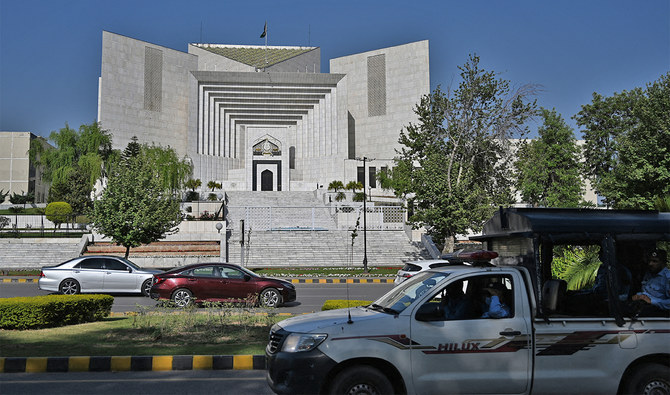
Rangers patrol along a street past Pakistan's Supreme Court in Islamabad, Pakistan, on April 5, 2022/ (AFP/File)
Short Url
Updated 25 July 2022
Follow

Pakistan top court rejects plea seeking full bench to hear Punjab CM’s election case

  • The ruling coalition requested for a full bench to hear all petitions regarding Punjab CM's election
  • Chief Justice Umar Ata Bandial says a full court bench is constituted in 'difficult and complex issues'

ISLAMABAD: The Supreme Court on Monday rejected the federal government's request to form a full court bench to hear all petitions regarding last week’s election of the Punjab chief minister, in which the deputy speaker had nullified 10 votes polled in favour of the opposition's candidate.  

The judgment came after hours-long hearing of the petition relating to the contentious re-election of Hamza Shehbaz on July 22, when Punjab Assembly Deputy Speaker Dost Muhammad Mazari invalidated 10 votes cast against him by the opposition Pakistan Muslim League-Quaid (PML-Q) members. 

Mazari based his ruling on a recent Supreme Court verdict that endorsed the idea of disqualifying legislators for voting against party lines. The deputy speaker quoted a letter written to him by PML-Q chief Chaudhry Shujaat Hussain, asking his party lawmakers to support Shehbaz instead of his rival and Hussain’s cousin, Chaudhry Pervaiz Elahi.   

The opposition candidate moved the court against the deputy speaker’s ruling on Friday night, claiming it was the prerogative of the parliamentary party head, not the party chief, to direct legislators ahead of voting in the provincial assembly. 

The federal government, comprising a number of coalition parties, demanded a full court bench of the Supreme Court decide on the validity of the CM election.   

During Monday's hearing, a three-member bench, led by Chief Justice Umar Ata Bandial, heard arguments of all sides, including the Punjab government.  

“This is not a complex matter. The full court is constituted in difficult and complex issues,” the chief justice remarked, while hearing the case.  

“There is only one question in the case whether a party chief can issue directions [to parliamentary party] or not.” 

In Friday’s election, the opposition alliance, comprising former Prime Minister Imran Khan’s Pakistan Tehreek-e-Insaf (PTI) and the PML-Q parties, bagged 186 votes and the Pakistan Muslim League-Nawaz-led ruling coalition secured 179 votes in the provincial house of 371.      

The election was held on the directions of the Supreme Court after 25 members of Khan's PTI party were disqualified for voting for the rival PML-N candidate, Shehbaz, in an April election for the same post.    

In a unanimous decision in May, the Election Commission of Pakistan (ECP) had said the PTI dissidents were being de-seated for defecting from the party under Article 63-A. The Supreme Court of Pakistan, in its interpretation of Article 63-A, has said votes cast against the party direction “cannot be counted and must be disregarded.”         

According to Article 63-A of the constitution, a parliamentarian can be disqualified on grounds of defection if he or she “votes or abstains from voting in the House contrary to any direction issued by the parliamentary party to which he belongs, in relation to election of the prime minister or chief minister; or a vote of confidence or a vote of no-confidence; or a money bill or a Constitution (amendment) bill.”   

During the hearing on Monday, the chief justice also noted that the candidate who bagged the majority of votes in the election was out and the one who got 179 votes was declared the chief minister of the province.  

“A solid foundation is required to retain Hamza Shehbaz as the chief minister,” Chief Justice Bandial said.  

The chief justice earlier said the constitution of a full bench was not possible before September as only two judges besides the three-member bench were available in Islamabad. “Should we stop all work till then,” he said. 

A detailed verdict on the formation of the full bench will be issued later, while the court will resume hearing arguments on the deputy speaker's ruling at 11:30am on Tuesday.


Pakistan condemns Sudan attack that killed Bangladeshi UN peacekeepers, calls it war crime

Updated 16 sec ago
Follow

Pakistan condemns Sudan attack that killed Bangladeshi UN peacekeepers, calls it war crime

  • Six peacekeepers were killed in a drone strike in Kadugli as fighting between Sudan’s army and the RSF grinds on
  • Pakistan, a major troop contributor to the UN, says perpetrators of the attack must be identified, brought to justice

ISLAMABAD: Pakistan on Sunday extended condolences to the government and people of Bangladesh after six United Nations peacekeepers from the country were killed in a drone strike in southern Sudan, condemning the attack and describing it as a war crime.

The attack took place amid a full-scale internal conflict that erupted in April 2023 between the Sudanese Armed Forces (SAF) and the Rapid Support Forces (RSF), a powerful paramilitary group, following a power struggle after the collapse of Sudan’s post-Bashir political transition.

Omar Al-Bashir, who ruled Sudan for nearly three decades, was ousted by the military in 2019 after months of mass protests, but efforts to transition to civilian rule later faltered, plunging the country back into violence that has since spread nationwide.

The drone strike hit a logistics base of the United Nations Interim Security Force for Abyei (UNISFA) in Kadugli, the capital of South Kordofan state, on Saturday, killing the Bangladeshi peacekeepers. Sudan’s army blamed the RSF for the attack, though there was no immediate public claim of responsibility.

“Pakistan strongly condemns the attack on @UNISFA in Kadugli, resulting in the tragic loss of 6 Bangladeshi peacekeepers & injuries to several others,” the country’s permanent mission to the UN said in a social media message. “We honor their supreme sacrifice in the service of peace, and express our deepest condolences to the government and people of #Bangladesh.”

“Such heinous attacks on UN peacekeepers amount to war crimes,” it added. “Perpetrators of this horrific attack must be identified and brought to justice. As a major troop-contributing country, we stand in complete solidarity with all Blue Helmets serving the cause of peace in the perilous conditions worldwide.”

According to Pakistan’s UN mission in July, the country has deployed more than 235,000 peacekeepers to 48 UN missions across four continents over the past eight decades.

Pakistan also hosts one of the UN’s oldest peacekeeping operations, the United Nations Military Observer Group in India and Pakistan (UNMOGIP), and is a founding member of the UN Peacebuilding Commission.

More than 180 Pakistani peacekeepers have lost their lives while serving under the UN flag.

Pakistan and Bangladesh have also been working in recent months to ease decades of strained ties rooted in the events of 1971, when Bangladesh — formerly part of Pakistan — became independent following a bloody war.

Relations have begun to shift following the ouster of former Bangladeshi prime minister Sheikh Hasina last year amid mass protests.

Hasina later fled to India, Pakistan’s neighbor and arch-rival, creating space for Islamabad and Dhaka to rebuild their relationship.