UN health agency declares monkeypox a global emergency

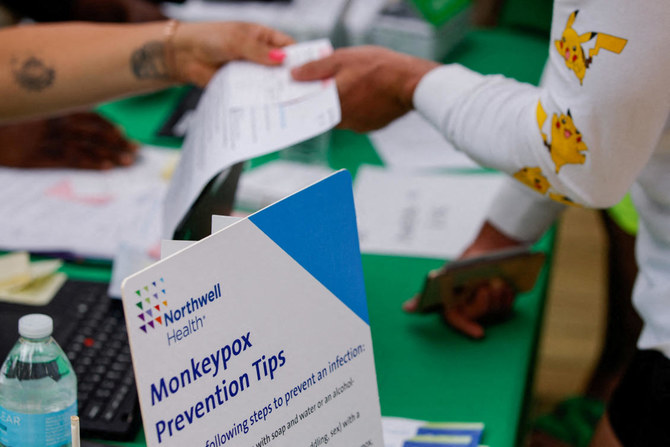
A person arrives to receive a monkeypox vaccination at the Northwell Health Immediate Care Center at Fire Island-Cherry Grove, in New York, on July 15, 2022. (Reuters)
Short Url
Updated 23 July 2022
Follow

UN health agency declares monkeypox a global emergency

  • Declaring a global emergency means the monkeypox outbreak is an “extraordinary event”
  • The emergency declaration mostly serves as a plea to draw more global resources and attention to an outbreak

LONDON: The World Health Organization (WHO) said the expanding monkeypox outbreak in more than 70 countries is an “extraordinary” situation that now qualifies as a global emergency.
Saturday’s declaration could spur further investment in treating the once-rare disease and worsen the scramble for scarce vaccines.
Although monkeypox has been established in parts of central and West Africa for decades, it was not known to spark large outbreaks beyond the continent or to spread widely among people until May, when authorities detected dozens of epidemics in Europe, North America and elsewhere.
Declaring a global emergency means the monkeypox outbreak is an “extraordinary event” that could spill over into more countries and requires a coordinated global response. WHO previously declared emergencies for public health crises such as the COVID-19 pandemic, the 2014 West African Ebola outbreak, the Zika virus in Latin America in 2016 and the ongoing effort to eradicate polio.
The emergency declaration mostly serves as a plea to draw more global resources and attention to an outbreak. Past announcements had mixed impact, given that the UN health agency is largely powerless in getting countries to act.
Last month, WHO’s expert committee said the worldwide monkeypox outbreak did not yet amount to an international emergency, but the panel convened this week to reevaluate the situation.
According to the US Centers for Disease Control and Prevention, more than 16,000 cases of monkeypox have been reported in 74 countries since about May. To date, monkeypox deaths have only been reported in Africa, where a more dangerous version of the virus is spreading, mainly in Nigeria and Congo.
In Africa, monkeypox mainly spreads to people from infected wild animals like rodents, in limited outbreaks that typically have not crossed borders. In Europe, North America and elsewhere, however, monkeypox is spreading among people with no links to animals or recent travel to Africa.
WHO’s top monkeypox expert, Dr. Rosamund Lewis, said this week that 99 percent of all the monkeypox cases beyond Africa were in men and that of those, 98 percent involved men who have sex with men. Experts suspect the monkeypox outbreaks in Europe and North America were spread via sex at two raves in Belgium and Spain.
Michael Head, a senior research fellow in global health at Southampton University, said it was surprising WHO hadn’t already declared monkeypox a global emergency, explaining that the conditions were arguably met weeks ago.
Some experts have questioned whether such a declaration would help, arguing the disease isn’t severe enough to warrant the attention and that rich countries battling monkeypox already have the funds to do so; most people recover without needing medical attention, although the lesions may be painful.
“I think it would be better to be proactive and overreact to the problem instead of waiting to react when it’s too late,” Head said. He added that WHO’s emergency declaration could help donors like the World Bank make funds available to stop the outbreaks both in the West and in Africa, where animals are the likely natural reservoir of monkeypox.
In the US, some experts have speculated whether monkeypox might be on the verge of becoming an entrenched sexually transmitted disease in the country, like gonorrhea, herpes and HIV.
“The bottom line is we’ve seen a shift in the epidemiology of monkeypox where there’s now widespread, unexpected transmission,” said Dr. Albert Ko, a professor of public health and epidemiology at Yale University. “There are some genetic mutations in the virus that suggest why that may be happening, but we do need a globally-coordinated response to get it under control,” he said.
Ko called for testing to be immediately scaled up rapidly, saying that similar to the early days of COVID-19, that there were significant gaps in surveillance.
“The cases we are seeing are just the tip of the iceberg,” he said. “The window has probably closed for us to quickly stop the outbreaks in Europe and the US, but it’s not too late to stop monkeypox from causing huge damage to poorer countries without the resources to handle it.”
In the US, some experts have speculated that monkeypox might become entrenched there as the newest sexually transmitted disease, with officials estimating that 1.5 million men are at high risk of being infected.
Dr. Placide Mbala, a virologist who directs the global health department at Congo’s Institute of National Biomedical Research, said he hoped any global efforts to stop monkeypox would be equitable. Although countries including Britain, Canada, Germany and the US have ordered millions of vaccine doses, none have gone to Africa.
“The solution needs to be global,” Mbala said, adding that any vaccines sent to Africa would be used to target those at highest risk, like hunters in rural areas.
“Vaccination in the West might help stop the outbreak there, but there will still be cases in Africa,” he said. “Unless the problem is solved here, the risk to the rest of the world will remain.”


Autopsy finds Cuban immigrant in ICE custody died of homicide due to asphyxia

Updated 2 sec ago
Follow

Autopsy finds Cuban immigrant in ICE custody died of homicide due to asphyxia

  • Witness: Lunas Campos was handcuffed as at least five guards held him down and one put an arm around his neck and squeezed until he was unconscious
  • The US Immigration and Customs Enforcement said Diaz was detained by ICE earlier this month during the immigration crackdown in Minneapolis
WASHINGTON: A Cuban migrant held in solitary confinement at an immigration detention facility in Texas died after guards held him down and he stopped breathing, according to an autopsy report released Wednesday that ruled the death a homicide.
Geraldo Lunas Campos died Jan. 3 following an altercation with guards. US Immigration and Customs Enforcement said the 55-year-old father of four was attempting suicide and the staff tried to save him.
But a witness said last week that Lunas Campos was handcuffed as at least five guards held him down and one put an arm around his neck and squeezed until he was unconscious.
His death was one of at least three reported in little more than a month at Camp East Montana, a sprawling tent facility in the desert on the grounds of Fort Bliss, an Army base.
The autopsy report by the El Paso County Medical Examiner’s Office found Lunas Campos’ body showed signs of a struggle, including abrasions on his chest and knees. He also had hemorrhages on his neck. The deputy medical examiner, Dr. Adam Gonzalez. determined the cause of death was asphyxia due to neck and torso compression.
The report said witnesses saw Lunas Campos “become unresponsive while being physically restrained by law enforcement.” It did not elaborate on what happened during the struggle but cited evidence of injuries to his neck, head and torso associated with physical restraint. The report also noted the presence of petechial hemorrhages — tiny blood spots from burst capillaries that can be associated with intense strain or injury — in the eyelids and skin of the neck.
Dr. Victor Weedn, a forensic pathologist who reviewed the autopsy report for AP, said the presence of petechiae in the eyes support the conclusion that asphyxia caused the death. Those injuries suggest pressure on the body and are often associated with such deaths, he said.
He said the contusions on Lunas Campos’ body may reflect physical restraint and the neck injuries were consistent with a hand or knee on the neck.
The autopsy also found the presence of prescription antidepressant and antihistamine medications, adding that Lunas Campos had a history of bipolar disorder and anxiety. It made no mention of him attempting suicide.
Government provided changing accounts of what happened
ICE’s initial account of the death, which included no mention of an altercation with guards, said Lunas Campos had become disruptive and staff moved him into a cellblock where detainees are held away from others.
“While in segregation, staff observed him in distress and contacted on-site medical personnel for assistance,” the agency said in its Jan. 9 statement. “Medical staff responded, initiated lifesaving measures, and requested emergency medical services.”
Lunas Campos was pronounced dead after paramedics arrived.
Last Thursday, after Lunas Campos’ family was first informed the death was likely to be ruled a homicide, Department of Homeland Security spokesperson Tricia McLaughlin amended the government’s account, saying he had attempted suicide and guards tried to help him.
“Campos violently resisted the security staff and continued to attempt to take his life,” she said. “During the ensuing struggle, Campos stopped breathing and lost consciousness.”
After the final autopsy report was released Wednesday, McLaughlin issued a statement emphasizing that Lunas Campos was “a criminal illegal alien and convicted child sex predator.”
New York court records show Lunas Campos was convicted in 2003 of sexual contact with a person under 11, a felony for which he was sentenced to one year in jail and placed on the state’s sex offender registry. Lunas Campos was also sentenced to five years in prison and three years of supervision in 2009 after being convicted of attempting to sell a controlled substance, according to the New York corrections records. He completed the sentence in January 2017.
“ICE takes seriously the health and safety of all those detained in our custody,” McLaughlin said Wednesday, adding that the agency was investigating the death. DHS has not responded to questions about whether any outside law enforcement agency was also investigating.
Deaths put a spotlight on Camp East Montana
The AP reported in August that the $1.2 billion contract to build and operate Camp East Montana, expected to become the largest detention facility in the US, was awarded to a private contractor headquartered in a single-family home in Richmond, Virginia. The company, Acquisition Logistics LLC, had no prior experience running a corrections facility and has subcontracted with other companies to help operate the camp.
It was not immediately clear whether the guards present when Lunas Campos died were government employees or those of a private contractor.
A final determination of homicide by the medical examiner would typically be critical in determining whether any guards are held criminally or civilly liable. The fact that Lunas Campos died on an Army base could limit state and local officials’ legal jurisdiction to investigate.
Lunas Campos was among the first detainees sent to Camp Montana East, arriving in September after ICE arrested him in Rochester, New York, where he lived for more than two decades. He was legally admitted to the US in 1996, part of a wave of Cuban immigrants seeking to reach Florida by boat.
ICE said he was picked up in July as part of a planned immigration enforcement operation due to criminal convictions that made him eligible for removal.
In addition to Lunas Campos, ICE announced that on Dec. 3 an immigrant from Guatemala held in Camp East Montana died after being transferred to a El Paso hospital for care. While the cause of death was still pending, the agency said Francisco Gaspar-Andres, 48, was suspected to have died of liver and kidney failure.
On Sunday, ICE announced that Victor Manuel Diaz, a 36-year-old immigrant from Nicaragua, died at Camp East Montana on Jan. 14 of a “presumed suicide.” The agency said Diaz was detained by ICE earlier this month during the immigration crackdown in Minneapolis.
Unlike with the two prior deaths, Diaz’s body wasn’t sent to the county medical examiner in El Paso. McLaughlin said Wednesday that the autopsy for Diaz is being performed at the Army medical center at Fort Bliss. DHS again did not respond to questions about whether any agency other than ICE will investigate the death.
Rep. Veronica Escobar, a Democrat whose district includes El Paso, called on DHS Secretary Kristi Noem and acting ICE Director Todd M. Lyons to brief Congress about the recent deaths.
“DHS must preserve all evidence — including halting their effort to deport the witnesses,” Escobar said Wednesday. “I reiterate my call for Camp East Montana to be shut down and for the contract with the corporation running it to be terminated.”