

Smoldering Beirut port silo at risk of collapse as grain ignites

1 / 4
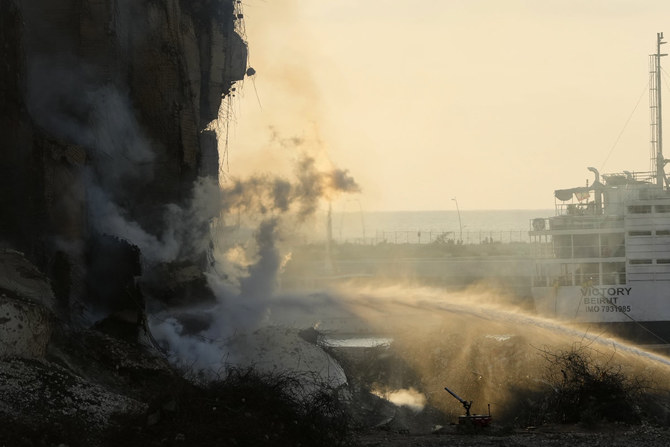
Firefighters extinguish a fire at the silos in the north block of the Beirut Port in Beirut on July 21, 2022. (AP)
2 / 4
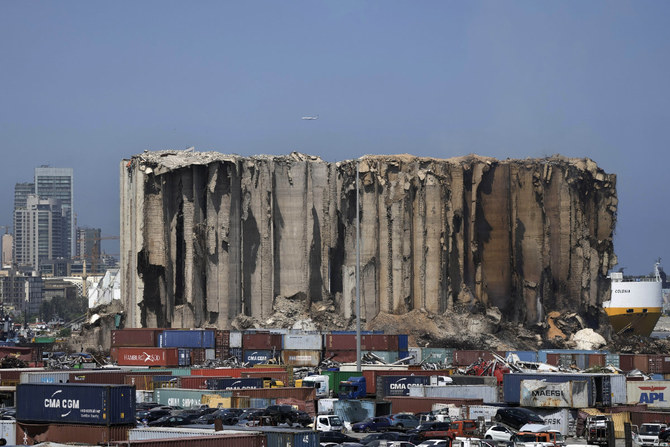
General view of fire-hit grain silos at Beirut port, Lebanon, on July 22, 2022. (AP Photo/Hassan Ammar)
3 / 4
General view of fire-hit grain silos at Beirut port, Lebanon, on July 22, 2022. (AP Photo/Hassan Ammar)
4 / 4
A view of the silos in the north block of the Beirut Port blackened by a dayslong fire on July 22, 2022. (AP)
Short Url
Updated 22 July 2022
Follow

Smoldering Beirut port silo at risk of collapse as grain ignites

  • Fire rages as Lebanon suffers from worsening wheat and bread shortages
  • Silos survived deadly port blast and ‘stand as a witness to a crime that affected everyone’

BEIRUT: A massive silo holding thousands of tons of grain at Beirut port is at risk of collapse because of a fire that has been smoldering for weeks amid Lebanon’s summer heat.

Flames and thick black smoke could be seen rising from the silo after the blaze flared up on Friday.

The fire prompted a warning by Lebanon’s Prime Minister Najib Mikati to “workers and members of the civil defense and the fire brigade not to approach the location for their safety and to avoid endangering their lives.”

Recent high temperatures are believed to have caused wheat in the silo — one of two massive structures that withstood the deadly blast at Beirut’s port two years ago — to ferment, igniting thousands of tons of grain.

Reports by the ministries of interior, economy, public works and environment have warned that “parts of the left side of the silo might be at risk of collapse.”

The threat to the silo is causing growing alarm among port workers and management of the facility.

Smoke and flames at the site also revive the painful memory of the deadly explosion that shook the port on Aug. 4, 2020.

Caretaker Interior Minister Bassam Mawlawi has asked the fire brigade and civil defense to immediately start “cooling down” the wheat silos.

While the Lebanese look on helplessly as the last of the wheat stored in the silo burns, mills and bakeries around the country are struggling with an acute shortage of subsidized flour used to make Lebanese pita bread.

Caretaker Economy Minister Amin Salam said that 50,000 tons of wheat will arrive in Lebanon in the coming 10 days, ensuring a six-week supply.

Seven mills out of 11 have closed because they ran out of subsidized wheat, according to a bakery owners’ syndicate.

The presence of more than 500,000 tourists in Lebanon is adding to the strain on bread supplies, it added.

Meanwhile, the silo fire has revived simmering tensions between families of the port blast victims and government bodies.

Last April, government agencies recommended the silos be demolished due to the risks the structures pose to the surrounding area.

However, families and activists reject the demolition, saying that it will destroy “one of the main landmarks of the biggest explosion witnessed by Lebanon,” according to the Order of Engineers.

The silos “stand as a witness to a crime that affected everyone,” it said.

The Order of Engineers has called for work to “consolidate the affected silos.”

Experts say that the fire will die down eventually, but have warned against using water to fight the blaze, saying this might accelerate the fermentation process.

Political, security, judicial and military officials continue to blame each other for the port explosion.

Judicial investigations into the crime were suspended last November, due to political interventions and lawsuits filed against judge Tarek Bitar, who is heading the inquiry.

Defendants, including former MPs and ministers, are calling for Bitar to be removed from the case.

In a briefing submitted to the Security Council on Thursday, the UN special coordinator for Lebanon, Joanna Wronecka, highlighted “the absence of progress in the judicial measures related to the Beirut port explosion case, which further saddens the families of the dead and wounded.”

Wronecka demanded that “hindrances obstructing the judicial course be removed, and a comprehensive and transparent investigation into the case be carried out.”


Tunisia’s famed blue-and-white village threatened after record rains

Updated 31 January 2026
Follow

Tunisia’s famed blue-and-white village threatened after record rains

  • The one-time home of French philosopher Michel Foucault and writer Andre Gide, the village is protected under Tunisian preservation law, pending a UNESCO decision on its bid for World Heritage status

SIDI BOU SAID, Tunisia: Perched on a hill overlooking Carthage, Tunisia’s famed blue-and-white village of Sidi Bou Said now faces the threat of landslides, after record rainfall tore through parts of its slopes.
Last week, Tunisia saw its heaviest downpour in more than 70 years. The storm killed at least five people, with others still missing.
Narrow streets of this village north of Tunis — famed for its pink bougainvillea and studded wooden doors — were cut off by fallen trees, rocks and thick clay. Even more worryingly for residents, parts of the hillside have broken loose.
“The situation is delicate” and “requires urgent intervention,” Mounir Riabi, the regional director of civil defense in Tunis, recently told AFP.
“Some homes are threatened by imminent danger,” he said.
Authorities have banned heavy vehicles from driving into the village and ordered some businesses and institutions to close, such as the Ennejma Ezzahra museum.

- Scared -

Fifty-year-old Maya, who did not give her full name, said she was forced to leave her century-old family villa after the storm.
“Everything happened very fast,” she recalled. “I was with my mother and, suddenly, extremely violent torrents poured down.”
“I saw a mass of mud rushing toward the house, then the electricity cut off. I was really scared.”
Her Moorish-style villa sustained significant damage.
One worker on site, Said Ben Farhat, said waterlogged earth sliding from the hillside destroyed part of a kitchen wall.
“Another rainstorm and it will be a catastrophe,” he said.
Shop owners said the ban on heavy vehicles was another blow to their businesses, as they usually rely on tourist buses to bring in traffic.
When President Kais Saied visited the village on Wednesday, vendors were heard shouting: “We want to work.”
One trader, Mohamed Fedi, told AFP afterwards there were “no more customers.”
“We have closed shop,” he said, adding that the shops provide a livelihood to some 200 families.

- Highly unstable -

Beyond its famous architecture, the village also bears historical and spiritual significance.
The village was named after a 12th-century Sufi saint, Abu Said Al-Baji, who had established a religious center there. His shrine still sits atop the hill.
The one-time home of French philosopher Michel Foucault and writer Andre Gide, the village is protected under Tunisian preservation law, pending a UNESCO decision on its bid for World Heritage status.
Experts say solutions to help preserve Sidi Bou Said could include restricting new development, building more retaining walls and improving drainage to prevent runoff from accumulating.
Chokri Yaich, a geologist speaking to Tunisian radio Mosaique FM, said climate change has made protecting the hill increasingly urgent, warning of more storms like last week’s.
The hill’s clay-rich soil loses up to two thirds of its cohesion when saturated with water, making it highly unstable, Yaich explained.
He also pointed to marine erosion and the growing weight of urbanization, saying that construction had increased by about 40 percent over the past three decades.
For now, authorities have yet to announce a protection plan, leaving home and shop owners anxious, as the weather remains unpredictable.