

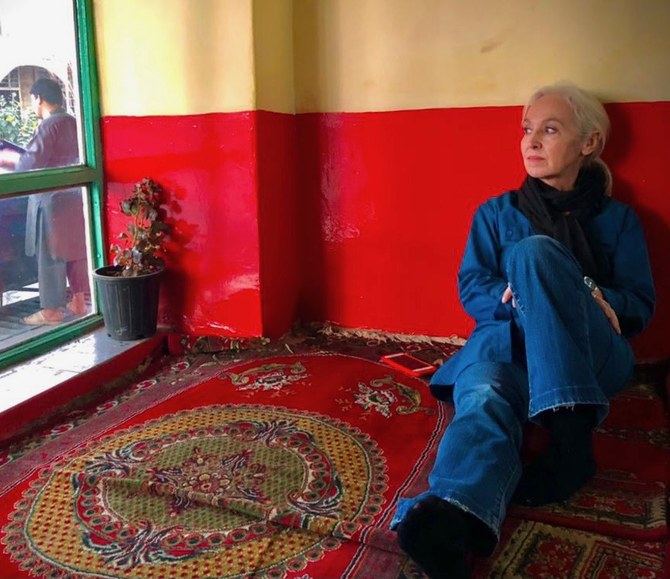

LONDON: An Australian journalist has claimed that the Taliban threatened to imprison her if she refused to tweet apologies for her previous reporting about the Afghan regime.
Lynne O’Donnell, a writer for Foreign Policy magazine who has covered the region extensively, traveled to Afghanistan on July 16 to report on how the country had changed since the Taliban retook control in August last year, following the collapse of the Western-backed government.
She told the BBC she was “detained, abused and threatened” after going to the Ministry of Foreign Affairs “in good faith” to register as a foreign correspondent in the country, adding that she was accused of “breaking their laws” and “offending Afghan culture.”
O’Donnell told the Committee to Protect Journalists that ministry spokesperson Abdul Qahar Balkhi had refused to grant her registration, citing “inaccurate” reporting she had done in 2021 over the plight of women and girls under the Taliban.
She added that, during the meeting, he had boasted of pride at the Taliban’s 2016 attacks on journalists working for the Afghan broadcaster TOLONews in retaliation for similar coverage it published of alleged sexual assaults by Taliban members. O’Donnell told the CPJ she interpreted this pointed reference as a threat.
The next day, she was contacted by a Taliban intelligence official called Ahmad Zahir, who asked her to visit the General Directorate of Intelligence for questioning. After she refused, Zahir called her again two days later to inform her she would be barred from leaving the country if she failed to comply.
She alleges that on July 19 Zahir and three other officers met her and accompanied her to a GDI branch, where she was interrogated for four hours, and told to use her Twitter account to publish apologies for articles she had written about the Taliban.
O’Donnell also claims that she was told to reveal her sources in Afghanistan, which she refused to do. “Throughout,” she wrote of the interrogation in an article for Foreign Policy, “a man with a gun was never far away.”
She was released after tweeting the apologies, which said her reporting was a “premeditated attempt at character assassination and an affront to Afghan culture,” and that her articles were “written without any solid proof or basis.” She also filmed a video stating that she had not been coerced into the statements, and was allowed to fly to neighboring Pakistan on July 20.
“They were bullies. I’d be lying if I said that I wasn’t afraid to some extent. But I wasn’t terrified,” O’Donnell told the BBC.
“I knew that I was taking a risk in going there: They lock up, they abuse, they beat, they kill journalists who are Afghans. They have a history of taking foreigners hostage to use as leverage. I didn’t know that that wouldn’t happen to me,” she added.
The Afghan Ministry of Foreign Affairs denied that O’Donnell had been asked to reveal her sources, but added that it believed her articles were “lies,” and that she had failed to produce any evidence for many of the claims made in them.
Balkhi tweeted that O’Donnell had “offered to rectify the situation by tweeting an apology,” adding that the Taliban “remains committed to the principles of Freedom of Press.”
The group Human Rights Watch says Afghanistan has become an increasingly dangerous place since the Taliban returned to power, including for women and girls, journalists, and minorities.
Carlos Martinez de la Serna, CPJ’s program director in Madrid, said in a statement: “The Taliban must stop their campaign of intimidation and abuse targeting Afghan and international journalists, and the GDI intelligence agency should be held accountable for (its) agents’ harassment and detentions of members of the press.
“The Taliban should apologize to Lynne O’Donnell for her treatment in the country, and allow all journalists (to) work free from fear.”
O’Donnell, meanwhile, wrote in Foreign Policy this week about the experience, adding that she will not be returning to Afghanistan for her own safety and the safety of her sources, saying that to do so would be “reckless.”


