

IAEA chief: Iran’s nuclear program is ‘galloping ahead’

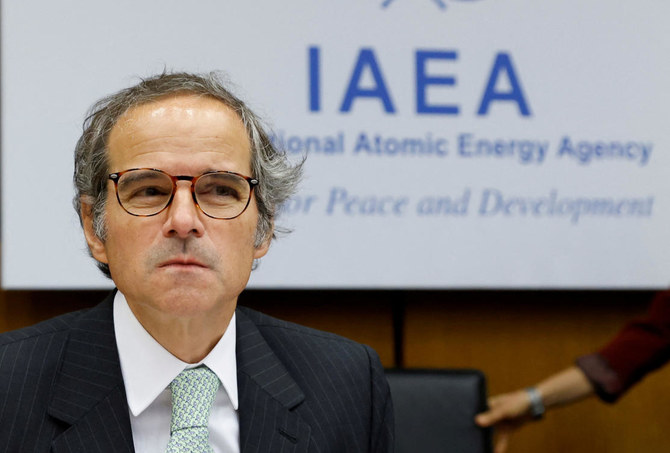
International Atomic Energy Agency chief Rafael Grossi said in June there was a window of just three to four weeks to restore at least some of the monitoring that was being scrapped before. (Reuters)
Short Url
Updated 23 July 2022
Follow

IAEA chief: Iran’s nuclear program is ‘galloping ahead’

  • In June, Iran began removing essentially all the agency’s monitoring equipment, installed under its 2015 nuclear deal with world powers
  • Indirect talks between Iran and the United States on reviving the 2015 deal have been stalled since March

JEDDAH: Iran’s nuclear program is “galloping ahead” and the UN atomic watchdog has no clear view of what Tehran is doing, the agency’s chief said on Friday.

In June, Iran began removing monitoring equipment installed by the International Atomic Energy Agency under the 2015 nuclear deal, the Joint Comprehensive Plan of Action. IAEA head Rafael Grossi said at the time this could deal a “fatal blow” to chances of reviving the agreement.

“The bottom line is that for almost five weeks I have had very limited visibility, with a nuclear program that is galloping ahead and, therefore, if there is an agreement, it is going to be very difficult for me to reconstruct the puzzle of this whole period of forced blindness,” Grossi told Spain’s El Pais newspaper in an interview published on Friday.

“It is not impossible, but it is going to require a very complex task and perhaps some specific agreements.”

Grossi said in June there was a window of just three to four weeks to restore at least some of the monitoring that was being scrapped before the IAEA lost the ability to piece together Iran’s most important nuclear activities.

Tehran has breached many of the deal’s limits on its nuclear activities since former US President Donald Trump pulled Washington out of the agreement in 2018 and re-imposed sanctions.

Iran is now enriching uranium to close to weapons grade, and analysts warn that Iran is close to being able to sprint toward making a nuclear bomb. Grossi said he was concerned and worried about the weeks with no visibility.

He said: “The agency needs to reconstruct a database, without which any agreement will rest on a very fragile basis, because if we don’t know what’s there, how can we determine how much material to export, how many centrifuges to leave unused?”

Talks to restore the deal have stalled since March amid differences between Tehran and Washington. The two sides negotiated indirectly through the EU coordinator.

Iran’s Foreign Minister Hossein Amirabdollahian said on Friday that negotiators were close to a new agreement, but Tehran was still seeking economic guarantees from the US.

“We have a ready text in front of us and we agree on more than 95 percent of its content, but there’s still an important flaw in this text — we need to get the full economic benefits of the agreement. We don’t want to be stung twice in the same spot,” he said.

“We are serious about reaching a good, strong and lasting agreement but we do not want an agreement at any price.” 

(With Reuters)


White House names some leaders with roles in next steps in Gaza, while Palestinian committee meets

Updated 14 sec ago
Follow

White House names some leaders with roles in next steps in Gaza, while Palestinian committee meets

  • Blair is a controversial choice in the Middle East because of his role in the 2003 invasion of Iraq, and Trump himself said last year that he wanted to make sure he was an “acceptable choice to everybody”
  • The plan’s second phase is now underway, though clouded by allegations of aid shortages and violence

CAIRO: The White House released the names of some of the leaders who will play a role in overseeing next steps in Gaza after the Palestinian committee set to govern the territory under US supervision met for the first time Friday in Cairo.
The committee’s leader, Ali Shaath, an engineer and former Palestinian Authority official from Gaza, pledged to get to work quickly to improve conditions. He expects reconstruction and recovery to take about three years and plans to focus first on immediate needs, including shelter.
“The Palestinian people were looking forward to this committee, its establishment and its work to rescue them,” Shaath said after the meeting, in a television interview with Egypt’s state-owned Al-Qahera News.
US President Donald Trump supports the group’s efforts to govern Gaza after the two-year war between Israel and Hamas. Israeli troops withdrew from parts of Gaza after the ceasefire took effect on Oct. 10, while thousands of displaced Palestinians have returned to what is left of their homes.
Now, there will be a number of huge challenges going forward, including the deployment of an international security force to supervise the ceasefire deal and the difficult process of disarming Hamas.
Under Trump’s plan, Shaath’s technocratic committee will run day-to-day affairs in Gaza under the oversight of a Trump-led “Board of Peace,” whose members have not yet been named.
White House names some officials to oversight boards
The White House said an executive board will work to carry out the vision of the Board of Peace.
The executive board’s members include US Secretary of State Marco Rubio, Trump envoy Steve Witkoff, Trump’s son-in-law Jared Kushner, former British Prime Minister Tony Blair, Apollo Global Management CEO Marc Rowan, World Bank President Ajay Banga, and Trump’s deputy national security adviser Robert Gabriel.
Nickolay Mladenov, a former Bulgarian politician and UN Mideast envoy, is to serve as the executive board’s representative overseeing day-to-day matters.
The White House also announced the members of another board, the “Gaza Executive Board,” which will work with Mladenov, the technocratic committee and the international stabilization force.
Witkoff, Kushner, Blair, Rowan and Mladenov will also sit on that board. Additional members include: Turkish Foreign Minister Hakan Fidan; Qatari diplomat Ali Al-Thawadi; Hassan Rashad, director of Egypt’s General Intelligence Agency; Emirati minister Reem Al-Hashimy; Israeli businessman Yakir Gabay; and Sigrid Kaag, the Netherlands’ former deputy prime minister and a Mideast expert.
Death of boy mourned in the West Bank
In the West Bank, friends and relatives gathered Friday to mourn the death of a 14-year-old Palestinian boy killed by Israeli forces.
The Palestinian Health Ministry, which confirmed his death, said Mohammad Na’san was the first child killed by the army in the occupied West Bank in 2026.
Residents said Israeli forces fired stun grenades and tear gas in an unprovoked attack. Israel’s military said in a statement that the incursion came after Palestinians had hurled rocks at Israelis and set tires aflame.
“There was gunfire directed at citizens and farmers, the most dangerous of which occurred during the storming of the village as people were leaving the mosques. The streets were crowded with the elderly, children, women, and elders, and they began firing relentlessly,” said Ameen Abu Aliya, head of the Al-Mughayyir village council.
The death was the latest episode of violence to hit Al-Mughayyir, a village east of Ramallah that has become a flashpoint in the West Bank. Much of the community’s agricultural land falls under Israeli military control.
Early this year, settlers and Israeli military bulldozers destroyed olive groves in the area, saying they were searching for Palestinian gunmen. A children’s park in Al-Mughayyir was also demolished.
In 2025, 240 Palestinians — including 55 children — were killed by Israeli forces or settlers in the West Bank, while Palestinians killed 17 Israelis — including one child — in the region, according to the United Nations.
Meanwhile, two children were killed Friday in Gaza, a 7-year-old girl and a 16-year-old boy. They were killed in Beith Lahiya, near the Yellow Line, and their bodies taken to Al-Shifa Hospital, the hospital said. No further details were immediately available.