

IAEA chief: Iran’s nuclear program is ‘galloping ahead’

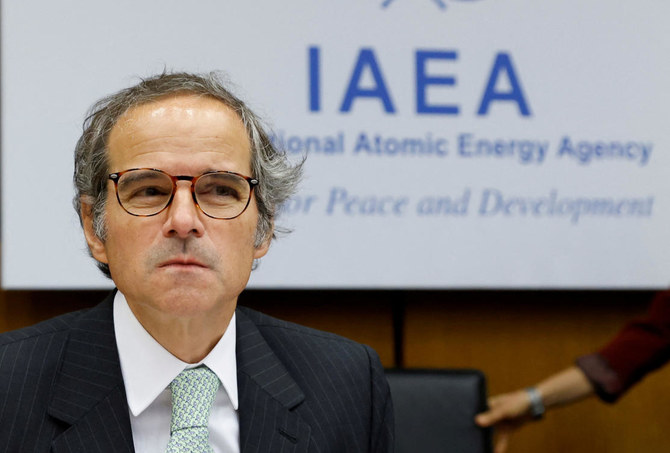
International Atomic Energy Agency chief Rafael Grossi said in June there was a window of just three to four weeks to restore at least some of the monitoring that was being scrapped before. (Reuters)
Short Url
Updated 23 July 2022
Follow

IAEA chief: Iran’s nuclear program is ‘galloping ahead’

  • In June, Iran began removing essentially all the agency’s monitoring equipment, installed under its 2015 nuclear deal with world powers
  • Indirect talks between Iran and the United States on reviving the 2015 deal have been stalled since March

JEDDAH: Iran’s nuclear program is “galloping ahead” and the UN atomic watchdog has no clear view of what Tehran is doing, the agency’s chief said on Friday.

In June, Iran began removing monitoring equipment installed by the International Atomic Energy Agency under the 2015 nuclear deal, the Joint Comprehensive Plan of Action. IAEA head Rafael Grossi said at the time this could deal a “fatal blow” to chances of reviving the agreement.

“The bottom line is that for almost five weeks I have had very limited visibility, with a nuclear program that is galloping ahead and, therefore, if there is an agreement, it is going to be very difficult for me to reconstruct the puzzle of this whole period of forced blindness,” Grossi told Spain’s El Pais newspaper in an interview published on Friday.

“It is not impossible, but it is going to require a very complex task and perhaps some specific agreements.”

Grossi said in June there was a window of just three to four weeks to restore at least some of the monitoring that was being scrapped before the IAEA lost the ability to piece together Iran’s most important nuclear activities.

Tehran has breached many of the deal’s limits on its nuclear activities since former US President Donald Trump pulled Washington out of the agreement in 2018 and re-imposed sanctions.

Iran is now enriching uranium to close to weapons grade, and analysts warn that Iran is close to being able to sprint toward making a nuclear bomb. Grossi said he was concerned and worried about the weeks with no visibility.

He said: “The agency needs to reconstruct a database, without which any agreement will rest on a very fragile basis, because if we don’t know what’s there, how can we determine how much material to export, how many centrifuges to leave unused?”

Talks to restore the deal have stalled since March amid differences between Tehran and Washington. The two sides negotiated indirectly through the EU coordinator.

Iran’s Foreign Minister Hossein Amirabdollahian said on Friday that negotiators were close to a new agreement, but Tehran was still seeking economic guarantees from the US.

“We have a ready text in front of us and we agree on more than 95 percent of its content, but there’s still an important flaw in this text — we need to get the full economic benefits of the agreement. We don’t want to be stung twice in the same spot,” he said.

“We are serious about reaching a good, strong and lasting agreement but we do not want an agreement at any price.” 

(With Reuters)


Israel bars some aid workers from Gaza as groups face suspension

Updated 4 sec ago
Follow

Israel bars some aid workers from Gaza as groups face suspension

  • NGOs ordered to cease operations unless they give employee details to Israel
  • MSF and others denied entry, impacting key medical services in Gaza
GENEVA/CAIRO/JERUSALEM: Israel said on Thursday it had barred entry to Gaza of foreign medical and humanitarian staff whose organizations ​were ordered to cease operations unless they register employee details with Israeli authorities and meet other new rules.
Fearing a renewed humanitarian crisis if medical and aid services can suddenly no longer access war-shattered Gaza, some of the 37 international nongovernmental organizations that were ordered to halt work are weighing whether to submit staff names to Israeli authorities, two aid sources told Reuters.
Three of the aid groups said their foreign staff were told by Israeli authorities this week they could not enter Gaza.
Israel’s diaspora ministry, which manages the registration process, says the measures are meant to prevent diversions of aid by Palestinian armed groups. NGOs say sharing staff details poses too much of a risk, pointing to the hundreds of aid workers who were killed or injured ‌during the two-year ‌Gaza war.
Israel has shared little evidence of aid being diverted in the Palestinian enclave, ‌an ⁠allegation ​that was ‌disputed in a US government analysis.
The diaspora ministry said that while the NGOs had been granted 60 days to conclude operations, “the entry of foreign personnel into Gaza is not approved.” It said international staff with “approved organizations” including the United Nations could continue work as usual.
Three prominent global NGOs — Medecins Sans Frontieres (MSF), Medecins du Monde Suisse and the Danish Refugee Council — said their international staff were refused entry to Gaza this week. Foreign aid staff had generally been permitted to rotate in and out of Gaza since the start of the war.
“If we don’t have somebody in a key position, such as the emergency coordinator in charge of operations, then we either have to ⁠compensate, or we have a gap” in aid service, said Anna Halford, Gaza emergency coordinator at MSF.

'System breaks down'

Israel’s government said some 23 aid groups ‌had agreed to the new registration rules, meaning humanitarian goods will continue to get ‍into Gaza.
But a UN-led coordination body has said the ‍international groups that have registered could meet only a fraction of the required humanitarian response in the devastated Gaza Strip, where ‍homelessness and hunger remain rife.
Some of the 37 banned groups operate specialized services like field hospitals, aid officials say. MSF bolsters six Gaza health ministry hospitals and runs two field hospitals. The Medicos del Mundo NGO screens Gaza residents for malnutrition and provides mental health services.
“Without nutritional staff doing the screening and primary health care centers doing the therapeutic feeding and referral of patients with severe malnutrition to in-patient care — the whole system ​breaks down,” an aid source told Reuters.
Fearing the loss of those essential services for Gaza’s two million residents, some aid groups are considering reversing course and agreeing to the new registration rules.
“The essence of ⁠the debate (for aid groups) is how to safeguard their principles, humanitarian standards, and the safety of the local staff while being able to continue the services,” a senior aid source said.
COGAT, the Israeli defense ministry unit that controls access to Gaza, said the NGOs’ conduct “raises suspicion regarding the parties with whom they operate” in Gaza, but they remained free to register with the diaspora ministry.

'Everything is missing'

Samira Al-Ashqar, 40, who fled her Beit Lahia home to Al-Ansar camp in north Gaza with her disabled husband and nine others during the war, depends on Oxfam — one of the aid groups facing an Israeli ban — for food and financial support.
“Now, after the war, everything is missing, and things have become dire ... If these institutions were to stop, the people of Gaza would face complete devastation,” Al-Ashqar said.
Mohamed Abu Selmia, head of Gaza’s Al Shifa Hospital, told Reuters the banning of groups like MSF could affect hundreds of thousands of people.
“The Israeli occupation’s decision comes at a time of unprecedented deterioration in health conditions. We suffer acute shortages of medication that ‌reach 100 percent in some areas, and 55 percent overall,” he said.
MSF said an Israeli ban could also mean that foreign aid groups would no longer be able to pay local staff in Gaza because Israel could block bank transfers.