

Hamza Shahbaz retains Punjab CM's post, opposition PTI to challenge result in court

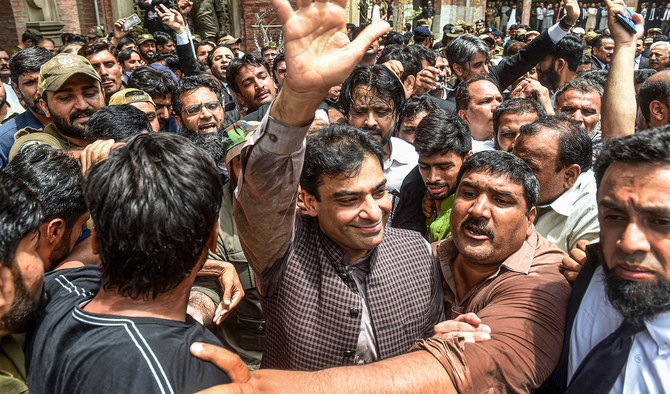
Hamza Shahbaz waves to supporters outside a court in Lahore, Pakistan, on June 11, 2019. (AFP/File)
Short Url
Updated 22 July 2022
Follow

Hamza Shahbaz retains Punjab CM's post, opposition PTI to challenge result in court

  • Deputy Speaker rejects ten votes polled for opposition's candidate for violating the party directions
  • PTI announces challenging the election in Supreme Court as legal experts differ with deputy speaker

ISLAMABAD: Hamza Shahbaz, son of Prime Minister Shehbaz Sharif, on Friday managed to retain the coveted slot of Punjab chief minister, with the opposition Pakistan Tehreek-e-Insaf (PTI) party announcing it would challenge the election result in the Supreme Court of Pakistan.  

Hours of drama followed the crucial election for the chief minister of the country’s most populous province on Friday, which was held on the directions of Supreme Court of Pakistan after 25 members of the opposition PTI were disqualified for voting for the rival Pakistan Muslim League-Nawaz (PML-N) candidate, Shahbaz, in violation of party directives.  

In Friday's election, the opposition alliance, comprising former Prime Minister Imran Khan’s PTI and the PML-Q parties, bagged 186 votes and the PML-N-led ruling coalition secured 179 votes in the provincial house of 371.  

But in a shock move, PML-Q chief Chaudhry Shujaat Hussain sent a letter to Deputy Speaker Dost Muhammad Mazari, in which he had directed PML-Q members to vote for Shahbaz, instead of his cousin brother and opposition's nominee, Chaudhry Pervaiz Elahi.   

The deputy speaker read out the letter and announced the ten votes cast by PML-Q members had been rejected in light of Hussain's declaration and the Supreme Court's ruling.  

"I, hereby, disregard the votes of Pakistan Muslim League [Quaid] polled in favour of Chaudhry Pervaiz Elahi," Deputy Speaker Mazari announced.   

The announcement came as a shock to the PML-Q and Khan's PTI party, which had defeated the ruling PML-N in Sunday’s by-elections and won 15 out of 20 Punjab Assembly seats. The other five members disqualified by the election commission had been elected on reserved seats for women and minorities. 

Asad Umar, a senior PTI member, said his party would file a petition against the election result in apex court tonight. 

"The entire nation has its sights on the Supreme Court whether the door of justice would open tonight or not," Umar said on Twitter.


PTI lawmaker Muhammad Basharat Raja strongly objected to the deputy speaker’s ruling, giving references of Article 63-A of the constitution. He said the parliamentary party leader was the only authorized person to issue directions to his party lawmakers about the vote.   

Raja said PML-Q chief Chaudhry Shujaat Hussain had “no legal authority to issue directions,” but the deputy speaker rejected his argument and said “you may challenge it in the court.”   

According to Article 63-A of the constitution, a parliamentarian can be disqualified on grounds of defection if he or she “votes or abstains from voting in the House contrary to any direction issued by the parliamentary party to which he belongs, in relation to election of the prime minister or chief minister; or a vote of confidence or a vote of no-confidence; or a money bill or a Constitution (amendment) bill.”     

In a unanimous decision in May, ECP members said the PTI dissidents were being de-seated for defecting from the party under Article 63-A of the constitution. The Supreme Court of Pakistan, in its interpretation of Article 63-A, has said votes cast against the party direction “cannot be counted and must be disregarded.”     

The PTI has announced moving the Supreme Court against the deputy speaker’s ruling, describing it as “unconstitutional” and hoping it would be overturned.   

PTI Senator Ali Zafar said it was the mandate of the parliamentary party head and not the party chief to decide about the vote of lawmakers in the house. “The constitution is very clear and the decision of the parliamentary party is supreme with respect to vote in the house,” he told Arab News.  

Barrister Ahmed Pansota said the lawmakers were bound to follow directions of the parliamentary party head, which was done in the PML-Q's case in Friday's election.   

“The Supreme Court has already ruled on these issues and if this matter goes to the apex court for adjudication, I believe the PTI-backed candidate will be declared winner in the chief minister’s election,” he said. 


At UNSC, Pakistan warns competition for critical minerals could fuel global conflict

Updated 54 min 58 sec ago
Follow

At UNSC, Pakistan warns competition for critical minerals could fuel global conflict

  • The demand for critical minerals has surged worldwide due to rapid expansion of electric vehicles, advanced electronics and clean energy technologies
  • Pakistan’s representative says all partnerships in critical minerals sector must be ‘cooperative and not exploitative’ and respect national ownership

ISLAMABAD: Ambassador Asim Iftikhar Ahmad, Pakistan’s permanent representative to the United Nations (UN), has warned that intensifying global competition over critical minerals could become a new driver of global conflict, urging stronger international cooperation and equitable access to resources vital for the world’s energy transition.

The warning comes as demand for critical minerals and rare earth elements surges worldwide due to the rapid expansion of electric vehicles, advanced electronics and clean energy technologies, with governments and companies increasingly competing to secure supply chains while raising concerns that this may lead to geopolitical rivalries in the coming years.

Speaking at a Security Council briefing on ‘Energy, Critical Minerals, and Security,’ Ahmad said experience showed that the risks of instability increased where mineral wealth intersected with weak governance, entrenched poverty and external interference.

“Access to affordable, reliable and sustainable energy is essential for development, stability and prosperity. The global transition toward renewable energy, electric mobility, battery storage and digital infrastructure has sharply increased the demand for critical minerals,” he said.

“This upsurge has generated new geopolitical and geo-economic pressures. If not managed responsibly, competition over natural resources can affect supply chains, aggravate tensions, undermine sovereignty and contribute to instability.”

In several conflict-affected settings, he noted, illicit extraction, trafficking networks and opaque financial flows have fueled armed conflict and violence, weakened state institutions and deprived populations of legitimate revenues.

“The scramble for natural resources and its linkage to conflict and instability is therefore not new,” Ahmad told UNSC members at the briefing. “Pakistan believes that natural resources must serve as instruments of economic development and shared prosperity, and not coercion or conflict.”

He urged the world to reaffirm the right of peoples to permanent sovereignty over their natural resources, saying all partnerships in the critical minerals sector must be cooperative and not exploitative, respect national ownership, ensure transparent contractual arrangements and align with host countries’ development strategies.

“In order to prevent the exploitation of mineral-producing countries and regions, particularly in fragile and conflict-affected settings, support their capacity-building for strengthening domestic regulatory institutions, combating illicit financial flows, ensuring environmental safeguards, and promoting equitable benefit-sharing with local communities,” he asked member states.

“Promote equitable participation in global value chains. Developing countries must be enabled to move beyond extraction toward processing, refining and downstream manufacturing. Technology transfer, skills development and responsible investment are essential to avoid perpetuating structural imbalances.”