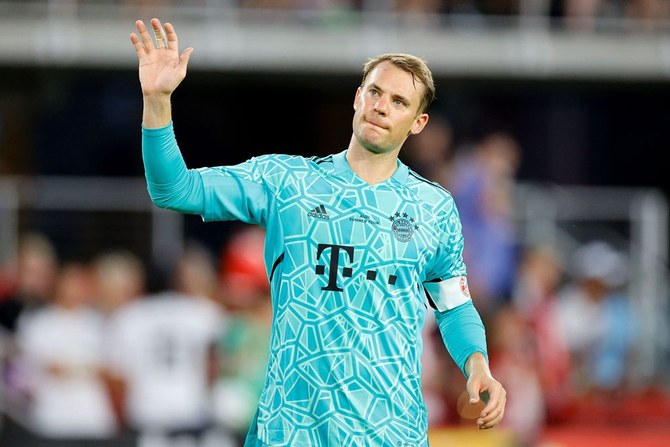
DUBAI: A Bavaria taxi driver was left bitterly unsatisfied by Bayern Munich’s goalkeeper Manuel Neuer, who only rewarded him with a signed jersey after returning his forgotten wallet.
Germany’s sweeper-keeper Neuer was reported to have left behind his wallet in a taxi that he took at Munich’s Odeonsplatz area.
The driver, identified by Sky Germany as Hazir S., found the goalkeeper’s wallet that contained €800 ($782) and two credit cards in the backseat of his car when he parked to have it cleaned.
Despite having driven nearly 120 km back to Munich to return the left behind wallet, according to media reports, Neuer was said to have given Hazir a signed jersey wrapped in a box.
Expressing his dissatisfaction with the reward, Hazir told Sky Germany: “This finder’s fee is a mockery. I have four children. I can’t do anything with the jersey.”
The driver said he “recognized him immediately” when he picked Neuer and his friend from Odeonsplatz square in Munich’s center.
But a few hours after drop off, Hazir claimed that he found the cash, a Visa Card Platinum and Black MasterCard in the goalie’s wallet.
Soon after his shift was over, the driver failed to reach the 2014 World Cup winner at his residence and the drop off point before he finally got hold of Neuer’s manager and handed him the wallet.
Media reports said Hazir was bitterly disappointed when he received his reward, a Bayern Munich jersey with Neuer’s signature on its back without any dedication or thank you comment.
According to German tabloid, Bild, the driver’s dissatisfaction was reasonable as given the laws in Germany he would have deserved 5 percent of the retrieved property and an additional 3 percent if it was worth over €500.

Taxi driver disappointed with ‘unsatisfactory’ reward from Bayern Munich’s Manuel Neuer
https://arab.news/mp4sx
Taxi driver disappointed with ‘unsatisfactory’ reward from Bayern Munich’s Manuel Neuer
- Driver rode 120 km to Munich to return goalkeeper’s wallet
- Neuer rewarded driver with signed Bayern Munich jersey, which he described as a ‘mockery’
As an uncertain 2026 begins, virtual journeys back to 2016 become a trend
- Over the past few weeks, millions have been sharing throwback photos to that time on social media, kicking off one of the first viral trends of the year
LONDON: The year is 2016. Somehow it feels carefree, driven by Internet culture. Everyone is wearing over-the-top makeup.
At least, that’s how Maren Nævdal, 27, remembers it — and has seen it on her social feeds in recent days.
For Njeri Allen, also 27, the year was defined by the artists topping the charts that year, from Beyonce to Drake to Rihanna’s last music releases. She also remembers the Snapchat stories and an unforgettable summer with her loved ones. “Everything felt new, different, interesting and fun,” Allen says.
Many people, particularly those in their 20s and 30s, are thinking about 2016 these days. Over the past few weeks, millions have been sharing throwback photos to that time on social media, kicking off one of the first viral trends of the year — the year 2026, that is.
With it have come the memes about how various factors — the sepia hues over Instagram photos, the dog filters on Snapchat and the music — made even 2016’s worst day feel like the best of times.
Part of the look-back trend’s popularity has come from the realization that 2016 was already a decade ago – a time when Nævdal says she felt like people were doing “fun, unserious things” before having to grow up.
But experts point to 2016 as a year when the world was on the edge of the social, political and technological developments that make up our lives today. Those same advances — such as developments under US President Donald Trump and the rise of AI — have increased a yearning for even the recent past, and made it easier to get there.
2016 marked a year of transition
Nostalgia is often driven by a generation coming of age — and its members realizing they miss what childhood and adolescence felt like. That’s certainly true here. But some of those indulging in the online journeys through time say something more is at play as well.
It has to do with the state of the world — then and now.
By the end of 2016, people would be looking ahead to moments like Trump’s first presidential term and repercussions of the United Kingdom leaving the EU after the Brexit referendum. A few years after that, the COVID-19 pandemic would send most of the world into lockdown and upend life for nearly two years.
Janelle Wilson, a professor of sociology at the University of Minnesota-Duluth, says the world was “on the cusp of things, but not fully thrown into the dark days that were to come.”
“The nostalgia being expressed now, for 2016, is due in large part to what has transpired since then,” she says, also referencing the rise of populism and increased polarization. “For there to be nostalgia for 2016 in the present,” she added, “I still think those kinds of transitions are significant.”
For Nævdal, 2016 “was before a lot of the things we’re dealing with now.” She loved seeing “how embarrassing everyone was, not just me,” in the photos people have shared.
“It felt more authentic in some ways,” she says. Today, Nævdal says, “the world is going downhill.”
Nina van Volkinburg, a professor of strategic fashion marketing at University of the Arts, London, says 2016 marked the beginning of “a new world order” and of “fractured trust in institutions and the establishment.” She says it also represented a time of possibility — and, on social media, “the maximalism of it all.”
This was represented in the bohemian fashion popularized in Coachella that year, the “cut crease” makeup Nævdal loved and the dance music Allen remembers.
“People were new to platforms and online trends, so were having fun with their identity,” van Volkinburg says. “There was authenticity around that.”
And 2016 was also the year of the “boss babe” and the popularity of millennial pink, van Volkinburg says, indications of young people coming into adulthood in a year that felt hopeful.
Allen remembers that as the summer she and her friends came of age as high school graduates. She says they all knew then that they would remember 2016 forever.
Ten years on, having moved again to Taiwan, she said “unprecedented things are happening” in the world. “Both of my homes are not safe,” she said of the US and Taiwan, “it’s easier to go back to a time that’s more comfortable and that you felt safe in.”
Feelings of nostalgia are speeding up
In the last few days, Nævdal decided to hide the social media apps on her phone. AI was a big part of that decision. “It freaks me out that you can’t tell what’s real anymore,” she said.
“When I’ve come off of social media, I feel that at least now I know the things I’m seeing are real,” she added, “which is quite terrifying.”
The revival of vinyl record collections, letter writing and a fresh focus on the aesthetics of yesterday point to nostalgia continuing to dominate trends and culture. Wilson says the feeling has increased as technology makes nostalgia more accessible.
“We can so readily access the past or, at least, versions of it,” she said. “We’re to the point where we can say, ‘Remember last week when we were doing XYZ? That was such a good time!’”
Both Nævdal and Allen described themselves as nostalgic people. Nævdal said she enjoys looking back to old photos – especially when they show up as “On This Day” updates on her phone, She sends them to friends and family when their photos come up.
Allen wished that she documented more of her 2016 and younger years overall, to reflect on how much she has evolved and experienced since.
“I didn’t know what life could be,” she said of that time. “I would love to be able to capture my thought process and my feelings, just to know how much I have grown.”


