

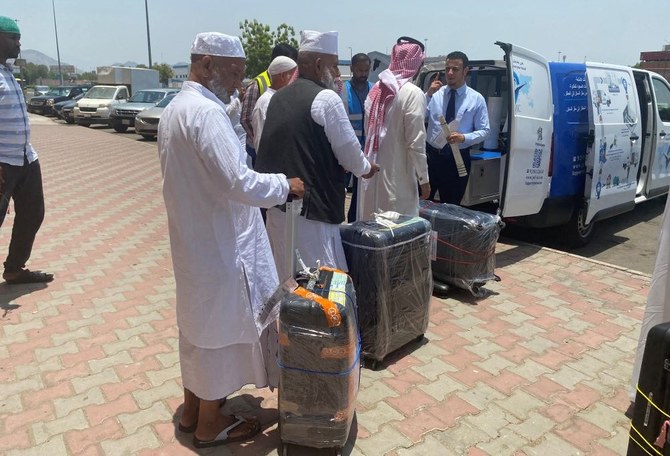
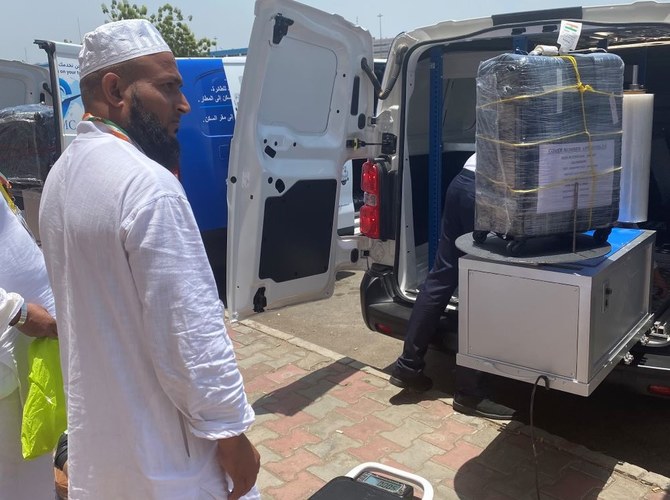

JEDDAH: Saudi Airlines’ free “luggage first” service has begun the departure stage for pilgrims after performing Hajj on Thursday.
The first-of-its-kind transport service was run last month in cooperation with Jeddah Management Company. The service picked up luggage from the pilgrim’s accommodation in Jeddah, Makkah or Madinah 24 hours before their flight, took it to the airport and checked it in for them.
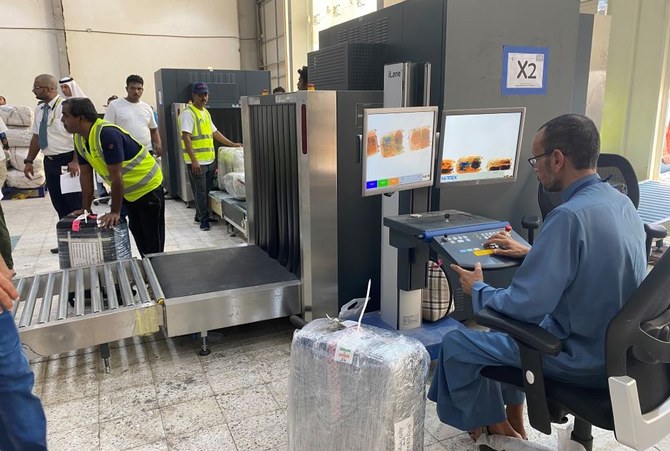
Arab News spoke to Hani Al-Hitairshi, general manager of domestic stations at Saudi Airlines, during a tour around JMC’s luggage scanning facility.
Al-Hitairshi explained that the airline had conducted phase two of the luggage transport operation.
“We received the luggage that was handed from the housing of these guests, then to this area (luggage scanning facility) for clearance before dispatching them to the airport,” he said.
“In this phase, we clear the luggage if there are any prohibited items inside or anything not allowed to be transported by air,” he said.
After this process, the airlines begin dispatching all luggage to the airport directly.
Al-Hitairshi said that it was important for Saudi Airlines to provide pilgrims with a safe and easy Hajj experience.
“It’s important because Saudi Airlines used to provide a new initiative every year, and this is the initiative of this year,” he said.
“This is what’s important, we need to develop services and improve our services to satisfy our customers.”
Chairman of the board of JMC, Mohammed Al-Sheikh, said that they also coordinated with the airport security.
“We have five inspection systems already; we are coordinating with airports’ security. The baggages will arrive at our building first and enter through the system,” he told Arab News.
“The security group will have made their inspections according to their policy. If necessary to open any baggage, there is an inspection and a representative from all airlines and us to open it,” he said.
He used “Zamzam” water as an example of a case where an item might be prohibited on a flight.
“If there are more items, the security will take the necessary actions,” he said.
A pallet specific to each flight is built then taken to the dispatch area.
“After that, it will be transported to the airport in a big truck 24 hours prior to the flight.”
“There we have a separate dedicated area for drop luggage near Hajj terminal; our team there will get all the information from the driver,” he said.
“The information is sent by email before arriving, and the original document is with the driver. They collect it then deliver it to a representative of the airlines then the ground services of the airlines will do their operations inside the airport.”


