

Clinical Abdullah Shafique powers Pakistan to victory in Galle Test 

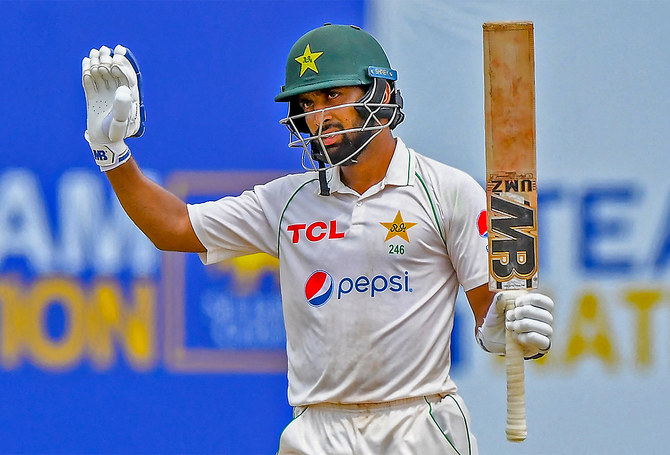
Pakistan’s Abdullah Shafique celebrates after scoring 150 runs during the final day of play of the first cricket Test match against Sri Lanka in Galle on July 20, 2022. (AFP)
Short Url
Updated 20 July 2022
Follow

Clinical Abdullah Shafique powers Pakistan to victory in Galle Test 

  • Abdullah Shafique held his nerve to score unbeaten 160 against Sri Lanka
  • Sri Lanka handed Pakistan 342-run target to win first Test

GALLE, Sri Lanka: Abdullah Shafique hit an unbeaten 160 as Pakistan chased down a record target of 342 at Galle to win a tense opening Test by four wickets against Sri Lanka on Wednesday.

Shafique hit the winning runs in the final session of play on day five to take a 1-0 lead in the two-match series.

Left-arm spinner Prabath Jayasuriya took a match haul of nine wickets but his efforts were in vain as Pakistan battled past the previous best chase in Galle of 268 by Sri Lanka against New Zealand in 2019.

The 22-year-old Shafique excelled with his second Test ton. He built crucial partnerships including a 101-run third-wicket stand with skipper Babar Azam, who made 55 after his 119 in the first innings on a tricky pitch to bat on.

Shafique finally combined with Mohammad Nawaz, 19 not out, to take the visitors home after a brief rain interruption halted their charge. The teams had taken early tea before returning for the third session of play.

Shafique survived three dropped catches, on 70, 135 and 151, but played the anchor's role to perfection as he surpassed his previous Test best of 136 not out.

Pakistan had a few anxious moments after Jayasuriya, who sent back talisman Azam before the close on day four, struck at the stroke of lunch to get debutant Salman Ali Agha out for 12.

Hasan Ali fell for five in the second over of the second session after being promoted up the order to hit out the remaining runs.


Pakistan beefs up security in Karachi, Islamabad and Skardu as Khamenei protests kill 24

Updated 48 min 42 sec ago
Follow

Pakistan beefs up security in Karachi, Islamabad and Skardu as Khamenei protests kill 24

  • At least 14 killed in northern Gilgit-Baltistan region, 10 in Karachi during Sunday’s clashes between protesters, law enforcers
  • Police close off roads leading to key government buildings in Islamabad, US consulate in Karachi with army deployed in Skardu

ISLAMABAD/GILGIT: Authorities beefed up security by deploying additional police contingents and sealing off most roads leading to government buildings in Islamabad, Karachi and Skardu on Monday after violent protests in the aftermath of Iranian Supreme Leader Ayatollah Ali Khamenei’s killing led to the deaths of at least 24 people in Pakistan. 

At least 10 people were killed and 73 others sustained injuries on Sunday in clashes with law enforcement outside the US consulate in Karachi. Hundreds of protesters had gathered outside the consulate, with videos showing angry crowds armed with sticks as they smashed doors and windows.

In Islamabad, protesters entered the Red Zone which houses key government and diplomatic offices in the capital, prompting authorities to fire tear gas to disperse them. Similarly, people gathered outside the press club in the northwestern city of Peshawar to protest Khamenei’s killing as well.

Skardu in Pakistan’s northern Gilgit-Baltistan (GB) region saw violent clashes on Sunday as well, as protesters set fire to and vandalized several buildings, including United Nations (UN) regional offices. Clashes with law enforcers caused the deaths of at least 14 people in the region, among them a soldier, a senior official told Arab News.

“Seven protesters were killed in Gilgit and seven in Skardu,” GB Caretaker Information Minister Ghulam Abbas confirmed. “One was soldier martyred in Skardu while the injured there were around 50.”

Police and Paramilitary vehicles stand outside the U.S. Consulate General, a day after a protest following news of U.S. and Israeli strikes on Iran that killed Supreme Leader Ayatollah Ali Khamenei, in Karachi, Pakistan, March 2, 2026. (Reuters)

The minister said the station house officer and deputy superintendent of police in Skardu were also injured, along with two soldiers, while 10 properties were damaged in the clashes. He said police have registered complaints against the culprits for the violence. 

“Schools are closed on Monday and courts’ activities will also be closed,” Abbas said. “A curfew has also been imposed for three days initially in Skardu and Gilgit cities from Mar. 2 to Mar. 4.”

The flare-up also prompted authorities to call in the army in Skardu under Article 245 of the Pakistani constitution, state media reported on Sunday.

Meanwhile, Islamabad Traffic Police said entry into the Red Zone area will remain open for people only through the Margalla Road and another route through Marriott Hotel.

“All other entry points leading toward the Red Zone will remain closed,” it said in its advisory. 

People ride past shipping containers on a road leading to the U.S. Consulate General, a day after a protest following news of U.S. and Israeli strikes on Iran that killed Supreme Leader Ayatollah Ali Khamenei, in Karachi, Pakistan, March 2, 2026. (Reuters)

A spokesperson for the Karachi Traffic Police said in a press release that the MT Khan Road, from PIDC road to the Mai Kolachi Road railway crossing, will remain closed on Monday for general traffic due to security reasons.

The US consulate, which was the scene of clashes between protesters and police, is located on Mai Kolachi Road near MT Khan and PIDC. 

“The general public is requested to cooperate with law enforcement agencies and traffic police to avoid inconvenience and difficulties,” the Karachi Traffic Police spokesperson said. 


MIDDLE EAST TENSIONS

The violence on Sunday came hours after Iranian authorities confirmed Khamenei was killed in coordinated strikes carried out by the US and Israel, dramatically escalating tensions in the Middle East and triggering protests in several countries.

According to US officials, the operation targeted Revolutionary Guard command facilities, air defense systems, missile and drone launch sites, and military airfields. The US military said it suffered no casualties and reported minimal damage to its bases despite what it described as “hundreds of Iranian missile and drone attacks.”

Iran retaliated by launching missiles and drones toward Israel and targeting US military installations in Bahrain, Kuwait, Qatar and the UAE. The Emirati government said its air defense systems intercepted dozens of Iranian missiles and drones, but debris from the interceptions caused material damage in Abu Dhabi and Dubai, and at least one civilian, a Pakistani national, was killed. It issued rare emergency alerts urging residents to seek shelter, underscoring how the conflict has rippled far beyond Iran’s borders.

The Israeli military said dozens of Iranian missiles were fired toward Israeli territory, many of which were intercepted. Israel’s Magen David Adom rescue service said a woman in the Tel Aviv area died after being wounded in a missile strike.