

Pakistan’s rupee pressured by politics, not fundamentals – finance minister

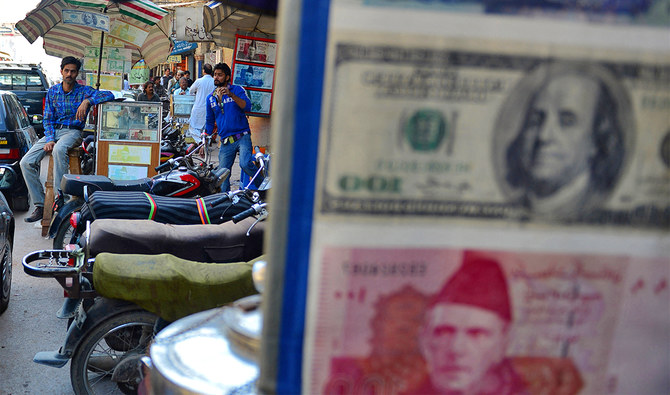
Pakistani currency dealers wait for customers at a roadside currency exchange stall in Karachi on February 11, 2013. (AFP/File)
Short Url
Updated 20 July 2022
Follow

Pakistan’s rupee pressured by politics, not fundamentals – finance minister

  • Rupee slid 3 percent against the dollar by Tuesday’s close and continued downtrend trading on Wednesday
  • Panic in market primarily due to political turmoil, “which will subside in few days,” finance minister says

KARACHI: Pakistan’s finance minister on Wednesday blamed the rupee’s slide on political turmoil, saying he expects market jitters over the currency’s sharp decline to subside soon.

“The rupee downturn is not due to economic fundamentals,” Finance Minister Miftah Ismail told Reuters. “The panic is primarily due to political turmoil, which will subside in a few days.”

The rupee fell 2 percent on Monday, and 3 percent on Tuesday, despite last week’s staff level agreement reached with the International Monetary Fund (IMF) that would pave the way for a disbursement of $1.17 billion under resumed payments of a bailout package.

On Wednesday morning, the rupee was trading at 225 per dollar, having ended Tuesday at 221.99 after Fitch ratings agency revised its outlook for Pakistan’s sovereign debt from stable to negative — though it affirmed Long-Term Foreign-Currency and Issuer Default Rating at “B-.”

“There is panic in the market, I fear it (the rupee) will go down further,” Zafar Paracha, Secretary General of a foreign exchange association, the Exchange Companies of Pakistan, told Reuters earlier on Wednesday.

Paracha said he did not see any reason for the depreciation in the rupee other than possible IMF pre-conditions. Neither the government or the IMF have said anything about the need for any further depreciation of the currency, though Pakistan recently adopted a market-based exchange rate under advice from the lender under the economic reforms agenda.

The finance minister said imports, which put pressure on the rupee, have been curbed and the current account deficit has been controlled in the first 18 days of June.

Pressure on the rupee will ease moving forward, he said, adding that Pakistan had already worked out sources to meet its financing gaps.

“The recent movement in the rupee is a feature of a market-determined exchange rate system,” the State Bank of Pakistan said in a series of Twitter posts late on Tuesday night.

Pakistan is grappling with fast depleting foreign reserves, a declining currency and widening fiscal and current account deficits, and the rupee has lost 18 percent of its value since Dec. 21.

Reserves have fallen to as low as $9.8 billion, hardly enough to pay for 45 days of imports.

Pakistan has also passed through another bout of political instability, with the government of Prime Minister Shehbaz Sharif taking over from ousted premier Imran Khan in April. Khan has been pressing the current government to call early elections, holding a series of political gatherings across the country.

On Tuesday, sovereign dollar bonds issued by Pakistan suffered sharp losses to record lows after Fitch’s move, while the Pakistan Stock Exchange’s KSE100 Index fell 2.36 percent. 


Pakistan Airports Authority reports ‘historic’ twin-engine aircraft landing in Lahore

Updated 13 December 2025
Follow

Pakistan Airports Authority reports ‘historic’ twin-engine aircraft landing in Lahore

  • Twin-engine aircraft are usually larger, heavier and require better airport infrastructure, navigation systems to land
  • Pakistan Airports Authority says landing reflects its commitment to enhance aviation sector, strengthen infrastructure

ISLAMABAD: The Pakistan Airports Authority (PAA) announced on Saturday that the New General Aviation Aerodrome achieved a significant milestone when it handled the landing of a twin-engine aircraft. 

A twin-engine aircraft has two engines that provide it redundancy and increased performance compared to single-engine counterparts. These aircraft range from small twin-engine propeller planes to large commercial jetliners. The presence of multiple engines enhances safety by allowing the aircraft to continue flying in the event of an engine failure.

However, twin-engine aircraft are usually larger, heavier and more complex than single-engine planes. They require advanced airport infrastructure such as better runways, navigation systems and air traffic coordination. 

“The New General Aviation Aerodrome, Lahore achieved another significant operational milestone today with the successful landing of a twin-engine aircraft, following the recent arrival of a single-engine aircraft,” the PAA said in a statement. 

It said the flight was also boarded by Air Vice Marshal Zeeshan Saeed, the director general of the PAA. The move reflected “strong institutional confidence” in the aerodrome’s safety standards, operational capability, and overall readiness, it added. 

“The landing was conducted with exceptional precision and professionalism, demonstrating the aerodrome’s robust operational framework, technical preparedness, and effective airside coordination in accordance with contemporary aviation requirements,” the PAA said. 

It said the landing represented a “major advancement” in Pakistan’s general aviation sector and underscores the PAA’s commitment to enhancing regional aviation capacity, strengthening infrastructure and promoting excellence in aviation development.