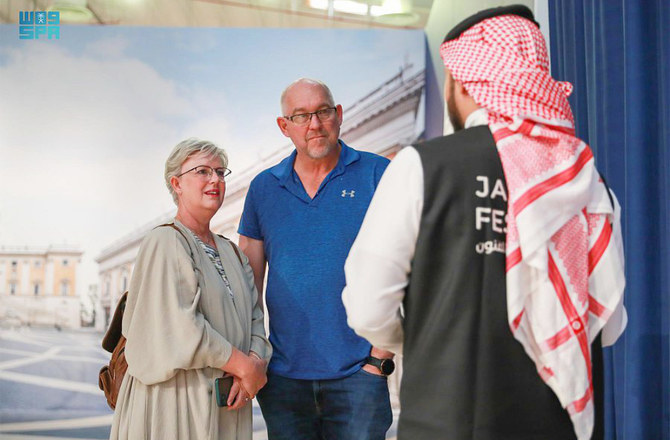

RIYADH: The Jax District in Diriyah has opened up its doors to the Saudi public in an immersive experience of art and virtual reality under the theme “a window to your senses.”
Jax Arts Festival encourages audiences to indulge in the five senses through a showcase of works by artists from around the world. The area is home to a collection of artist studios and frequent public engagement events.
In its first arts festival, the experience prompts Saudis and tourists alike to “arouse curiosity,” allowing visitors to touch, create or become part of the artwork itself.
As you walk through the entrance doors to the Jax Arts Festival, you are engulfed in a fog that slowly reveals the first pieces. Emirati artist Alissar Mzayyek’s artwork, Clear Vision — Beginning of the Journey, is the first work that visitors will see.
“I’m proud to see our work featuring in such beautiful festivals and proud to see that Saudi Arabia is opening up and adopting art in such innovative ways,” Mzayyek told Arab News.
Featuring a collection of suspended rocks carrying plants native to Saudi Arabia, the piece symbolizes the Kingdom’s upward-moving vision.
In the adjacent hall, a flurry of people surround the art pieces and performances at hand: An interactive art painting where visitors can create a painting using the pendulum technique, a colossal black LED cube that reacts to every movement, a live music experience and more.
In a way, the festival aims to highlight an art scene that is accessible to the public. Ultimately, the festival creates a space where art is a channel for entertainment, stripping away the layers of elitism that can make art intimidating for public audiences.
“The Kingdom of Saudi Arabia is currently experiencing a golden period, through the clear orientation of the cultural and artistic entities in the Kingdom, headed by the Ministry of Culture … in raising the level of quality of life, and supporting and enabling the artistic and cultural scene within the Kingdom’s Vision 2030,” featuring artist Abdelrahman Elshahed told Arab News.
His piece was inspired by the words of Minister of Culture Prince Badr bin Farhan, who said: “The story of Arabic calligraphy is a story of civilization, legacy, culture and life.”
Interdisciplinary artist Elham Dawsari told Arab News: “I expect that Jax festival and similar festivals are going to open more doors for people to accept art and to not feel intimidated by going to a gallery. It’s breaking barriers that people have of art and what art is in a way that speaks more to them.”
Dawsari frames her work within the context of Saudi women and urban growth boundaries. As the Kingdom turns toward the future, some worry that its past may be forgotten. Dawsari’s four sculpted pieces of women doing daily activities pay tribute to often forgotten members of the Saudi public who sacrificed their dreams and ambitions to raise a generation unlike any before it.
“They are the seed for this beautiful change,” she told Arab News. “They felt unheard for a very long time, and now it’s kind of happening again. While we all appreciate their effort, we’re not really making an effort to show them that publicly.”
French artist Julien Gardair takes an abstract approach toward visualizing Saudi culture, carving various portrayals of Saudi people and heritage onto medium-density fiberboard. The designs cut into the wooden boards are all carved with one line, creating a positive and negative contrast, then placed separately and used to build his pillars.
“You make me see my own culture and country through a different light,” one woman told Gardair.
He derived his imagery — which has touched many of the local festivalgoers — from a past visit to the Kingdom before the COVID-19 pandemic.
“One was moved to tears. Another was telling me how beautiful it was to be depicted like this by a foreigner. That made me realize that people might have suffered from the image that has been spread about them outside the country,” he told Arab News.
Guatemalan artist Maria Ines Henry (Milah) sits in her color-block chair viewing reactions to her artwork, Colors of Life.
“A grandmother, she starts to cry, because she felt so excited … you can feel the power,” she told Arab News. “I have goosebumps when I see people interacting with my art … you have this idea inside, and then you put it into the material world.”
Another of Henry’s pieces, “Gift to Saudi,” is an abstract shape recreating the Jax logo. It is a product of seven years of work and research into the psychology of colors, and how individuals connect to them.
She places tones together in an explosion of colors on eight separate pillars. The audience may interact with the work by sitting in a supplementary chair to take photos engulfed in the various hues.
The local artworks displayed at the festival hone in on the way of life within the Kingdom. Saudi artist Um Kalthoum Al-Alawi’s work is inspired by historical Jeddah’s building exteriors, Mashrabiyat, where historically, women in the city spent most of their time. While it may look complex from afar, the work is based on geometrical shapes formed by three main strokes: Straight, slanted and curved lines.
The repetitive shapes are built up to create a cascading imagery, all meant to signify the prominence of sociality, community and family within the region.
“What makes it seem complicated is their meeting together and intertwining,” Al-Alawi told Arab News.
“All geometrical shapes result from a circle, and a circle is resultant from a dot. The whole universe results from a dot, and from nothing comes everything.”
With long lines of visitors waiting to enter, the XR Experience immerses attendees in historical sights within Saudi Arabia, most notably AlUla and historical Jeddah.
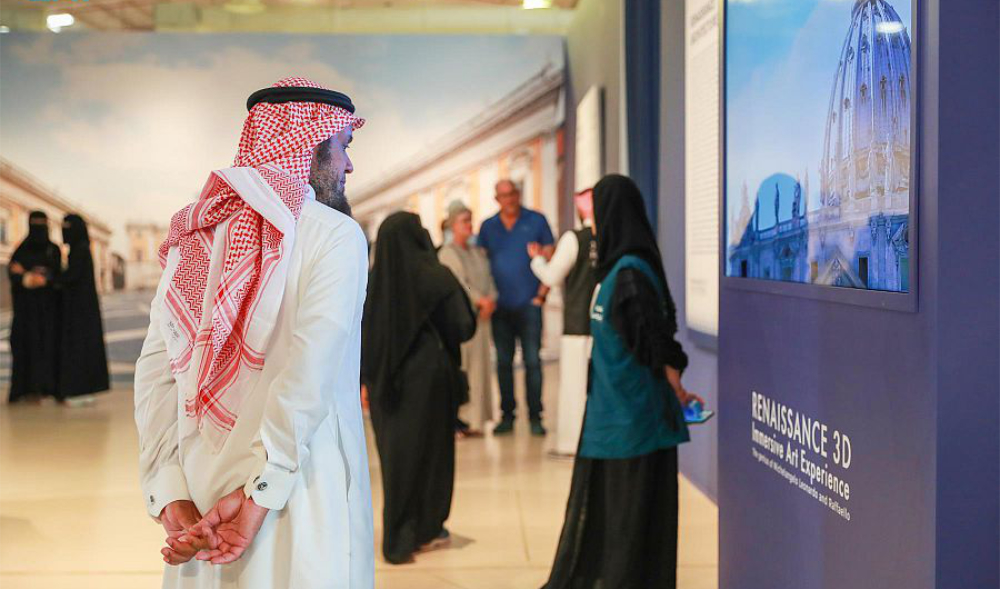
Another attraction, a “Renaissance 3D” experience, has been curated to adapt to Saudi culture through augmented and virtual reality technologies.
Jax Arts Festival is free-of-charge and open to the public in Riyadh through July 24.