

Global index puts Pakistani passport at world's fourth weakest for international travel

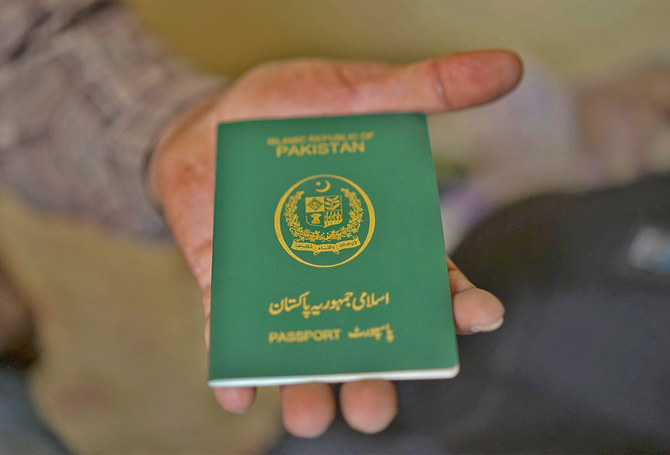
The image shows a man holding a Pakistani passport in Bangkok, Thailand, on November 3, 2018. (AFP)
Short Url
Updated 20 July 2022
Follow

Global index puts Pakistani passport at world's fourth weakest for international travel

  • Pakistani passport holders enjoy visa-free access to only 32 destinations worldwide
  • Only three other countries, Syria, Iraq and Afghanistan, rank lower than Pakistan

ISLAMABAD: Pakistan’s passport maintained its rank as the fourth weakest for international travel, according to a global index report published this week that grades travel documents on the basis of international mobility enjoyed by holders.

The Henley Passport Index ranks visa-free access of 199 passports to 227 travel destinations across the world. The global index has exclusive access to data from the International Air Transport Authority (IATA), which maintains the world’s largest and most accurate travel information.  

As per the index’s report for the third quarter of 2022, Pakistan retained its position at number 109 in the list, the fourth worst in the index, with visa-free access to only 32 destinations across the world. Pakistan also ranked 109th on the index in the last report published by the global index in the second quarter of 2022.  

Only three other countries’ passports rank lower than Pakistan, Syria (110), Iraq (111) and Afghanistan (112). Pakistan’s eastern neighbor India has been placed at number 87, with visa-free access to 60 destinations.  

Pakistan enjoyed its highest ranking on the index in 2006 when it was 79 on the index. The country’s position gradually fell over the years until it dropped to its lowest ranking of 113 in 2021.  

Japan, Singapore and South Korea are placed at number one on the index, with visa-free access to 193 destinations across the world.


Pakistan launches second indigenous EO-2 satellite from China, SUPARCO says

Updated 12 February 2026
Follow

Pakistan launches second indigenous EO-2 satellite from China, SUPARCO says

  • Earth observation satellite launched from Yangjiang Seashore Launch Center in China
  • EO-2 to enhance disaster response, governance, resource management capabilities

KARACHI: Pakistan has successfully launched its second indigenous Earth Observation satellite, EO-2, from China’s Yangjiang Seashore Launch Center, the national space agency SUPARCO said on Thursday.

The launch marks a significant step in Pakistan’s efforts to strengthen its domestic space and remote sensing capabilities, with the satellite expected to improve imaging continuity, disaster monitoring, agricultural planning and strategic resource management.

In a statement, Pakistan’s SUPARCO said the EO-2 satellite would enhance the country’s earth observation and imaging capabilities and support governance and planning functions across multiple sectors.

“Pakistan’s second indigenous EO-2 satellite has been successfully launched,” SUPARCO said, adding that the mission represents a “milestone” in the expansion of the country’s satellite fleet.

According to the agency, EO-2 will provide critical data for planning and resource management while improving the continuity and accuracy of national earth observation systems.

The satellite is expected to support disaster management, urban planning, environmental monitoring and infrastructure development by supplying updated geospatial imagery and data.

SUPARCO said the launch demonstrates growing indigenous capability in satellite development and reflects Pakistan’s broader objective of strengthening its national space program through locally developed platforms.

Pakistan has gradually expanded its space cooperation with China in recent years, including satellite launches and joint missions, as Islamabad seeks to build technical capacity and reduce reliance on external data sources.

The EO-2 satellite is expected to play a key role in improving data availability for federal and provincial authorities, particularly in areas vulnerable to floods, climate stress and rapid urbanization.