Man detained in police probe of raging wildfires in France

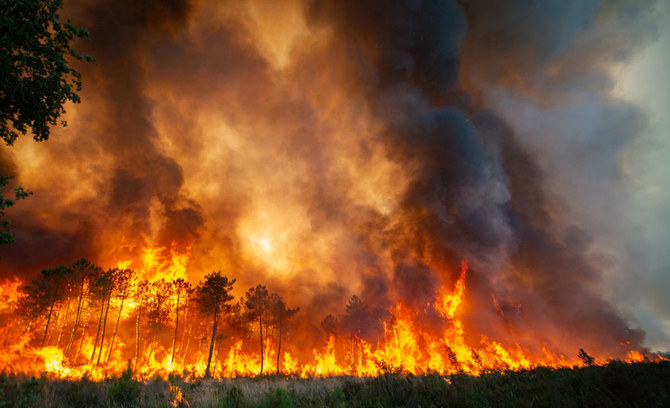
Strong winds and hot, dry weather are frustrating French firefighters’ efforts to contain a huge wildfire that raced across pine forests in the Bordeaux region Saturday for a fifth straight day. (AP)
Short Url
Updated 19 July 2022
Follow

Man detained in police probe of raging wildfires in France

  • One of the blazes, tearing through woodlands south of Bordeaux, is suspected to have been started deliberately
  • Criminal investigators found evidence pointing to possible arson

LA TESTE-DE-BUCH, France: French investigators probing the suspected deliberate lighting of what has become a raging wildfire in the country’s southwest detained a man for questioning,
Meanwhile, firefighters and water-bombing planes on Tuesday fought the ferocious flames fueled by a heat wave smashing temperature records in Europe.
Two huge fires feeding on tinder-dry pine forests in the Gironde region have forced tens of thousands of people to flee homes and summer vacation spots since they broke out July 12.
One of the blazes, tearing through woodlands south of Bordeaux, is suspected to have been started deliberately. A motorist told investigators that he saw a vehicle speeding away from the spot where that fire started on July 12. The motorist pulled over and tried unsuccessfully to extinguish the flames, the Bordeaux prosecutor’s office said.
Criminal investigators found evidence pointing to possible arson, it said.
The 39-year-old man being questioned Tuesday lives in Gironde and was detained on Monday afternoon, the prosecutor’s office said. He previously also was questioned in 2012 on suspicion of starting a forest fire but that investigation was shelved in 2014 for lack of evidence, the prosecutor’s office added.
Investigations are continuing and witnesses are being heard, it said.
Ten water-bombing planes and more than 2,000 firefighters are working day and night to contain that fire and another fierce blaze southwest of Bordeaux that police investigators are treating as accidental. The blazes have already burned through more than 190 square kilometers (more than 70 square miles) of forest and vegetation, Gironde authorities said.
Thick clouds of smoke and the risk of flames spreading to buildings have forced the evacuations of more than 37,000 people, including 16,000 on Monday alone, authorities said. A smaller third fire broke out late Monday in the Medoc wine region north of Bordeaux, further taxing regional firefighting resources.
Those evacuated Monday included 74 residents of a retirement home, authorities said. Animals were also evacuated from a zoo. Five camping sites went up in flames in the Atlantic coast beach zone southwest of Bordeaux, around the Arcachon maritime basin famous for its oysters and resorts.
Swirling winds and extreme heat have complicated the firefighting. But changing weather Tuesday offered some consolation, with heat-wave temperatures easing along the Atlantic seaboard and rains expected to roll in late in the day.
The double blow of heat waves and droughts exacerbated by climate change are making wildfires more frequent, destructive and harder to fight. In Spain, the prime minister has linked wildfires that have killed two people to global warming, warning Monday that “climate change kills.”
The head of Spain’s Civil Protection and Emergencies agency, Leonardo Marcos González, noted Tuesday that extreme heat and wildfires have hit the country three weeks earlier than usual this year and that many fires broke out at the same time.
“We are in the midst of the most significant civil protection emergency on record,” he told radio station SER.
In Portugal, cooling temperatures have eased pressure on emergency crews, with just two major wildfires being tackled by around 800 firefighters Tuesday. But more torrid weather is forecast for Wednesday.
Authorities suspect a wildfire is to blame for the death of a couple in their 80s whose car went off the road and flipped over in a northern Portuguese village late Monday. Their charred vehicle with two bodies inside was found after a blaze engulfed the area, and officials suspect they were killed while trying to flee the flames.
The pilot of a water-dumping plane also died in Portugal last week when his aircraft crashed while fighting a wildfire.


Trump cuts India tariffs as Modi ‘agrees’ to stop buying Russian oil

Updated 13 sec ago
Follow

Trump cuts India tariffs as Modi ‘agrees’ to stop buying Russian oil

  • US will impose an 18 percent tariff on Indian goods, down from the earlier 50 percent punitive levy
  • Withdrawal from Russian oil may affect India’s relations with BRICS, expert says

NEW DELHI: The US and India have announced reaching a trade agreement after months of friction, with President Donald Trump saying that Prime Minister Narendra Modi had “agreed” to halt purchases of Russian oil.

In August, Trump accused India, which imports most of its crude oil, of funding Moscow’s war in Ukraine and subjected it to a combined tariff rate of about 50 percent on most of the exports.

Following a call with Modi on Monday, Trump took to social media to say that he would cut with immediate effect US levies on Indian goods to 18 percent after Modi “agreed to stop buying Russian Oil, and to buy much more from the United States and, potentially, Venezuela.”

At the same time, India, Trump wrote, would “reduce their Tariffs and Non Tariff Barriers against the United States, to ZERO,” committing to buy “over $500 BILLION DOLLARS of US Energy, Technology, Agricultural, Coal, and many other products.”

Modi confirmed the agreement on social media, saying: “Made in India products will now have a reduced tariff of 18 percent,” without commenting on Russian oil or duty-free imports of American goods.

When the US announced its punitive tariffs last year, India quickly moved forward with free trade negotiations with other countries — signing a deal with Oman and finalizing negotiations with New Zealand and the EU.

While the agreements were expected to partially offset the loss of exports to the US, economists did not expect they would immediately mitigate it, as shifting supply chains takes time.

The newly announced agreement with the US will therefore offer short-term relief for Indian exporters — especially of textiles, gems, jewelry and marine products — who were facing the threat of a market exit.

“In that case, the trade deal with the US is a welcome step. It provides short-term relief, allowing India to continue exporting to the US without being forced to exit the US market and diversify with a huge transition cost,” said Anisree Suresh, geoeconomics researcher at the Takshashila Institution.

“However, one shouldn’t look at it as a comprehensive long-term trade deal like the one India signed with the EU. The unpredictability of the Trump administration remains a major concern, regardless of whether there is a trade deal with the US ... India cannot treat this deal the same as other FTAs, as it is limited in scope and subject to reversal.”

When the US imposed its punitive tariffs on India, about 66 percent of total Indian exports were subject to that rate. Overall, India recorded a negative margin of 19.5 percent, meaning its exports were taxed more heavily than those of its competitors.

“From that point of view, Indian goods will have a larger market over there. However, there’s a problem when we talk about a 0 percent tariff on the US,” said Prof. Arun Kumar, a development economist.

“The US will be able to export a lot more to India, and therefore it will affect our production within the economy. And that will be a setback, so while exports may rise, the internal economy may actually suffer because of this decrease in tariffs on American goods. And especially if it affects agriculture.”

The sudden withdrawal from India’s partnership with Russia may not have a serious economic impact but politically could affect New Delhi’s relations, also with other countries, especially those from BRICS — a grouping that besides India and Russia includes also Brazil and China, and is the most powerful geopolitical forum outside of the Western world.

“You can always substitute Russian oil with some other oil, but I think it’s more of a strategic question, because India and Russia have had long-standing relationships, and if we bend to US pressure and reduce purchases from Russia, then it will affect in future also our relationship with Russia, because we will not be seen as a stable ally,” Kumar said.

“BRICS nations will not trust India very much in the future ... and that’s what Trump wants. He wants to disrupt BRICS. That’s what he has been doing right since the beginning to divide nations and deal with them individually.”