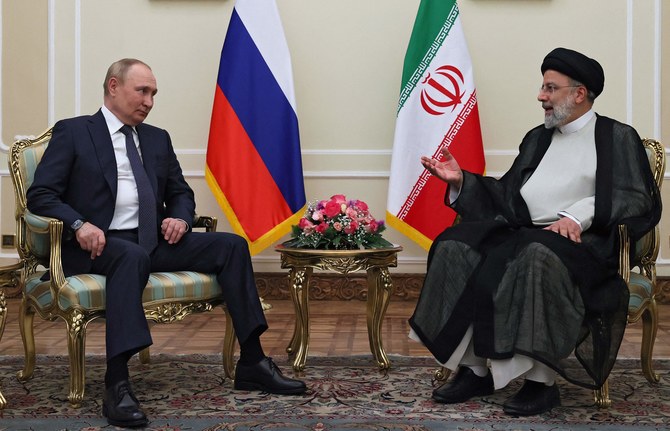

TEHRAN: Russian President Vladimir Putin arrived in Tehran for talks Tuesday on the Syrian war at a three-way summit overshadowed by fallout from his country’s war on Ukraine.
Putin traveled abroad for only the second time since ordering the invasion of Ukraine in order to attend the gathering that also involves Turkish President Recep Tayyip Erdogan.
The summit comes days after US President Joe Biden visited the Middle East for the first time in his presidency, with stops in Iran’s regional foes Israel and Saudi Arabia.
It is the first hosted by Iran’s ultra-conservative president Ebrahim Raisi since he took office last year and is ostensibly aimed at ending more than 11 years of conflict in Syria.
All three are involved in the conflict, with Iran and Russia supporting Syria’s President Bashar Assad and Turkey backing rebel forces.
Ahead of the trilateral meeting, Iran’s supreme leader Ayatollah Ali Khamenei met Erdogan, who has repeatedly threatened to launch a new military offensive against Kurdish militants in northern Syria.
Khamenei warned the Turkish leader that such a move would be “detrimental” for the region and called for the issue to be resolved through dialogue between Ankara, Damascus, Moscow and Tehran.
Erdogan, speaking later at a joint news conference with his Iranian counterpart, said Kurdish militias caused “great trouble” for both Iran and Turkey.
“We should fight against these terrorist organizations in solidarity and alliance,” he added.
The presidents also oversaw the signing of a number of agreements in different fields, including in trade and economy.
Erdogan has for months been offering to meet Putin in a bid to help resolve heightened global tensions.
“The timing of this summit is not a coincidence,” Russian analyst Vladimir Sotnikov said.
“Turkey wants to conduct a ‘special operation’ in Syria just as Russia is implementing a ‘special operation’ in Ukraine.”
Turkey has launched waves of attacks on Syria since 2016, targeting Kurdish militias as well as Daesh group extremists and Assad loyalists.
In their talks, Putin and Erdogan would discuss mechanisms to export grain from Ukraine, a Kremlin source said.
Russia’s war on Ukraine has massively hampered shipments from one of the world’s biggest exporters of wheat and other grain, sparking fears of global food shortages.
Turkey — a NATO member on speaking terms with both Russia and Ukraine — has spearheaded efforts to resume the grain deliveries.
Ultimately, Erdogan is hoping to get “the green light” from Putin and Raisi for Turkey’s military operation in Syria, said Sinan Ulgen, a visiting scholar at Carnegie Europe.
EU foreign policy chief Josep Borrell warned on Monday that Russia’s blockade of Ukrainian ports threatens supplies to countless thousands vulnerable to starvation.
Borrell dubbed the issue “one of life and death for many human beings.”
On Sunday, a day after Biden ended his tour of the Middle East, Iran accused the United States of provoking crises in the region.
Biden had vowed the US would not “tolerate efforts by any country to dominate another in the region through military buildups, incursions, and/or threats,” in reference to Iran.
In a speech at a Saudi summit of Gulf Arab states as well as Egypt, Jordan and Iraq, Biden assured those gathered that the US would remain fully engaged in the Middle East.
“We will not walk away and leave a vacuum to be filled by China, Russia or Iran,” he said.
Following the meeting, a joint statement committed the leaders to “preserve regional security and stability.”
It also underscored diplomatic efforts to prevent Iran from developing a nuclear weapon, a goal the Islamic republic has always denied seeking.
On Sunday, Iran accused the US of having “once again resorted to the failed policy of Iran-phobia, trying to create tensions and crises in the region.”
The US last week alleged Iran plans to deliver “hundreds of drones” to Russia to aid its war on Ukraine, an accusation the Islamic republic dismissed as “baseless.”