Political uncertainty plunges Pakistani currency to new all-time low against dollar

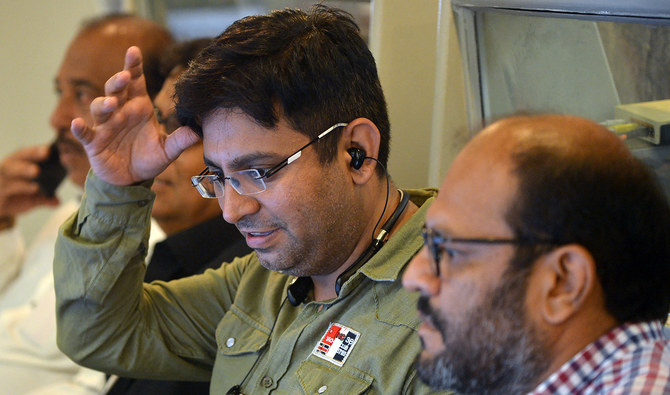
Stockbrokers monitor the latest share prices during a trading session at the Pakistan Stock Exchange (PSX) in Karachi on June 13, 2022. (AFP/File)
Short Url
Updated 18 July 2022
Follow

Political uncertainty plunges Pakistani currency to new all-time low against dollar

  • Analysts say the result of by-polls in Pakistan's most populated Punjab has cast doubt on the next IMF tranche
  • Pakistan last week reached staff-level agreement with IMF and expects to receive $1.17 billion in next few weeks

KARACHI: Pakistan’s national currency on Monday plunged to another all-time low as the US dollar closed at Rs215.20 in the interbank market, currency dealers and analysts said, attributing it to the uncertain political situation after the landslide victory of ex-prime minister Imran Khan’s party in Punjab by-polls. 

Khan’s Pakistan Tehreek-e-Insaf (PTI) party won 15 seats out of 20 that were up for grabs in the 371-member Punjab Assembly in the hotly contested by-polls on Sunday. This has brought the overall number of seats held by the PTI and its allies to 188, two seats more than the simple majority of 186 needed to rule the province.  

On Monday, the Pakistani currency lost its value by 1.97 percent, or Rs4.25, against the greenback as demand in the interbank market surged due to concerns over the International Monetary Fund (IMF) loan program.  

Pakistan last week reached a staff-level agreement with the global lender and is expected to receive $1.17 billion after the approval of the IMF board in the next six weeks.   

“The rupee is under pressure after the results of the by polls held yesterday which has brought back the element of uncertainty,” Tahir Abbas, head of research at the Arif Habib Limited securities brokerage firm, told Arab News.  

“Most likely the PTI would make the government in Punjab and there could be some changes at the federal level [too]. In the developing situation, the question arises whether Pakistan would be able to secure the IMF tranche or not.”  

The local currency previously hit a record low of Rs211.93 against the dollar on June 22 before it recovered to Rs204.56 on July 4, according to the central bank data.  

After the substantial devaluation of rupee, Pakistani currency dealers said it was one of the worst day for Pakistan’s economy. 

“Today was one of the worst days for the economy of Pakistan following the substantial devaluation of Pakistani rupee and the government’s non-interference,” Zafar Paracha, general secretary of the Exchange Companies Association of Pakistan (ECAP), said.   

Paracha was of the view that despite the political uncertainty, the rupee's devaluation seemed part of the IMF agreement.   

“The government has not shown any concerns so it means that the further devaluation of the currency is part of the agreement authorities have signed with the IMF,” he said. 

"Pakistan’s fundamentals are strong and there is a broad consensus among the analysts that the dollar must not be more than Rs190 in any condition." 

Paracha said if the current situation persisted, it would be hard to avert a Sri Lanka-like situation in Pakistan.   

Pakistan's equities also started the week on a bearish note in the backdrop of increasing noise on the political front after the shock victory of the PTI in Punjab by-elections.  

“Pakistan stocks witnessed massive pressure in scrips across the board on political uncertainty and record slump in rupee after the PML-N lost to the opposition in Punjab province,” Ahsan Mehanti, chief executive officer of the Arif Habib Corporation, told Arab News. 

“The unexpected delay in release of IMF tranche to the next two to three weeks and uncertainty over funding from friendly countries to support plunging rupee played a catalyst role in bearish activity at the Pakistan Stock Exchange.”  

Analysts say if the country goes for an early election, it would unclear whether the IMF tranche would be released or the global lender would wait for the next government to take charge and then disburse the sum. 

On Saturday, Finance Minister Miftah Ismail said Pakistan was expected to receive $4 billion from friendly states in the next few months, while another $6 billion were expected from the Asian Development Bank and the World Bank. 


Pakistan says multilateralism in peril, urges global powers to prioritize diplomacy over confrontation

Updated 8 sec ago
Follow

Pakistan says multilateralism in peril, urges global powers to prioritize diplomacy over confrontation

  • The country tells the UN international security system is eroding, asks rival blocs to return to dialogue
  • It emphasizes lowering of international tensions, rebuilding of channels of communication among states

ISLAMABAD: Pakistan warned the world community on Monday that multilateralism was “in peril” amid rising global tensions, urging major powers to revive diplomacy and dialogue to prevent a further breakdown in international security.

Speaking at a UN Security Council briefing, Pakistan’s ambassador to the UN, Asim Iftikhar Ahmad, said the world was drifting toward confrontation at a time when cooperative mechanisms were weakening.

His comments came during a session addressed by Finland’s foreign minister Elina Valtonen, chairing the Organization for Security and Co-operation in Europe (OSCE), the world’s largest regional security body.

Formed out of the 1975 Helsinki Final Act, the OSCE was designed during the Cold War to reduce tensions, uphold principles of sovereignty and human rights and promote mechanisms for peaceful dispute resolution.

“Today, the foundational ethos of international relations, multilateralism, cooperation and indivisible security, as envisaged in the preamble of Helsinki Final Act, is perhaps facing its biggest challenge in decades,” Ahmed said. “The OSCE, too, is navigating a difficult geopolitical landscape, with conflict raging in the heart of Europe for nearly four years, depletion of trust and unprecedented strains on peaceful co-existence.”

He said a return to the “Helsinki spirit” of dialogue, confidence-building and cooperative security was urgently needed, not only in Europe but globally.

“This is not a matter of choice but a strategic imperative to lower tensions, rebuild essential channels of communication, and demonstrate that comprehensive security is best preserved through cooperative instruments, and not by the pursuit of hegemony and domination through military means,” he said. “Objective, inclusive, impartial, and principle-based approaches are indispensable for success.”

Ahmed’s statement came in a year when Pakistan itself fought a brief but intense war after India launched missile strikes at its city in May following a militant attack in Indian-administered Kashmir. New Delhi blamed Pakistan for the assault, an allegation Islamabad denied while calling for a transparent international investigation.

The Pakistani diplomat said the international system was increasingly defined by bloc politics, mistrust and militarization, warning that such trends undermine both regional stability and the authority of multilateral institutions, including the UN itself.

He urged member states to invest more in preventive diplomacy and the peaceful settlement of disputes as reaffirmed by the Council in Resolution 2788.

Ahmad said Pakistan hoped the OSCE would continue reinforcing models of cooperative security and that the Security Council would back partnerships that strengthen international law and the credibility of multilateral frameworks.

The path forward, he added, required “choosing cooperation over confrontation, dialogue over division, and inclusive security over bloc-based divides.”