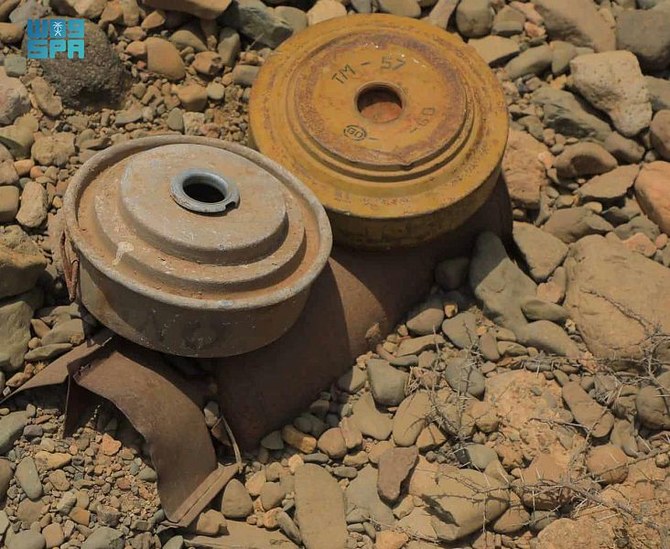
DUBAI: About 700 mines planted by the Houthi militia across Yemen were dismantled by the King Salman Humanitarian Aid and Relief Center’s (KSrelief) Masam project during the second week of July.
The extraction included 320 anti-tank mines and 380 non-explosive ordnances, bringing the total number of mines removed in July to 1,538, state-owned Saudi Press Agency reported.
The Masam team removed 54 anti-tank mines and 86 non-explosive ammunition in Aden, while 266 anti-tank mines and 294 non-explosive ammunition were extracted from Marib district.
The project has successfully removed 350,0421 mines since it was launched in 2018.
Earlier in June, KSrelief renewed the demining Masam project for a fifth year at a cost of $33.292 million.

700 Houthi mines dismantled in Yemen under Masam project
https://arab.news/jugnp
700 Houthi mines dismantled in Yemen under Masam project
- The extraction included 320 anti-tank mines and 380 non-explosive ordnances
Program to train experts in forest rehabilitation
- Forest Ambassadors program is one of several specialized training initiatives designed to equip forestry personnel, relevant authorities, and university students
- Program focuses on providing trainees with advanced scientific knowledge and skills in fieldwork, data management, and technical report writing
RIYADH: The National Center for Vegetation Cover Development and Combating Desertification continues to strengthen national capabilities to implement environmental initiatives requiring advanced technical skills and scientific expertise in assessing and rehabilitating vegetation resources.
The Forest Ambassadors program is one of several specialized training initiatives designed to equip forestry personnel, relevant authorities, and university students with the knowledge and skills to conduct vegetation inventories, assessments, and prepare technical plans for rehabilitating degraded forest areas.
The program offers a mix of theoretical and practical training, including presentations, educational modules, group discussions, and case studies, according to the Saudi Press Agency.
These components enable participants to conduct vegetation inventories and assessments, identify degradation, determine rehabilitation needs, and develop technical forest management plans.
The program focuses on providing trainees with advanced scientific knowledge and skills in fieldwork, data management, and technical report writing, the SPA reported.
It serves as a model for building highly qualified national cadres capable of applying best scientific practices in forest management and rehabilitation, contributing to the protection of natural resources, advancing the Saudi Green Initiative, and supporting the long-term sustainability of the Kingdom’s vegetation cover.


