

Sri Lanka declares state of emergency ahead of vote for new president

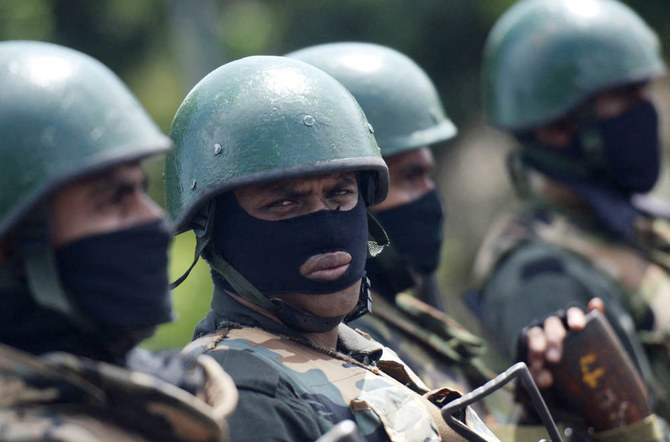
Army cadets stand guard in front of Sri Lankan parliament building in Colombo on July 16, 2022. (AFP)
Short Url
Updated 18 July 2022
Follow

Sri Lanka declares state of emergency ahead of vote for new president

  • Parliament expected to decide new leader on Wednesday
  • Protesters continue to demand acting president’s resignation

COLOMBO: Sri Lanka’s acting President Ranil Wickremesinghe has declared a state of emergency that went into effect on Monday, as the interim government seeks to quell unrest ahead of a vote in parliament later this week to elect a new leader.

The island nation of 22 million people has suffered through shortages of essentials and days-long fuel queues for months, while foreign exchange reserves dwindled close to zero and headline inflation hit 54.6 percent in June.

Wickremesinghe was sworn in as interim president on Friday after his predecessor, Gotabaya Rajapaksa, fled abroad last week after resigning following months-long mass protests over the country’s economic meltdown.

The Sri Lankan Parliament convened on Saturday to begin the process of electing a new leader who will serve the rest of Rajapaksa’s term. Nominations for the election will be heard on July 19, and a vote is expected to take place the next day.

The acting president ordered the state of emergency “in the interest of public security, the protection of public order and the maintenance of supplies and services essential to the life of the community,” an official notice said.

“There were elements within society who were attempting to disrupt the peace in the country,” Wickremesinghe said in a televised statement on Monday. “They would be prohibited from disrupting the country’s progress.”

The government will engage “peaceful protesters who had legitimate concerns” and work with them to find solutions, he added.

Wickremesinghe’s move to impose an emergency comes as protests demanding his resignation continued in different parts of the country. Previous emergency regulations have been used to deploy the military to arrest and detain people, as well as dampen public protests.

“The current declaration of emergency rule is to merely protect (the government) from the people and deny people of their democratic rights,” Dr. Ruvaiz Haniffa, social activist and former president of the Sri Lanka Medical Association, told Arab News.

“Why does it have to use an emergency as a punitive measure against the people it’s supposed to serve unless it is aware that it has not and is not delivering the service the people expect?”

Namal Jayaweera, one of the protest leaders, said that Wickremesinghe was appointed as premier to safeguard the interest of the Rajapaksas, whose family dynasty ruled over Sri Lankan politics for more than 20 years.

Wickremesinghe was named prime minister only in May, after Gotabaya’s elder brother, Mahinda Rajapaksa, stepped down from the position following violent clashes between protesters and supporters of the ruling party in Colombo.

“When he came on as prime minister he said his first priority was to give three meals, get petrol and gas, and power to the people,” Jayaweera told Arab News. “He has failed and could not keep his promises.”

“We will continue the fight until Ranil is also ousted, as we see him as a dealmaker and protector of the Rajapaksa regime.”


US ‘totally stupid’ to attack Iran during talks: UN ambassador

Updated 03 March 2026
Follow

US ‘totally stupid’ to attack Iran during talks: UN ambassador

  • “War was not our option. War was imposed on Iran,” Bahreini told UN correspondents
  • “Nobody should expect Iran to show restraint in front of aggression”

GENEVA: The United States made a “totally stupid decision” to attack Iran while in negotiations, and betrayed Gulf nations by trashing their diplomatic efforts, Tehran’s UN ambassador said Tuesday.
Ali Bahreini, Iran’s ambassador in Geneva, insisted Tehran had no problem with its neighbors, but could not let US bases in the Gulf be used as launchpads for attacks on Iran.
“War was not our option. War was imposed on Iran,” Bahreini told UN correspondents.
“Nobody should expect Iran to show restraint in front of aggression.
“We will continue our defense until the point that this aggression is stopped,” he said.
On February 26, Washington and Tehran held indirect negotiations in Geneva on Iran’s nuclear program — with the Omani mediators reporting “significant progress.”
Bahreini was present for part of those talks and said “everybody was optimistic” and the US team “agreed to continue negotiations” in Vienna this week.
But Bahreini said Israeli Prime Minister Benjamin Netanyahu had convinced US President Donald Trump to destroy diplomacy and attack Iran, with strikes starting on Saturday.
“It was a totally stupid decision. They will know in the future how stupid this decision has been. Both of them will understand, because Iran will firmly determine the situation and the destiny of this war,” he said.
“All our neighbors are now disappointed with the betrayal of the United States because everybody was working for diplomacy, particularly Oman.
“The US betrayed everybody.”

- ‘Not a regional war’ -

Tehran has launched strikes against countries in the region that host US bases.
“I cannot accept labelling what we are doing as reprisal. What we are doing is a kind of self-defense,” said Bahreini.
The ambassador said Iran’s problem was not with its neighbors, describing the Gulf countries as friends.
“We are in daily dialogue with our neighbors to convey to them the message that this war is not a war against our neighbors.
“This is not a regional war.
“But we cannot ignore the fact that the US bases in their lands are operational against us.
“In no way we can allow those bases to be used to make military operations against Iran.”
He said Iran’s operations were “exclusively” against US military targets, and said “there has been very serious order given to our military forces not to make any harm to civilians.”
Trump claimed Tuesday that the Iranian leadership “want to talk” but Bahreini insisted no approach had been made to Washington, saying “there hasn’t been any contact from our side” since the war erupted.