Iran arrests several after protests at drying lake

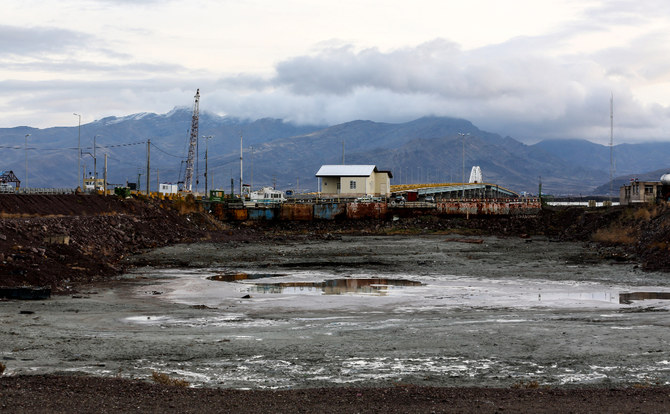
Iran's salt lake of Urmia had been shrinking in one of the worst ecological disasters of the past 25 years. (AFP)
Short Url
Updated 18 July 2022
Follow

Iran arrests several after protests at drying lake

  • Lake Urmia began shrinking in 1995 due to drought and water extraction for farming

TEHRAN: Iranian police have arrested several people for disturbing security after they protested the drying up of a lake once regarded as the Middle East’s largest, official media said Sunday.
Lake Urmia, in the mountains of northwest Iran, began shrinking in 1995 due to a combination of prolonged drought, and the extraction of water for farming and dams, according to the UN Environment Programme.
Urmia, one of the largest “hypersaline” — or super salty — lakes in the world, is located between the cities of Tabriz and Urmia, with more than six million people dependent on agriculture around its shores.
On Sunday, Rahim Jahanbakhsh, the police chief of Iran’s West Azerbaijan province, reported the arrests.

Opinion

This section contains relevant reference points, placed in (Opinion field)

He described the suspects as “many evil and hostile elements, who had no other objective than to destroy public property and disturb the security of the population,” according to state news agency IRNA.
On Saturday, the Fars news agency reported that “dozens of people in the cities of Naghadeh and Urmia had protested against the authorities’ lack of attention to the drying up of Lake Urmia.”
Fars said protesters had shouted slogans in the provincial capital of Urmia warning the lake was shrinking.
“Lake Urmia is dying, parliament orders its killing,” some shouted, Fars reported, with others calling out that “Lake Urmia is thirsty.”
Largely arid Iran, like other nearby countries, has suffered chronic dry spells and heat waves for years, which are expected to worsen with the impacts of climate change.
In the last few months, thousands of people have demonstrated against the drying up of rivers, particularly in central and southwestern Iran.
Lake Urmia is an important ecosystems, a key stopping point for migratory birds, and home to an endemic shrimp as well as other underwater species.

Druze: the great survivors
How the world's most secretive faithhas endured for a thousand years

Enter


keywords

Al-Zubaidi’s political social media post from Abu Dhabi sparks controversy

Updated 7 sec ago
Follow

Al-Zubaidi’s political social media post from Abu Dhabi sparks controversy

  • Former head of STC rallies followers in southern Yemen

JEDDAH: Aidarous Al-Zubaidi, former head of the dissolved Southern Transitional Council, sparked widespread reaction by posting a political message on his official X account after his departure from Yemen.

Observers viewed the post as an indication that he has not withdrawn from political life in Yemen.

According to data on the X platform, the post was published from within the UAE at 12:05 a.m. on Feb. 11, 2026, with the account geolocation feature indicating his presence there at the moment of posting. It is not clear whether Al-Zubaidi personally wrote the post or whether it was written by others.

In his first post in some time, Al-Zubaidi wrote a brief message addressing what he described as “the southern people” at home and abroad. He wrote: “As we salute you, we renew our pledge to you, a pledge of men to men, and we urge you to continue your fight across the various arenas and fields of the revolution, to strengthen your support for your transitional council, and to adhere to the principles of the Constitutional Declaration of the State of South Arabia.” He concluded the message with a prayer for the deceased.

Above, the social media account of Aidarous Al-Zubaidi, former head of the dissolved Southern Transitional Council.

On Jan. 6, Al-Zubaidi informed Saudi authorities of his intention to attend a meeting with the chairman of the Presidential Leadership Council, Rashad Al-Alimi, to discuss the escalatory measures which started on Dec. 3, 2025.

A delegation of STC members, headed by Al-Zubaidi, went to the airport, where the Yemenia Airways flight scheduled to depart at 10:10 p.m. was delayed for more than three hours.

The flight was subsequently allowed to depart, carrying several senior STC leaders; but it departed without Al-Zubaidi, who later fled to an undisclosed location before the details of his escape were revealed in a statement issued by the Arab Coalition to Support Legitimacy on Jan. 8.

Above, a social media posting of Aidarous Al-Zubaidi, former head of the dissolved Southern Transitional Council.

According to the statement, intelligence emerged that Al-Zubaidi, along with others, fled aboard a vessel from the port of Aden shortly after midnight on Jan. 7, heading toward Somaliland in the Federal Republic of Somalia. They switched off the identification system and arrived at the Berbera Port at approximately 12:00 p.m.

It was revealed that Al-Zubaidi contacted an officer known as “Abu Saeed,” later identified as Maj. Gen. Awad Saeed bin Musleh Al-Hababi, commander of joint operations in the UAE Armed Forces, informing him of their arrival, and he was present to receive them.

Al-Zubaidi and those accompanying him boarded a plane that departed without disclosing a destination and landed at Mogadishu Airport at 3:15 p.m., where it remained for an hour before departing across the Arabian Sea and heading toward the Arabian Gulf, without declaring its destination.

The identification system was switched off over the Gulf of Oman and reactivated 10 minutes before landing at Al-Reef Military Airport in Abu Dhabi.