

Grand Mosque distributes 12m liters of Zamzam water to Hajj pilgrims
High-tech smart carts and robots help keep worshippers hydrated over 15 days
Updated 16 July 2022
Nada Hameed
JEDDAH: A total of 12 million liters of Zamzam water were distributed at the Grand Mosque during this year’s Hajj period, according to official figures.
The General Presidency for the Affairs of the Two Holy Mosques said via Twitter on Saturday that the water was distributed over a period of 15 days.
Abdulrahman Al-Zahrani, who manages the Zamzam water department at the mosque, said the total comprised 990,000 liters distributed in the form of 3 million 330ml bottles and 11 million liters from more than 25,000 water containers, each with a capacity of 40 liters.
The containers, distributed throughout the Grand Mosque and its courtyards, were refilled five times a day.
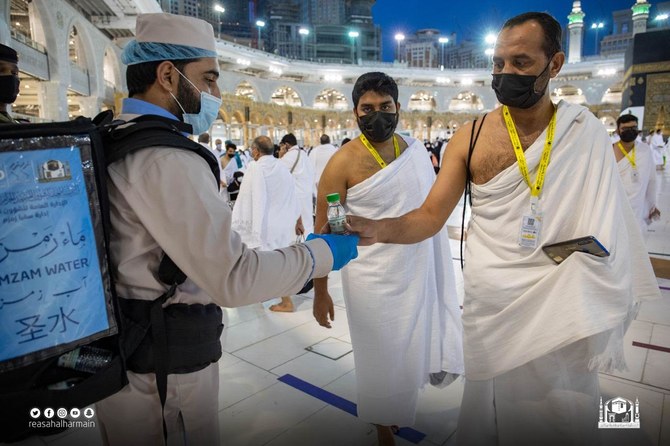
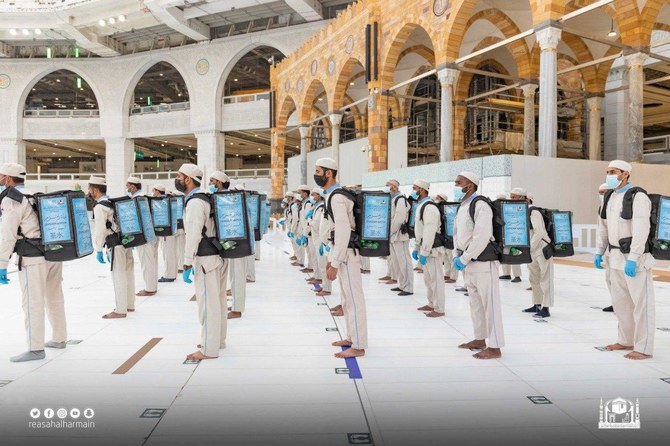
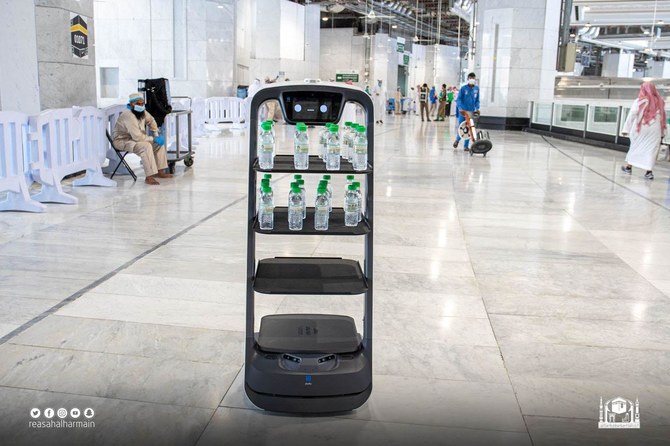
Al-Zahrani said 1,150 workers helped to distribute the bottles, while 80 smart carts and water-dispensing robots were also employed around the mosque to ensure the pilgrims kept hydrated.
All of the carts and bags used to carry the water, were frequently washed and sterilized to ensure good health standards, he added.
The same sanitation protocols were applied to the water pumps, which were supervised by 150 workers, he said.
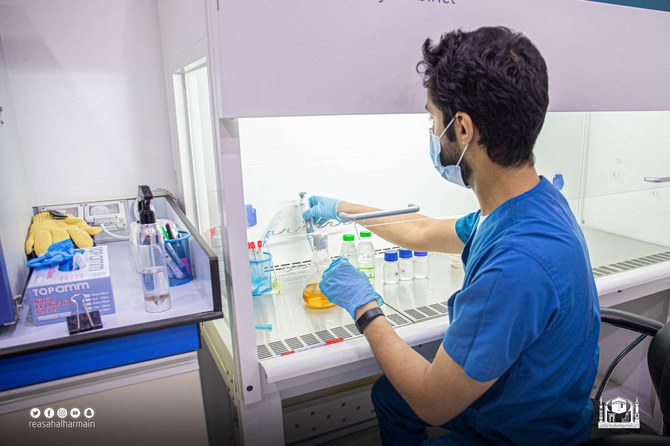
As a further safety measure, employees of the Zamzam water laboratory tested more than 70 samples a day to ensure the water pumped to the Grand Mosque was potable.
Al-Zahrani said technology would increasingly be used in the management and distribution of Zamzam water, in line with the 2024 plan for the presidency — headed by Sheikh Abdulrahman Al-Sudais — and the wider Saudi Vision 2030.
The volume of Zamzam water distributed during the Hajj period was about the same as provided during Ramadan, taking the total for the year to 24 million liters.
Absher Hackathon finalists highlight scale of Saudi tech talent
World’s largest hackathon underscores growing national enthusiasm for tech innovation
Updated 14 December 2025
Ghadi Joudah
RIYADH: Saudi Arabia’s push to position itself as a global hub for digital innovation was on display this weekend as the Absher Tuwaiq Hackathon 2025 — billed as the world’s largest hackathon — concluded with the announcement of finalist teams competing for prizes totaling SR1 million ($266,000).
The three-day hackathon, organized by the Ministry of Interior in partnership with Tuwaiq Academy, brought together innovators from across the Kingdom to develop digital solutions aligned with the ministry’s digital transformation goals.
The finalist teams recognized for their projects were: Shadow, Wusool, Watheeq , Tanabbah, HRS, Ikhlaa, Amal, Mustabiq, Al‑Dahna, Inspire, Saqour Al‑Watan, Thaqib, Sawt Al‑Mustaqbal, Manee, and YS Advance International.
The finalists were announced at the end of the three-day Absher Tuwaiq Hackathon organized by the Ministry of Interior in partnership with Tuwaiq Academy. (AN photo/Supplied)
In addition to cash prizes, the competition offered SR450,000 in support from the National Technology Development Program, along with incubation opportunities at Invi Lab to help teams turn prototypes into market-ready products.
Tariq Al‑Hamid, official spokesperson for the Absher Conference, told Arab News that the hackathon has generated strong momentum nationwide.
This year’s event included more than 4,000 participants from all regions of the Kingdom — “a reflection of the growing national enthusiasm for digital innovation,” he said.
HIGHLIGHT
The Absher Tuwaiq Hackathon brought together innovators from across the Kingdom to develop digital solutions aligned with the ministry’s digital transformation goals.
According to Al‑Hamid, the 2025 event was structured around four specialized tracks: digital identity and security applications; artificial intelligence for predictive and proactive security; Internet of Things applications supporting field operations; and innovations to enhance or expand services on the Absher Platform.
Tariq Al-Hamid (center) said that the hackathon’s impact extends beyond prize money. (Supplied)
He added that this focused approach allowed participants “to present high‑quality ideas and advanced prototypes at levels comparable to international competitions.”
Participants also took part in more than 80 training programs delivered by global partners including Google Cloud, Meta, NVIDIA, and Huawei, an experience Al-Hamid said significantly strengthened both the competition and participants’ skills.
Al-Hamid said that the hackathon’s impact extends beyond prize money. “More important than the cash reward is the opportunity to turn creative ideas into real products that make an impact on citizens, residents, and visitors.”
Standout participants often attract the attention of leading national technology companies seeking new talent, he added.
Participation was open to individuals and teams from across Saudi Arabia, from high school students to industry professionals, highlighting the inclusivity of the event and the breadth of the Kingdom’s innovation ecosystem.
The hackathon forms part of the wider Absher Tuwaiq initiative, a core pillar of the upcoming Absher Conference 2025, which will empower more than 100,000 participants across seven technical tracks in 16 cities, in partnership with 20 local and international organizations.
The conference, organized by the Ministry of Interior and Tuwaiq Academy, sponsored by Elm Company and held in strategic partnership with the Saudi Data and Artificial Intelligence Authority, will take place in Riyadh from Dec. 17 -19.
The event will showcase national digital innovations and reinforce Saudi Arabia’s role in global technology.