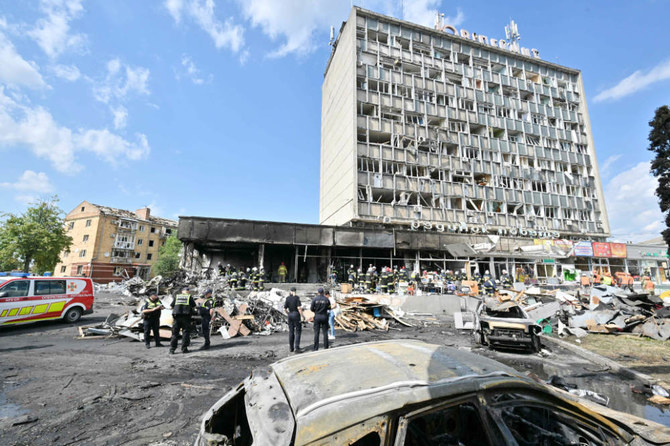

VINNYTSIA, Ukraine: A Ukrainian city far from the frontline grieved its dead from a missile strike, including a 4-year-old girl, as Russian bombardment rained down on towns across the country.
Ukraine said Thursday’s strike on an office building in Vinnytsia, a city of 370,000 people about 200 km (125 miles) southwest of Kyiv, had been carried out with Kalibr cruise missiles launched from a Russian submarine in the Black Sea.
Kyiv said the attack killed at least 23 people and wounded dozens.

Liza Dmitrieva, a 4 year old who died in a Russian missile strike, is pictured in Vinnytsia, Ukraine in this undated handout image. (REUTERS)
The missiles destroyed a nearby medical center and some people arriving for treatment were burnt alive in their cars outside, the owner of the center said. Two doctors were severely wounded.
The attack was the latest in a series of Russian hits in recent weeks using long-range missiles on crowded buildings in cities far from the front, each killing dozens of people.
Late on Friday, Russian missiles hit the central city of Dnipro, killing three people and wounding 15 others, governor Valentyn Reznychenko said on Telegram. Rockets hit an industrial plant and a street next to it, he said. Footage on social media showed thick black smoke rising from the buildings and burning cars.
Eight people were killed and 13 injured in a string of shellings in 10 locations in the eastern Donetsk region, its regional governor, Pavlo Kyrylenko, said in a television interview.
“Right now, as I am writing this address, there is an air alarm over almost the entire territory of our state. There is preliminary information about hits — Dnipro, Kremenchuk, Kyiv region,” Ukrainian President Volodymyr Zelensky said in a Telegram post.
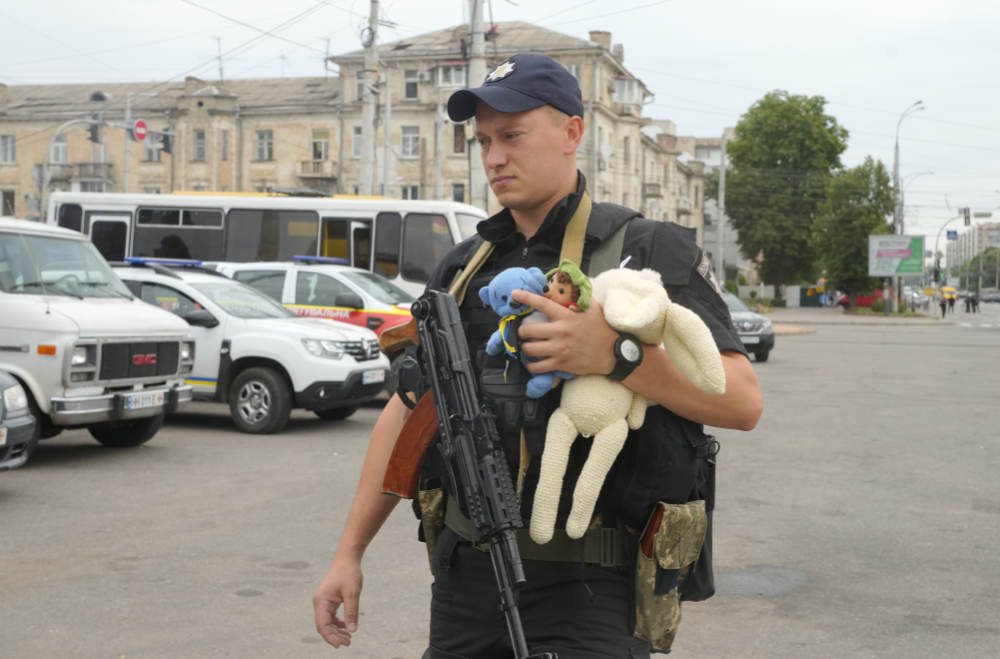
A Ukrainian serviceman carries toys to lay at the site of a Russian shelling on Thursday, in Vinnytsia, Ukraine, Friday, July 15, 2022. (AP)
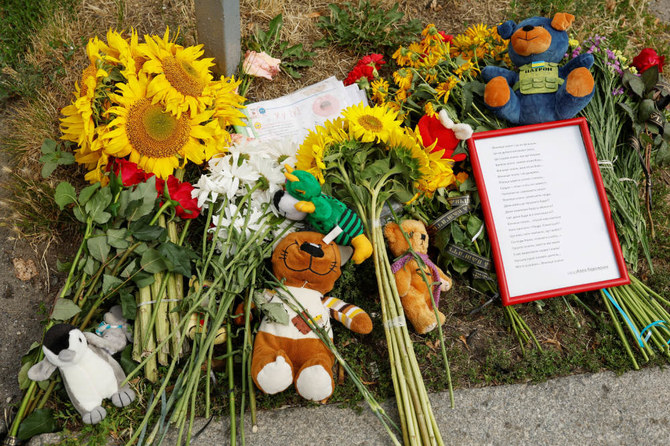
In Vinnytsia, residents placed teddy bears and flowers at a makeshift memorial to those killed in Thursday’s attack.
Among the dead was Liza, a 4-year-old girl with Down’s Syndrome, found in the debris next to a pram. Images of her pushing the same pram, posted by her mother on a blog less than two hours before the attack, quickly went viral.
Her severely injured mother, Iryna Dmitrieva, was being kept in an information blackout at a hospital for fear that finding out about her daughter would kill her, doctors said.
“She is suffering from burns, chest injuries, abdominal injuries, liver and spleen injuries. We have stitched the organs together, the bones were crushed as if she went through a meat grinder,” said Oleksandr Fomin, chief doctor at the Vinnytsia Emergency Hospital. Were she told of her daughter’s death, “we would lose her.”
The building housed an officers’ club, which Russia’s defense ministry said was being used for a meeting between military officials and foreign arms suppliers. It added: “The attack resulted in the elimination of the participants.”
Ukraine said the club functioned as a cultural center. The building also housed shops, commercial offices and a concert hall, where musicians were rehearsing for a pop concert planned for that night.
Authorities in the southern city of Mykolaiv, closer to the frontlines, also reported fresh strikes on Friday which wounded at least two people.
GRAIN PROGRESS
Despite the bloodshed, both sides have described progress toward an agreement to lift a blockade restricting the export of Ukrainian grain. Mediator Turkey has said a deal could be signed next week.
Asked if that timeline was realistic, a senior Ukrainian official told Reuters: “We really hope so. We’re hurrying as fast as we can.” The source asked not to be identified.
Russia’s defense ministry said an agreement was close, but Moscow’s negotiator cautioned that a grains deal will not lead to a resumption of peace talks.
A deal would probably involve inspections of vessels to ensure Ukraine was not bringing in arms and guarantees from Western countries that Russia’s own food exports are exempt from sanctions.
Moscow welcomed a written clarification by Washington on Thursday that banks, insurers and shippers would not be targeted by sanctions for facilitating shipments of Russian grain and fertilizer.
The war dominated a meeting of G20 finance ministers in Indonesia on Friday. The conflict involving two of the world’s top grain exporters and one of its main oil and gas producers is causing global shortages of food and energy, inflation, financial crisis and, potentially, hunger.
“By starting this war, Russia is solely responsible for negative spillovers to the global economy, particularly higher commodity prices,” US Treasury Secretary Janet Yellen said.
Russia calls its Feb. 24 intervention a “special military operation” to disarm Ukraine and root out nationalists. Kyiv and its allies call it an attempt to reconquer a country which broke free of Moscow’s rule in 1991.
The stepped-up Russian attacks on cities far from the front come at a time when momentum appears to be shifting after weeks of Russian gains.
Since capturing the eastern industrial cities of Sievierodonetsk and Lysychansk in battles that killed thousands of troops on both sides, Russia has paused. A Ukrainian general said Kyiv had not lost “a single meter” of territory in a week.
Ukraine has meanwhile unleashed new HIMARS rocket systems received from the United States, striking targets deep in Russian-held territory. It appears to have blown up depots of ammunition Moscow relies on for massive artillery barrages.
The first M270 systems that will give Ukraine additional multi-rocket firepower have arrived in the country, Ukraine’s defense minister said on Friday.
Ukraine says it is preparing a counter-attack in coming weeks to recapture a swath of southern territory near the Black Sea coast.