

Biden arrives in Saudi Arabia, holds ‘important discussions’ with king, crown prince

1 / 11
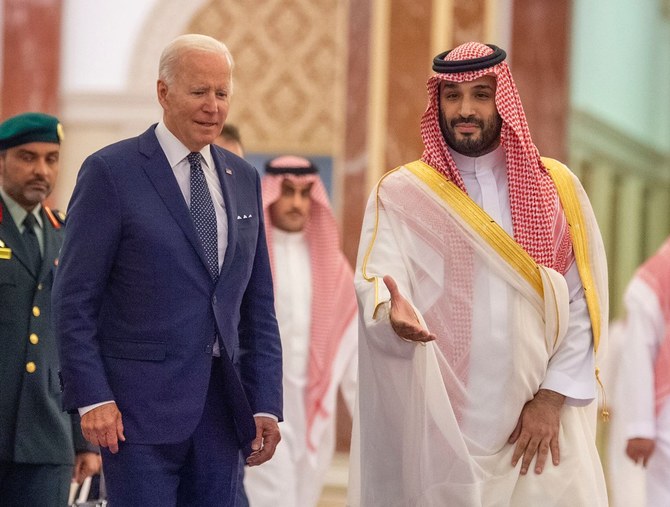
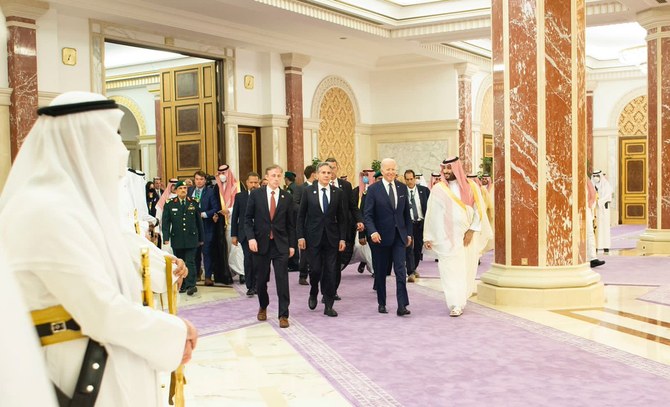
Joe Biden received at Al-Salam Palace in Jeddah by Crown Prince Mohammed bin Salman. (SPA)
2 / 11
Joe Biden received at Al-Salam Palace in Jeddah by Crown Prince Mohammed bin Salman. (SPA)
3 / 11
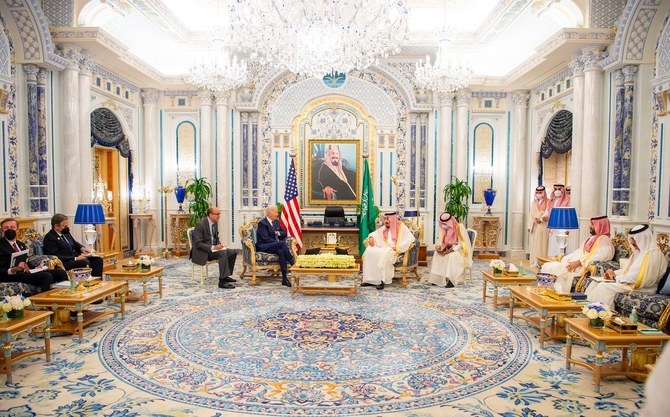
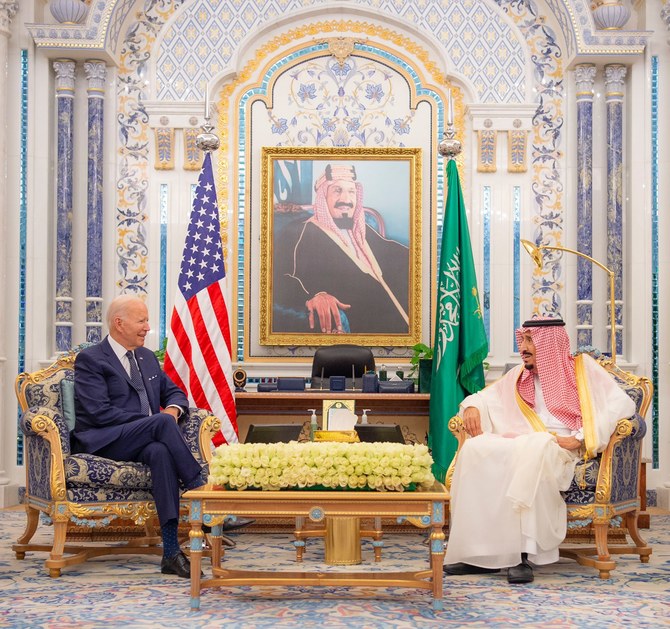
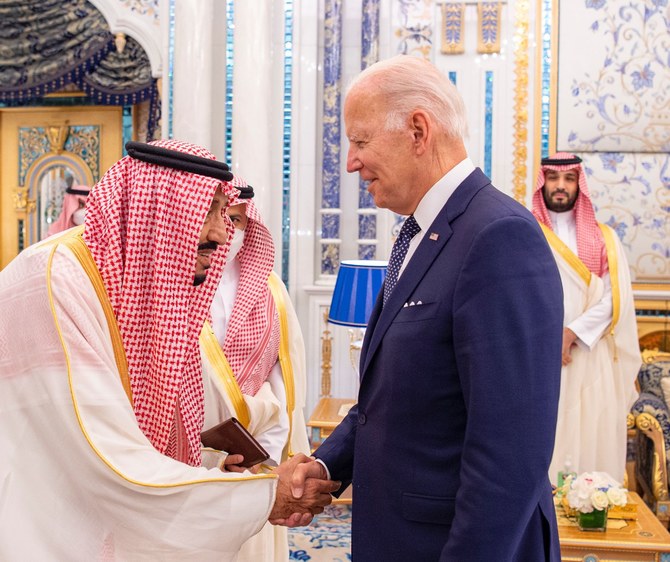
US President Joe Biden and Saudi Arabia's King Salman meeting at Al-Salam Palace in Jeddah. (SPA)
4 / 11
US President Joe Biden and Saudi Arabia's King Salman meeting at Al-Salam Palace in Jeddah. (SPA)
5 / 11
US President Joe Biden and Saudi Arabia's King Salman meeting at Al-Salam Palace in Jeddah. (SPA)
6 / 11
US President Joe Biden and Saudi Arabia's King Salman meeting at Al-Salam Palace in Jeddah. (SPA)
7 / 11
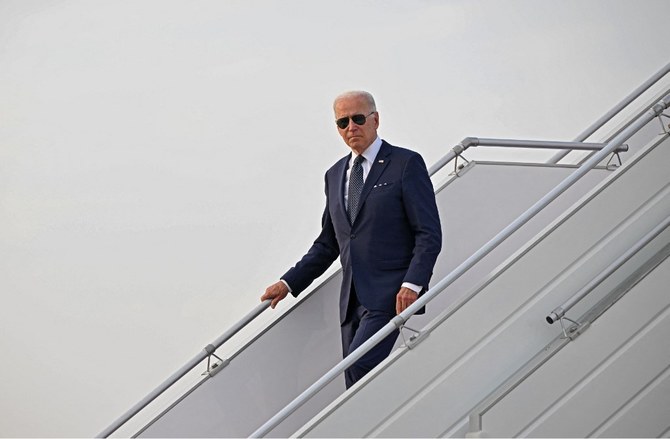
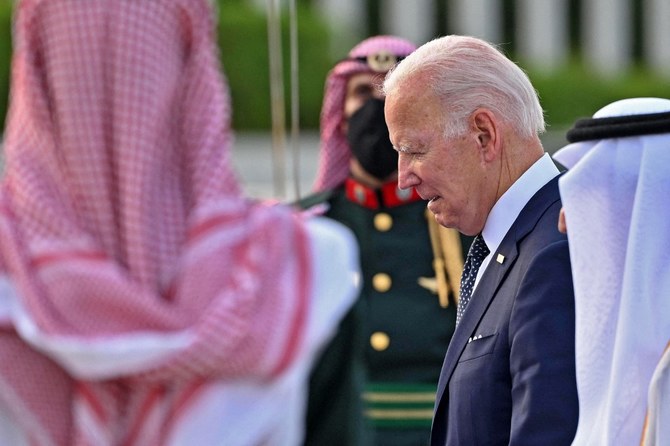
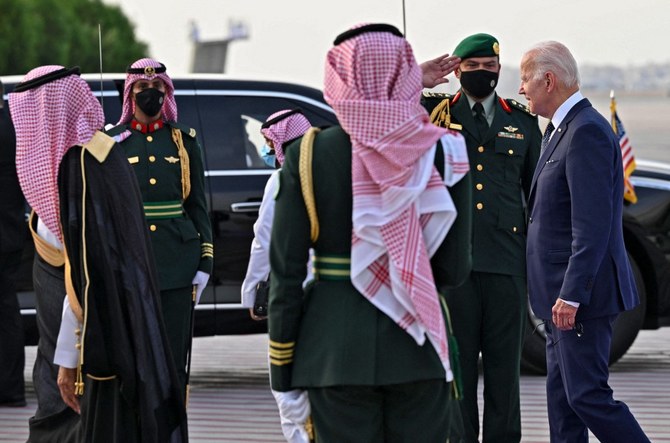
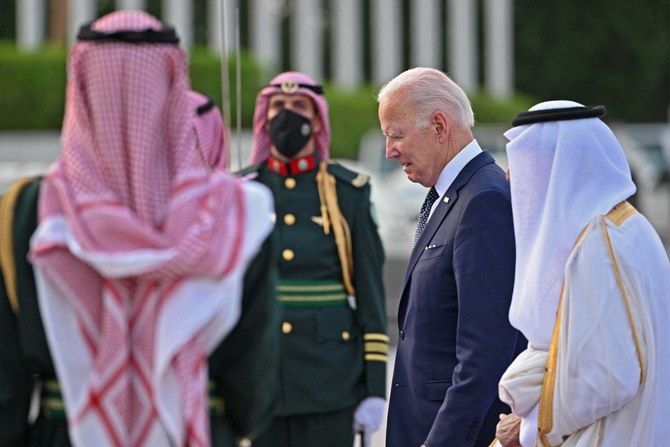
US President Joe Biden is welcomed at the King Abdulaziz International Airport in the Saudi coastal city of Jeddah, upon his arrival from Israel. (AFP)
8 / 11
US President Joe Biden is welcomed at the King Abdulaziz International Airport in the Saudi coastal city of Jeddah, upon his arrival from Israel. (AFP)
9 / 11
US President Joe Biden is welcomed at the King Abdulaziz International Airport in the Saudi coastal city of Jeddah, upon his arrival from Israel. (AFP)
10 / 11
US President Joe Biden is welcomed at the King Abdulaziz International Airport in the Saudi coastal city of Jeddah, upon his arrival from Israel. (AFP)
11 / 11
US President Joe Biden is welcomed at the King Abdulaziz International Airport in the Saudi coastal city of Jeddah, upon his arrival from Israel. (AFP)
Short Url
Updated 16 July 2022
Follow

Biden arrives in Saudi Arabia, holds ‘important discussions’ with king, crown prince

  • Biden said talked about several issues with King Salman and Crown Prince Mohammed bin Salman
  • Saudi Arabia’s security needs and global energy issues were discussed

RIYADH: US President Joe Biden arrived in Saudi Arabia on Friday, the latest stop on his first Middle East tour as US leader, where he met with the Kingdom’s leadership.

In a speech made from his Jeddah hotel on Friday evening, Biden said he had held “important discussions” with King Salman and Crown Prince Mohammed bin Salman.

He praised the role the Kingdom played in the “stabilization” of Yemen and its support of a UN-brokered ceasefire, adding: “I agreed with the Saudi leadership to deepen and extend it.”

Biden announced that peacekeeping forces in Tiran and Sanafir will leave their positions, which he said would contribute to the development of the islands for investments and tourism.
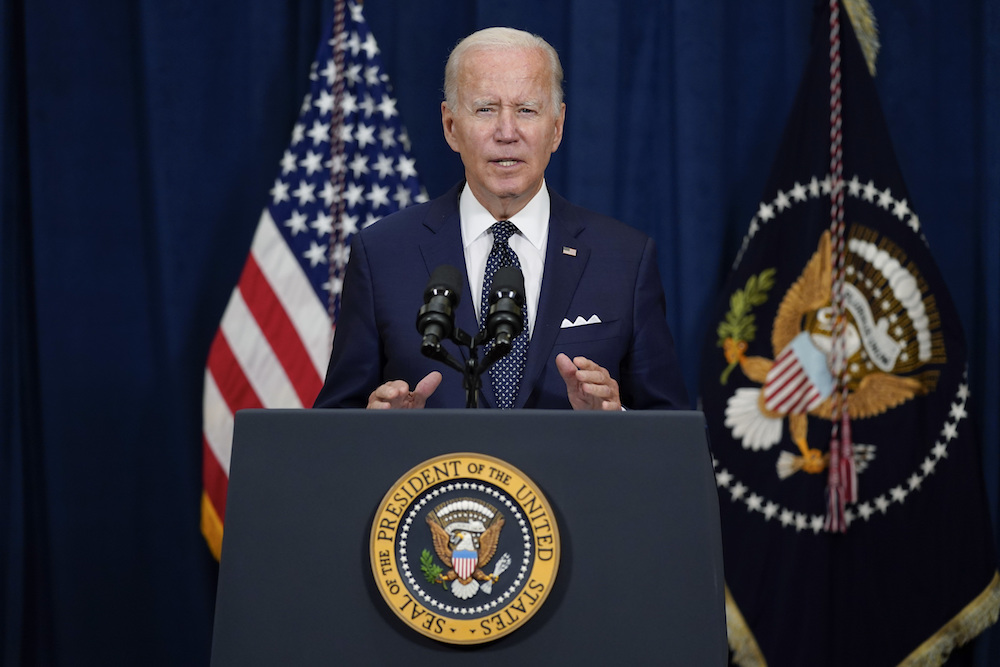


Biden delivers a statement to reporters at the Waldorf Astoria Jeddah Qasr Al-Sharq hotel, after meetings with Saudi Crown Prince Mohammed bin Salman. (AP)

He added that Saudi Arabia’s security needs and global energy issues were also discussed, including cooperation on clean energy initiatives.

Biden arrived at King Abdulaziz International Airport in the Red Sea port city of Jeddah on the third day of a four-day swing through the Middle East, where he was received by Makkah Gov. Prince Khalid Al-Faisal and the Saudi ambassador to the US Princess Reema bint Bandar.

He then met with the king, where they reviewed the historical relations between Saudi Arabia and the US and ways to strengthen them to serve the interests of the two countries in various fields, the official Saudi Press News Agency reported.

He spent the first two days meeting with Israeli officials and traveled to the West Bank on Friday to meet with Palestinian Authority President Mahmoud Abbas and others before flying to Saudi Arabia.

Biden also met with Crown Prince Mohammed bin Salman at Al-Salam Palace, where they also discussed aspects of bilateral cooperation in a number of fields, and ways to confront regional and international challenges.

The talks were attended by Minister of Energy Prince Abdulaziz bin Salman, Minister of Sport Prince Abdulaziz bin Saud bin Nayef, Minister of Interior Prince Abdulaziz bin Saud bin Naif, Saudi ambassador to the US Princess Reema bint Bandar, and Foreign Minister Prince Faisal bin Farhan, along with a number of other senior officials.

The meeting was also attended by US Secretary of State Antony Blinken, National Security Adviser Jake Sullivan, and US envoy to Yemen Tim Lenderking.

Biden also will take part in a Saturday gathering of leaders from the Gulf Cooperation Council — Bahrain, Kuwait, Oman, Qatar, Saudi Arabia and the UAE — before returning to Washington. The leaders of Mideast neighbors Egypt, Iraq and Jordan are also to attend.
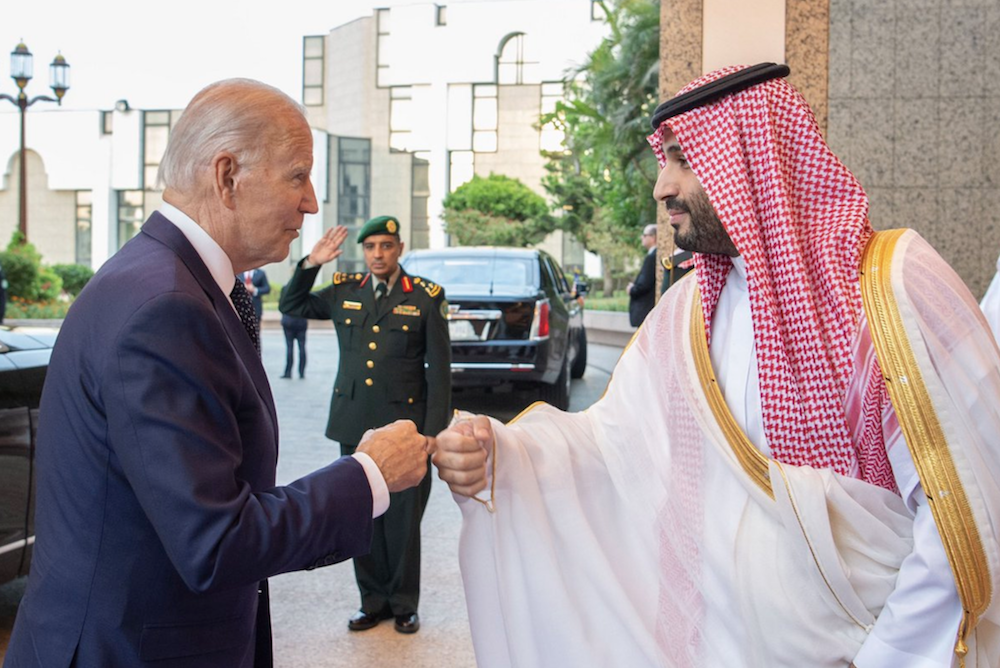


Biden being received at Al-Salam Palace in Jeddah by Crown Prince Mohammed bin Salman ahead of their meeting. (SPA)

The Saudi leadership paved the way for Israeli planes to use its airspace by announcing it was lifting restrictions on “all carriers,” a move welcomed by Biden as “historic.”

“Saudi Arabia’s decision can help build momentum toward Israel’s further integration into the region, including with Saudi Arabia,” the US leader said.

Biden’s direct flight is the first by an American president from Israel to Saudi Arabia.

(With AFP and Reuters)


Games and street flavors celebrate community spirit during Ramadan

Neighborhoods across Jeddah transform into lively hubs of laughter and friendly competition at night during Ramadan.
Updated 55 min 2 sec ago
Follow

Games and street flavors celebrate community spirit during Ramadan

  • Beyond the spiritual reflection of the holy month, long-held traditions — from classic games to humble food stalls — continue to bring families and communities together

JEDDAH: As night falls during Ramadan, neighborhoods across Jeddah transform into lively hubs of laughter, friendly competition and the aroma of sizzling street food. 

Beyond the spiritual reflection of the holy month, long-held traditions — from classic games to humble food stalls — continue to bring families and communities together.

For many, Ramadan evenings are incomplete without traditional games that once defined social life after iftar and Taraweeh prayers. 

While digital entertainment has become widespread, classics such as carrom and baloot still hold their place in homes and gathering spots.

Carrom, a tabletop game with roots in the Indian subcontinent, remains a favorite across generations. 

Played on a square wooden board with four corner pockets, the game challenges players to flick colored discs into the pockets using precise finger movements. Two or four players compete, and victory goes to the side that collects the highest score. Its mix of patience and strategy makes it ideal for long Ramadan nights.

Baloot, a trick-taking card game widely enjoyed in Saudi Arabia and across the Gulf, is another staple. Played by two teams of two using a 32-card deck, the game requires coordination and quick thinking. The first team to reach 152 points claims the win, often after hours of animated rivalry. 

Yasser Al-Soufi, who organizes late-night baloot games in Al-Balad, said: “Every night from 10 to 12, people gather to play baloot and enjoy some social time together. It’s a wonderful way for friends and neighbors to connect, laugh and share the spirit of Ramadan.”

Alongside these classics, families are also embracing newer Ramadan-themed games designed to blend fun with learning. 

Stores such as Akwan offer interactive games including the Ramadan Memory Game, which introduces children to Arabic culture while boosting memory and cognitive skills, and Tharaba Cards, a set of 50 educational cards teaching polite expressions, manners and everyday social phrases across themes such as daily life, hospitality, gratitude and special occasions.

Founder Lujain Abulfaraj told Arab News: “We design child-centered toys that help little ones feel connected to their culture, language and the spirit of Ramadan through playful, meaningful experiences. 

“Our Ramadan collection is created to plant seeds of generosity, gratitude, social awareness and pride in identity. It includes Little Dailies (Buthoor Al-Khair) for practicing conscious acts of kindness; the Dallah toy, which celebrates hospitality through role-play and coffee-serving etiquette, and an Athkar book that holds daily prayers children can recite throughout their day.”

The brand also offers free Ramadan printables on their website.

Sarah Laban, a mother of three, said: “I first discovered these games during Hayy Jameel’s Ramadan Nights and since then, buying Ramadan program cards from Akwan for my children has become a family tradition. Playing memory and trivia games together makes learning about our faith fun, and it’s wonderful to see my kids laugh, explore and connect with Islamic history in a meaningful way.”

Additionally, Jarir Bookstore offers Islamic trivia cards covering key events from the life of Prophet Muhammad, the companions, and the names of Allah, as well as Islamic history and the virtues of the holy month, encouraging children and adults alike to test their knowledge in an engaging and meaningful way.

Another growing favorite is Ramadan bingo, where traditional numbers are replaced with words and themes linked to the month, such as fasting, charity, prayer and patience. 

As family members mark off squares, conversations naturally turn toward the values and stories behind each term, making the activity both entertaining and meaningful. 

Deena Rahman, who organizes the game at least twice a week, said: “I invite my friends and family to join me at a cafe, enjoy some coffee, and play Ramadan bingo together. These gatherings bring my family closer and allow us to talk more openly without hesitation. Since Ramadan is all about forgiveness and moving forward, the game becomes a wonderful way to strengthen bonds and reconnect in a meaningful way.”

While homes echo with the sounds of competition and learning, the streets outside come alive with food stalls that reflect the spirit of togetherness.

Opposite a shopping center in Makronah, Abu Saad stands over a hot pan, preparing fried liver, a staple during the month. 

Speaking to Arab News, he said: “We serve the fresh fried liver straight to customers’ tables and truly enjoy it. With the pleasant weather this year, I was able to expand my stall with tables and chairs to offer a better experience. My father started this as a small street-side cart, and I’m hoping to grow it into something more profitable.”

Despite rising costs of ingredients such as oil, liver and vegetables, many vendors say they try to keep prices stable to serve the community. Among the most recognizable Ramadan street foods is balila, a warm chickpea dish seasoned with cumin, vinegar and pickles often sold from seasonal “basta” pop-ups. French fries have also become a late-night favorite and a staple of late-night strolls.

Traditional drinks such as sobia, Qamar Al-Din, karkadeh and Vimto complete the Ramadan street scene, with many carts offering them alongside their snack selections.

Sultan Mohammed, who runs a food cart in Al-Zahrah district, said: “My friend and I started this because we love learning about new people and traditions, sharing food, and giving a little something for free. After all the hard work, it’s always rewarding to see people enjoying it. 

“Every year, we plan to introduce something new while keeping our products fresh and healthy. This year, we’ll be serving French fries, balelah fish, chips, shrimp, kebda, and of course, sobia. We’ll be open from 9 a.m. to 3 p.m the entire Ramadan.”

Seasonal stalls are deeply rooted in Hijazi culture, with young people often stepping in to keep traditions alive. In Ruwais district, 19-year-old Mohammed Saeed and his six friends operate a tea and coffee stand throughout the month. 

“We are a group of seven young people and run this stall in our area to keep the Ramadan spirit alive. We open our stalls immediately following Isha prayers and continue till 3:30 a.m.,” he said.