


RIYADH: On Saturday, Ons Jabeur stood at Wimbledon Center Court and tearfully wished the people around the world a happy Eid Al-Adha.
Throughout the Arab world, and beyond, there was a collective breaking of hearts. Almost a week on from the Wimbledon Ladies final loss to Elena Rybakina, and those hearts are, just maybe, starting to heal.
And the Minister of Happiness is smiling again.
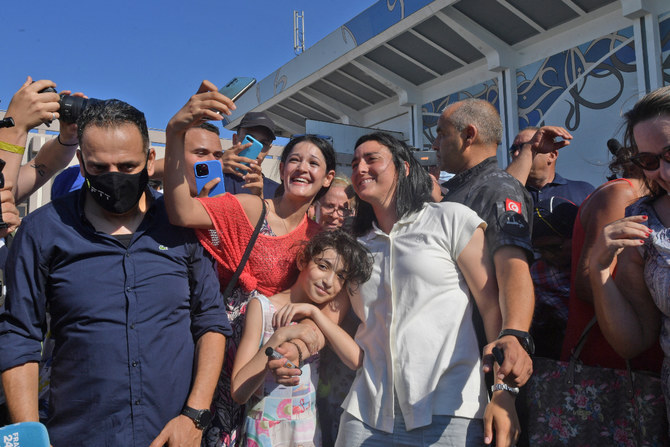
On Wednesday, she received a hero’s welcome on her return to Tunisia, and a day later she was presented with the Order of Merit by the country’s President Kais Saied.
Professionally, the world No. 2 — despite becoming the first Arab and African to reach a Grand Slam final — will no doubt carry the scars of that loss a little longer.
But, in time, she — and her fans — will look back on those two weeks in southwest London as a monumental and joyous achievement.
It is always best to guard against hyperbole, but there is a case to be made that the Tunisian hero is one of the greatest Arab athletes of all time, if not the greatest.
While a select few may have claim to that title, what Jabeur has done in her sport over the last two years is arguably unmatched by any other Arab, male or female, perhaps with the exception of Egyptian footballer Mohamed Salah.
Certainly, in an individual sport, few can rival her achievements.
Of course, there has been some supreme, if rare, Arab feats at Olympic and international level.
Who can forget Moroccan Nawal Al-Moutawakel’s charge to win the first ever women’s 400 meters hurdles event at the 1984 Olympics in Los Angeles, followed by her tearful coronation on the podium?
Or compatriot Said Aouita’s legendary 800 meters and 5,000 meters wins at the same games 38 years ago?
Another Moroccan, Khalid Skah, stormed to a memorable 10,000 meters gold medal at the Barcelona Games in 1992, while Algeria’s Noureddine Morceli won the 1,500 meters gold at the 1996 Atlanta Olympics, as well as three world titles at the distance. He also held the world record for the 1,500 and 3,000 meters.
But while those fellow North African athletes peaked at high-profile Olympic Games and are rightly considered legends in their own nations and throughout the Arab world, they seem to belong to a bygone era. None have had the global name recognition Jabeur is enjoying now.
Medals during the 2000s were few and far between for Arab athletes, an indictment of the systems which, with the right funding and backing, could produce champions, but that all too predictably and sadly do not, be it for political, cultural, or economic reasons.
At the delayed 2020 Japan Olympics last year, Arab athletes collected 18 medals. Impressive only in that it was a record haul, beating the previous mark of just eight at the 2004 Games in Athens.
There were some outstanding performances; Hedaya Malak of Egypt won a gold in the women’s taekwondo, while Saudi Arabia’s Tarek Hamdi was cruelly denied a sensational gold in the men’s karate competition due to a disqualification in the final. His silver was still enough to see him return home a hero.
And there was Jabeur’s compatriot Ahmed Hafnaoui, the gifted 18-year-old who stunned the world by taking gold in swimming’s 400-meter freestyle competition.
But even with the best will in the world, however, such outstanding achievements have not elevated these young champions to global fame. At least not yet.
Jabeur, on the other hand, is now one of the most famous people on the planet.
But are image, popularity, and goodwill in themselves enough to make her the best Arab athlete of all time?
Of course not. But her results on the court make her a contender.
Ironically, after losing such a high-profile final, what Jabeur is doing is normalizing winning for an Arab tennis player, an Arab athlete. Normalizing being one of the best in her field in the way that footballers Salah and Riyadh Mahrez have become among the world’s greatest in theirs.
What differentiates Jabeur is that she is charging to the top of one of the world’s most popular individual sports. And when was the last time that could be said of an Arab athlete?
Jabeur made history as the first Tunisian, Arab, or African to win a Women’s Tennis Association 1000 title when she claimed the Madrid Open in May, her second WTA title.
Her clear, utter devastation at losing the Wimbledon final showed just how far Jabeur has come, and how quickly our, and her own, expectations have risen in such a short period of time. She believed it was “her title,” and that is the mentality needed to be a champion.
For too long now this part of the world has, with a few exceptions, contented itself with simply taking part.
The first man ever to take part in this, the first ever female in that, the first at the Olympics, and so on. But as we celebrate these important but ultimately modest landmarks, the rest of the world is racing ahead in terms of excellence.
The time has come to compete, and win, at the highest level and in that sense, Jabeur has not only moved the line, but she has also obliterated it.
For Arab sports women and men, simply taking part should not be the extent of their ambition. And for that, we have the Minister of Happiness to thank.


