

China In-Focus — Yuan touches 2-month low; Property shares slide; Asian giant’s economy sinks

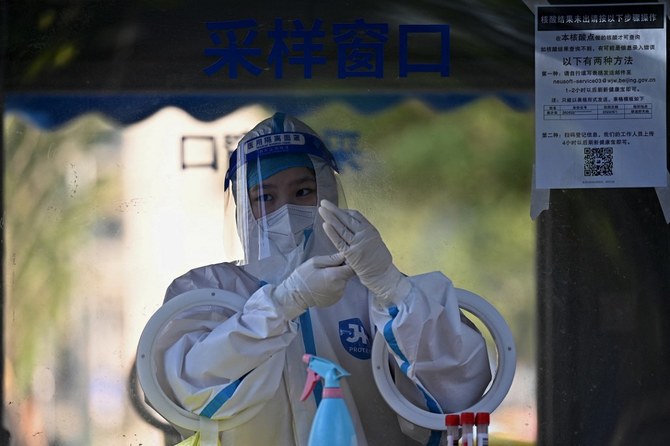
A health worker is seen at a swab collection booth for Covid-19 coronavirus in Beijing on July 6, 2022. (AFP)
Short Url
Updated 15 July 2022
Follow

China In-Focus — Yuan touches 2-month low; Property shares slide; Asian giant’s economy sinks

RIYADH: China’s yuan touched a two-month low against the dollar on Friday and looked set for its biggest weekly drop since May, as much weaker-than-expected economic growth data raised doubts about this year’s growth target.

China’s economy contracted sharply in the second quarter from the previous quarter while annual growth also slowed significantly, highlighting the colossal toll on activity from widespread COVID-19 lockdowns, which jolted industrial production and consumer spending.

Prior to the market opening, the People’s Bank of China set the midpoint rate at 6.7503 per dollar, weaker than the previous fix of 6.7265.

In the spot market, the onshore yuan opened at 6.7505 per dollar and eased to a low of 6.77, the weakest level since May 17. By midday, it was changing hands at 6.7663, 82 pips softer than the previous late session close.

Property shares edge down

China stocks edged down on Friday, dragged by property developers, as homebuyers’ threats to stop mortgage payments on unfinished apartments dented sentiment, despite Beijing’s assurance to solve the crisis.

Losses were capped by strong performance in consumer stocks, after data showed a surprising rise in retail sales, and as dismal economic growth in the second quarter raised expectations of more stimulus.

The CSI300 index fell 0.1 percent, to 4,320.11 points at the end of the morning session, while the Shanghai Composite Index lost 0.2 percent, to 3,273.87 points.

The Hang Seng Property Index, tracking a group of mainland-based property developers, fell 1.2 percent by the midday trading break on Friday, dragging the Hong Kong benchmark index down 1.2 percent. 

Among those hardest hit, shares in Longfor Group Holdings Ltd were down 4.5 percent, while Country Garden Holdings Co. Ltd. fell 5.5 percent by the midday break.

Chinese economy sinks in Q2

China’s economy contracted sharply in the second quarter, highlighting the colossal toll on activity from widespread COVID lockdowns and pointing to persistent pressure over coming months from a darkening global growth outlook.

Gross domestic product fell 2.6 percent in the second quarter from the previous quarter, official data showed, compared with expectations for a 1.5 percent decline and a revised 1.4 percent gain in the previous quarter.

On a year-on-year basis, GDP in the April-June quarter grew a tepid 0.4 percent, missing forecast of a 1.0 percent gain, according to a Reuters poll of analysts, a sharp slowdown from 4.8 percent in the first quarter.

For the first half of the year, GDP grew 2.5 percent, well below the government’s target of around 5.5 percent growth for this year.

H1 refinery output in first annual decline since at least 2011

China’s refinery throughput for the six months to June marked the first annual decline for the period since at least 2011, data showed on Friday, as strict COVID-19 restrictions and fuel export curbs dampened production.

For June, output was 54.94 million tons, according to data from the National Bureau of Statistics, bringing January-June processing volumes to 332.22 million tons or 13.4 million barrels per day, down 6 percent from a year earlier.

The production in June was equivalent to 13.37 million bpd — up 5 percent from 12.7 million bpd in May, but about 10 percent below the all-time high of 14.8 million bpd reached in June 2021.

The month-on-month rebound came as some independent refiners began raising production late in May, after steep cuts between February and April, in response to a moderate pick up in demand as some COVID-19 curbs were eased.

The return of Sinopec Corp’s Yangzi and Hainan refineries from overhauls also contributed to the higher processing, though the state major had to close a 320,000 bpd plant in Shanghai due to a fire on June 18. 

Production in the first six months rose 4 percent versus a year earlier to 102.88 million tons, as national oil firms accelerated developing conventional and unconventional resources on Beijing’s call to boost domestic supply security.

Despite record production, the increase remains marginal as China imports nearly three-quarters of its crude oil needs

Growth in natural gas production, however, slowed to 0.4 percent in June from a year earlier to 17.3 billion cubic meters, but output year-to-date rose 4.9 percent.

(With input from Reuters) 


Saudi Aramco achieves significant progress in its gas production plan

Updated 26 February 2026
Follow

Saudi Aramco achieves significant progress in its gas production plan

RIYADH: Saudi Aramco has announced the achievement of significant progress in its plan to expand gas production, with the start of production at the Jafurah field, the largest unconventional gas field in the Middle East, and the commencement of operational activities at the Tanajib Gas Plant, one of the largest gas plants in the world.

The oil giant aims to increase its sales gas production capacity by approximately 80 percent by 2030 compared to 2021 production levels, reaching nearly 6 million barrels of oil equivalent per day from total gas and associated liquids production, according to the Saudi Press Agency.

This is expected to generate additional operating cash flows ranging between $12 billion and $15 billion in 2030, subject to future demand for sales gas and liquids prices.

President and CEO of Saudi Aramco, Amin Al-Nasser, said: “We are proud to commence production at the Jafurah field and begin operations at the Tanajib Gas Plant. These are major achievements for Saudi Aramco and the future of energy in the Kingdom. Our ambitious gas program is expected to become a key source of profitability.”

He affirmed that these mega-projects contribute to meeting the growing domestic demand for gas, supporting industrialization and development in several key sectors, in addition to producing significant quantities of high-value liquids.

Al-Nasser expressed his gratitude for the support, trust, and attention that Saudi Aramco receives from the Custodian of the Two Holy Mosques, King Salman bin Abdulaziz Al Saud, and His Royal Highness Prince Mohammed bin Salman bin Abdulaziz Al Saud, crown prince and prime minister, noting that this has had the most profound impact on the company’s achievements and distinguished projects that serve the Kingdom’s Vision 2030.

The gas extracted from the Jafurah field is expected to support the Kingdom’s growth targets in key sectors such as energy, artificial intelligence, major industries, and petrochemicals, potentially providing a major boost to the Kingdom’s economy and strengthening its position among the world’s top ten gas producers.

Saudi Aramco began first producing unconventional shale gas from the Jafurah field in December 2025, with technology playing a pivotal role in unlocking the potential of the Jafurah field and establishing it as a global benchmark for unconventional gas development. 

Since its inception, the project has leveraged technology to help reduce drilling and stimulation costs and enhance well productivity, contributing to its strong economic prospects.

The Jafurah area covers 17,000 sq. km and is estimated to contain 229 trillion standard cubic feet of raw gas and 75 billion barrels of condensates. The Jafurah field project aims to produce 2 billion standard cubic feet per day of sales gas, 420 million standard cubic feet per day of ethane, and approximately 630,00 barrels per day of gas liquids and condensates by 2030.

The Tanajib Gas Plant is a key pillar in Aramco’s strategy to increase gas processing capacities and diversify its energy product portfolio, helping to foster long-term economic growth. 

Operations began in December 2025, and its raw gas processing capacity is expected to reach 2.6 billion standard cubic feet per day in 2026. The start of operations at the Tanajib Plant coincided with the commencement of production from the Marjan field expansion and development program. 

The plant is distinguished by its digital integration, enhanced operational efficiency, capability to execute complex projects, and optimal use of resources. It processes raw gas associated with crude oil production from the offshore Marjan and Zuluf fields.

Aramco’s gas expansion is expected to create thousands of direct and indirect job opportunities, generating significant added value and strengthening its position as a reliable energy provider. 

It also helps meet the growing demand for natural gas and enhances its supply to national industries. 

The expansion strategy supports efforts aimed at achieving the optimal energy mix for local electricity generation, advancing the Kingdom’s liquid fuel displacement program, which will have a positive environmental impact, supporting the Kingdom’s ambition to achieve net-zero emissions by 2060, enhancing energy security, and contributing to building a more diversified national economy.