

Melilla migrants likely died of ‘suffocation’: Moroccan probe

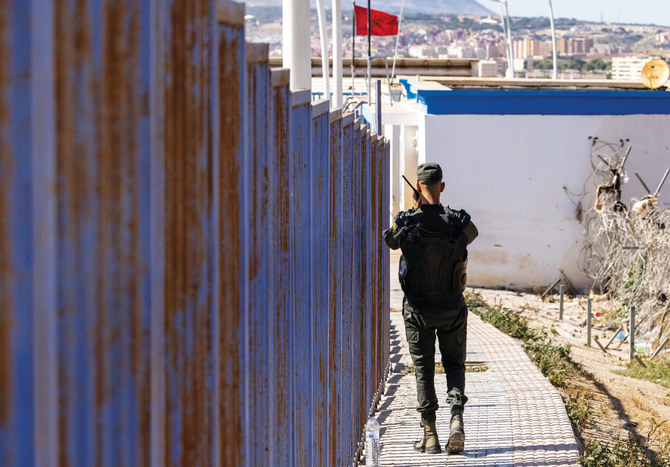
Moroccan security forces guard patrols the border fence separating Morocco and Spain’s North African enclave of Melilla. An attempt by migrants to storm the barrier between Morocco and Melilla resulted in ‘unprecedented violence’ last month. (AFP)
Short Url
Updated 15 July 2022
Follow

Melilla migrants likely died of ‘suffocation’: Moroccan probe

  • CNDH cites the danger posed by ‘large number of migrants’ carrying sticks and stones

RABAT: At least 23 migrants who died last month in a mass attempt to enter the Spanish enclave of Melilla from Morocco likely “suffocated,” Morocco’s state-backed CNDH rights group said.

The death toll after around 2,000 people, many from Sudan, stormed the frontier on June 24 was the worst in years of attempted migrant crossings into Spain’s Ceuta and Melilla enclaves, which have two of the EU’s only land borders with Africa.

Adil El-Sehimi, a doctor who examined the bodies during a CNDH fact-finding mission, said the migrants had most likely died of “mechanical asphyxiation,” when a force or object prevents a person from breathing.

CNDH chief Amina Bouayach said 23 migrants had died in the incident, confirming the official toll.

None of the dead have been buried and autopsies were pending, Bouayach told a press conference in Rabat to present the initial findings of the CNDH probe.

Spanish rights group Caminando Fronteras says as many as 37 people lost their lives.

Five days after the incident, Human Rights Watch (HRW) cited “reports that the authorities in Morocco may be organizing hasty mass burials,” along with photographic evidence of recently dug graves in nearby Nador.

The CNDH said large numbers of migrants, “armed with sticks and stones ... split into two groups: The first stormed a border post closed since 2018 and the second climbed nearby walls topped with barbed wire.”

It said that the dead had been crushed in part of a border post, where manual turnstiles allow the passage of a single person at a time.

“A large number of migrants found themselves crammed into this narrow area, resulting in jostling which led to migrants suffocating,” it said.

The UN, the African Union and independent rights groups have denounced the use of excessive force by Moroccan and Spanish security personnel.

HRW said a video showed a Moroccan security agent “beating obviously injured men prone on the ground and another agent throwing a limp body onto a pile of people.”

The CNDH defended Moroccan forces’ actions, saying such cases were “isolated” and citing the danger posed by “the large number of migrants” carrying sticks and stones.

“Law enforcement did not use any firearms,” it added.

Also Wednesday, the trial opened in Nador of a group of 29 migrants, including a minor, accused of “illegal entry onto Moroccan territory” as well as “violence against law enforcement officers” and “participating in a criminal gang with a view to organizing and facilitating” irregular migration.

The prosecution presented “medical certificates of members of the security forces hurt during the clashes. The judge decided to summon them,” said Khalid Ameza, a lawyer for the accused.


Spain highlights importance of Gaza reconstruction

Palestinian prime minister, Mohammed Mustafa, and the Spanish foreign minister, Jose Manuel Albares. (AP)
Updated 02 January 2026
Follow

Spain highlights importance of Gaza reconstruction

  • Spain officially recognized Palestine as a state in May 2024, in a coordinated move alongside Ireland and Norway

RAMALLAH: The Palestinian prime minister, Mohammed Mustafa, and the Spanish foreign minister, Jose Manuel Albares, on Friday discussed the latest developments in the West Bank and Gaza Strip.
During their telephone conversation they emphasized the need to intensify international efforts to end the Israeli occupation and halt attacks and settler violence, and to secure the release of Palestinian funds held by Israeli authorities.
They affirmed the importance of ongoing efforts relating to plans for the reconstruction of Gaza, and Europe’s significant role in this process. Mustafa and Albares highlighted the need to unify Palestinian institutions in Gaza with those in the West Bank, with the aim of establishing a Palestinian state in line with international resolutions, including last year’s New York Declaration.
They also discussed coordination between their countries, and the strengthening of Spain’s political, diplomatic and financial support for Palestine, and Mustafa thanked Spain for its ongoing support.
Spain officially recognized Palestine as a state in May 2024, in a coordinated move alongside Ireland and Norway. Estephan Salameh, the Palestinian finance and planning minister, is set to visit Spain this month to discuss enhanced cooperation, particularly in the areas of development and reconstruction. Meanwhile, Israel continues operating in the occupied West Bank.
The Palestinian Prisoners media office said on Friday that Israel carried out numerous raids across the territory, including the major cities of Ramallah and Hebron, according to The Associated Press.
Nearly 50 people were detained, following the arrest of at least 50 other Palestinians on Thursday, most of those in the Ramallah area.
As 2026 begins, the shaky 12-week-old ceasefire between Israel and Hamas has largely ended large-scale Israeli bombardment of Gaza. 
But Palestinians are still being killed by Israeli fire, especially along the so-called Yellow Line that delineates areas under Israeli control, and the humanitarian crisis is compounded by frequent winter rains and colder temperatures.
On Friday, American actor and film producer Angelina Jolie visited the Rafah border crossing between Egypt and the Gaza Strip. 
The only crossing between the territory and a country other than Israel, it remains closed despite Palestinian requests to reopen it to people and aid.
Jolie met with members of the Red Crescent on the Egyptian side of the Rafah border crossing and then visited a hospital in the nearby city of Arish to speak with Palestinian patients on Friday, according to Egyptian officials.
Aid groups say not enough shelter materials are getting into Gaza during the truce.