

EU, Morocco renew migration deal after Spanish border deaths

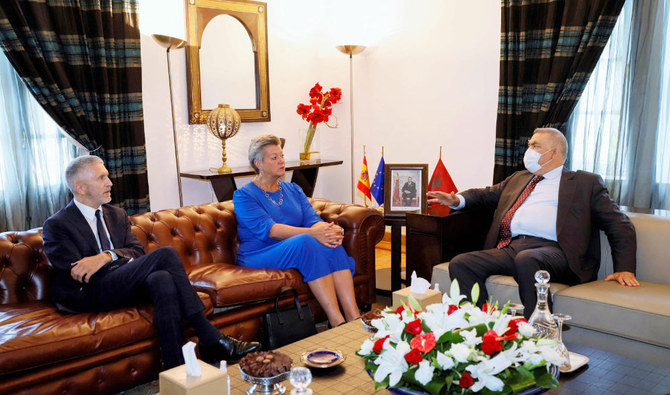
Interior Minister Abdelouafi Laftit (R) meeting with Ylva Johansson (C), European Commissioner for Home Affairs, and Fernando Grande-Marlaska (L), Spain's Interior Minister, in the capital Rabat on July 8, 2022. (AFP)
Short Url
Updated 10 July 2022
Follow

EU, Morocco renew migration deal after Spanish border deaths

  • Rights groups have condemned authorities on both sides of border for excessive use of force

RABAT: The European Commission has vowed to step up its work with Morocco to fight human smugglers who are using “new, extremely violent methods” — a move that comes two weeks after 23 people died at the border between Morocco and the Spanish enclave of Melilla.

EU Commissioner for Home Affairs Ylva Johansson and Spanish Interior Minister Fernando Grande-Marlaska met with Morocco’s Interior Minister Abdelouafi Laftit in Rabat to discuss the events of June 24, when hundreds of sub-Saharan migrants and asylum-seekers attempted to storm through a border post and scale a border fence into Melilla.
In addition to the deaths, some 200 Moroccan and Spanish law enforcement officers and more than 70 civilians were injured.
“We have discussed how we can further cooperate on fighting the smugglers, preventing such violent and dangerous situation as we saw two weeks
ago,” Johansson said in a video message after the meeting.

BACKGROUND

EU Commissioner for Home Affairs Ylva Johansson and Spanish Interior Minister Fernando Grande-Marlaska met with Morocco’s Interior Minister Abdelouafi Laftit in Rabat to discuss the events of June 24.

There were no further details on what exactly the new, violent methods being used by smugglers were but the European Commission said it would enhance police cooperation with Morocco, including with joint investigations.
Mustafa Baitas, a spokesman for the Moroccan government, said on Thursday the events at the Nador-Mellila border were “planned and orchestrated” in a way that was not typical of other attempts to storm the border into Spain.
At the time, Moroccan authorities said the migrants had died as a result of a stampede.
But several human rights organizations have called for an independent investigation into the deaths and condemned authorities on both sides of the border for excessive use of force.
Morocco’s Human Rights Association says 27 migrants died, four more than Morrocan authorities have reported.
Many of the victims were believed to be Sudanese, it tweeted.
“The Commissioner and the two ministers welcomed the fact-finding commission set up by the Moroccan National Human Rights Council,” the EU Commission statement said. Spanish prosecutors also announced last week they had launched an investigation into June 24.
Videos showing countless Black men lying on the ground that day, some motionless and bleeding as Moroccan officers stood over.


Jordan condemns Israel’s seizure of planning powers at Ibrahimi Mosque

Updated 9 sec ago
Follow

Jordan condemns Israel’s seizure of planning powers at Ibrahimi Mosque

  • Announcement on Wednesday by Israeli Civil Administration said it had transferred planning powers from Palestinian Authority-run Hebron Municipality to its own Supreme Planning Council

AMMAN: Jordan’s Ministry of Foreign and Expatriates Affairs on Friday strongly condemned Israel’s decision to revoke the planning and construction authorities of the Hebron Municipality at the Ibrahimi Mosque, the Jordan News Agency reported.

The ministry described the move as a blatant violation of international law and the historical and legal status quo at the holy site, JNA added.

The condemnation follows an announcement on Wednesday by the Israeli Civil Administration the body overseeing the occupied West Bank, that it had transferred planning powers from the Palestinian Authority-run Hebron Municipality to its own Supreme Planning Council.

The decision was accompanied by approval for a project to construct a roof over the mosque’s internal courtyard, a move that has drawn fierce Palestinian opposition.

The Hebron Municipality also condemned the Israeli decision, describing it as a “serious and illegal violation” and part of a systematic effort to alter the status quo at the mosque and weaken the authority of Palestinian institutions responsible for its management.

In a statement, the Jordanian ministry said Israel, as the occupying power, was acting unlawfully by unilaterally approving construction works at the Ibrahimi Mosque and stripping Palestinian authorities of their administrative powers, warning that the measures undermine the Islamic administration of the site.

The ministry’s official spokesperson, Fouad Al-Majali, affirmed Jordan’s “absolute rejection and severe condemnation” of Israel’s continued illegal unilateral measures in the occupied West Bank, most recently those targeting the Ibrahimi Mosque in Hebron.

Al-Majali added that the actions constituted clear violations of international law and international humanitarian law, including the 1954 Hague Convention for the Protection of Cultural Property in the Event of Armed Conflict, as well as relevant United Nations resolutions.

He also pointed to UNESCO’s 2017 decision to inscribe Hebron’s Old City and the Ibrahimi Mosque on the List of World Heritage in Danger.

He called on the international community to shoulder its “legal and moral responsibilities” by compelling Israel to halt its illegal measures in the occupied Palestinian territory, protect the cultural and religious heritage of the Ibrahimi Mosque, and preserve its outstanding universal value, which he said is under increasing threat due to Israeli actions.

Al-Majali further emphasized that achieving security and a just and comprehensive peace would remain impossible without fulfilling the legitimate rights of the Palestinian people to self-determination, including the establishment of an independent, sovereign Palestinian state on 1967 lines, with East Jerusalem as its capital.