

Melilla migrants likely died of ‘suffocation’: Moroccan probe

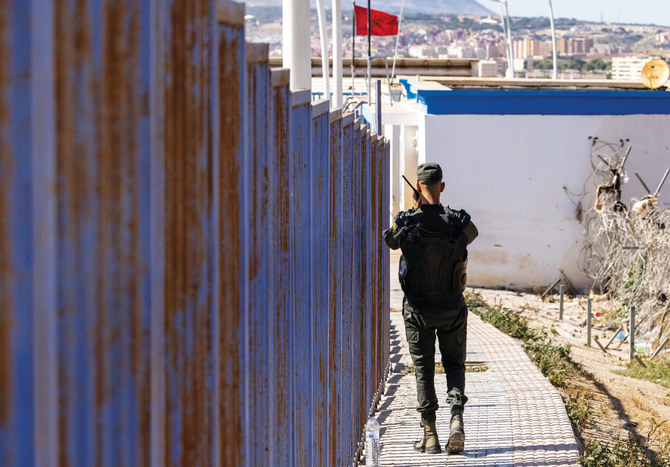
Moroccan security forces guard patrols the border fence separating Morocco and Spain’s North African enclave of Melilla. An attempt by migrants to storm the barrier between Morocco and Melilla resulted in ‘unprecedented violence’ last month. (AFP)
Short Url
Updated 15 July 2022
Follow

Melilla migrants likely died of ‘suffocation’: Moroccan probe

  • CNDH cites the danger posed by ‘large number of migrants’ carrying sticks and stones

RABAT: At least 23 migrants who died last month in a mass attempt to enter the Spanish enclave of Melilla from Morocco likely “suffocated,” Morocco’s state-backed CNDH rights group said.

The death toll after around 2,000 people, many from Sudan, stormed the frontier on June 24 was the worst in years of attempted migrant crossings into Spain’s Ceuta and Melilla enclaves, which have two of the EU’s only land borders with Africa.

Adil El-Sehimi, a doctor who examined the bodies during a CNDH fact-finding mission, said the migrants had most likely died of “mechanical asphyxiation,” when a force or object prevents a person from breathing.

CNDH chief Amina Bouayach said 23 migrants had died in the incident, confirming the official toll.

None of the dead have been buried and autopsies were pending, Bouayach told a press conference in Rabat to present the initial findings of the CNDH probe.

Spanish rights group Caminando Fronteras says as many as 37 people lost their lives.

Five days after the incident, Human Rights Watch (HRW) cited “reports that the authorities in Morocco may be organizing hasty mass burials,” along with photographic evidence of recently dug graves in nearby Nador.

The CNDH said large numbers of migrants, “armed with sticks and stones ... split into two groups: The first stormed a border post closed since 2018 and the second climbed nearby walls topped with barbed wire.”

It said that the dead had been crushed in part of a border post, where manual turnstiles allow the passage of a single person at a time.

“A large number of migrants found themselves crammed into this narrow area, resulting in jostling which led to migrants suffocating,” it said.

The UN, the African Union and independent rights groups have denounced the use of excessive force by Moroccan and Spanish security personnel.

HRW said a video showed a Moroccan security agent “beating obviously injured men prone on the ground and another agent throwing a limp body onto a pile of people.”

The CNDH defended Moroccan forces’ actions, saying such cases were “isolated” and citing the danger posed by “the large number of migrants” carrying sticks and stones.

“Law enforcement did not use any firearms,” it added.

Also Wednesday, the trial opened in Nador of a group of 29 migrants, including a minor, accused of “illegal entry onto Moroccan territory” as well as “violence against law enforcement officers” and “participating in a criminal gang with a view to organizing and facilitating” irregular migration.

The prosecution presented “medical certificates of members of the security forces hurt during the clashes. The judge decided to summon them,” said Khalid Ameza, a lawyer for the accused.


Israeli military drops charges against soldiers accused of sexually assaulting Palestinian detainee

Updated 7 sec ago
Follow

Israeli military drops charges against soldiers accused of sexually assaulting Palestinian detainee

  • “Israel’s military advocate general just gave his soldiers license to rape — so long as the victim is Palestinian,” said Bashi
  • Netanyahu welcomed the decision, saying that “the state of Israel must pursue its enemies, not its heroic fighters”

JERUSALEM: Israel’s military on Thursday said it was dropping charges against five soldiers accused of beating and sexually abusing a Palestinian detainee in an alleged assault partially caught on camera.
The decision, which came as much of the country’s attention was focused on the war with Iran, closed a flashpoint case that has bitterly divided Israel since the soldiers were arrested in 2024 at the notorious Sde Teiman military prison, prompting anger from members of the far-right government and hard-line ultranationalists who violently overran the prison in protest.
Prime Minister Benjamin Netanyahu hailed the announcement, while human rights groups accused the military of ignoring one of the gravest instances of abuse in the country’s network of wartime prisons.
“Israel’s military advocate general just gave his soldiers license to rape — so long as the victim is Palestinian,” said Sari Bashi, executive director of the Public Committee Against Torture in Israel, after the case was dismissed. She said the decision was “the latest in a long line of actions that whitewash abuses against detainees whose frequency and severity have worsened since Oct. 7, 2023.”
Netanyahu welcomed the decision, saying that “the state of Israel must pursue its enemies, not its heroic fighters.”
The now-dismissed indictment against the soldiers accused them of an assault that included dragging a Palestinian prisoner along the floor, stepping on him, tasering him, and sexually assaulting him by stabbing him in the rectum. The Palestinian was taken to an Israeli hospital with fractured ribs and a perforated rectum that required surgery before he was returned to the prison.
The allegations of abuse at the facility gained steam when, in August 2024, Israeli news broadcast a leaked video of the alleged assault.
The video showed a group of masked soldiers wresting a detainee from the ground, where he and other Palestinians were lying face down and handcuffed in a fenced-in pen, and taking the detainee to an area of the pen they cordoned off using shields.
In its Thursday decision dismissing the case, the military’s top legal officers said the charges against the soldiers were being dropped because the video did not show abuse violent enough to merit a criminal conviction and had been improperly leaked to the media. The decision added that the Palestinian victim had since been released back to Gaza, creating an “absence of certainty” he would be able to testify in a trial.
In November 2025, after much speculation about how the leaked video got out, Military Advocate General Yifat Tomer-Yerushalmi — the top legal official in the military — admitted that she had approved its release, saying she had wanted to show how serious the abuse was and convince people the military had a duty to investigate.
Facing an uproar from Netanyahu’s government, she abruptly resigned and then disappeared, only to be found phoneless on a Tel Aviv beach after a frantic search by authorities. The phone, believed to hold possible evidence against her, was later recovered in the sea.
The Associated Press investigated allegations of inhumane treatment and abuse at Sde Teiman before the surveillance video.
The prison was set up after Oct. 7, 2023, to hold Palestinians rounded up in Gaza during Israel’s war against the Hamas militant group. The secretive facility quickly gained notoriety as employees and Palestinians freed from detention described scenes of abuse and torture and Israeli rights groups petitioned the country’s top court for it to be shuttered.
Israel has long been accused of failing to hold its soldiers accountable for crimes committed against Palestinians. The allegations have intensified during the war in Gaza. Israel says its forces act within military and international law and says it thoroughly investigates any alleged abuses.