

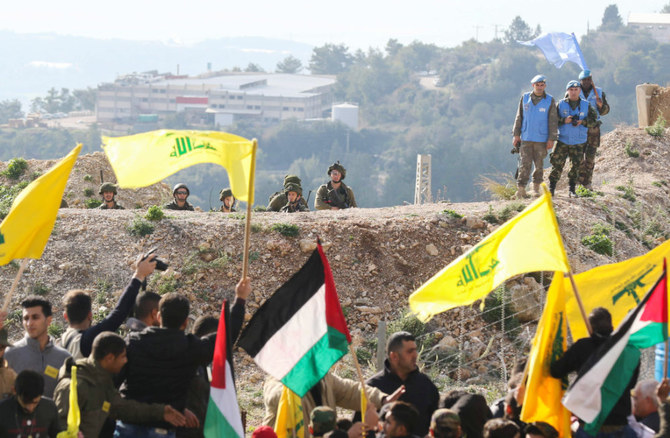

BEIRUT: Hezbollah Secretary-General Hassan Nasrallah’s speech on Wednesday night, in which he ratcheted up tensions with Israel, has raised fresh fears in Lebanon over possible escalations with its southern neighbor.
The speech came amid indirect Lebanese–Israeli talks over the demarcation of the maritime border between the two countries, and follows the downing of three drones flown by Hezbollah towards the Karish gas field by the Israel Defense Forces earlier this month.
Nasrallah warned that sending drones over the field in the Mediterranean earlier this month was “a modest beginning to where the situation could be heading,” adding that “if the results of the negotiations are negative, not only will we reach Karish, but we will also go beyond Karish.”
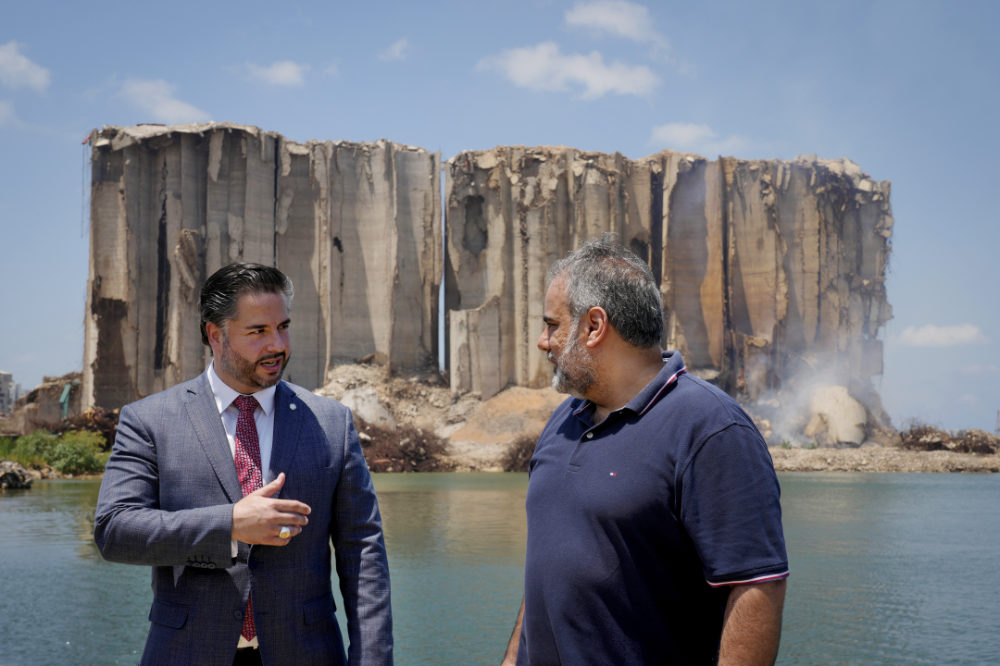
Lebanese caretaker Economy Minister Amin Salam speaks with Beirut Port Silos General Manager Assad Haddad near Beirut Port silos, that were destroyed by a massive explosion in 2020. (AP)
He added that “maritime border demarcation and Lebanon’s gas exploration and extraction constitutes a crucial matter to save the country,” and stressed that it was necessary to “settle this issue once and for all through demarcation and extraction, or else we will cross all limits and flip the table on everyone.”
In September, a liquefied natural gas production and storage vessel belonging to Energean will start extracting gas at the behest of Israel from the Karish field, which was discovered in 2013.
Part of the field is located within two miles of Line 29 to the north, considered by Lebanon a potential starting point of its maritime border with Israel.
Lebanon recognizes Line 23 as the current demarcation, according to documents submitted to the UN in 2011, and has not yet legally amended its stance, but considers Line 29 to be open to negotiation — whilst the gas field may well extend under it.
Nasrallah described the moment as a “golden opportunity” for Lebanon to exploit Mediterranean gas resources, with the conflict between Russia and Ukraine causing energy issues in Europe, with autumn fast approaching.
The speech raised fears across Lebanon about possible escalation with Israel, with the Energean Power vessel a point of contention amid Hezbollah’s threats to continue to operate drones in the area.
Christina Abi Haidar, a legal expert in oil affairs, cast doubt on the feasibility of exploiting Europe’s energy issues, saying: “In case we find gas, we cannot export it to Europe because we are not part of the EastMed project.”
She told Arab News that Nasrallah’s speech would not help Lebanon’s negotiating position, adding: “Lebanon is no longer the starting point of the maritime demarcation, meaning that what Nasrallah has said does not have any legal grounds.
“Moreover, Hezbollah is part of the ruling class, the government and the Parliament, so why did not it push toward the amendments previously?
Regarding Nasrallah’s remarks and the effect they may have on oil and gas exploration and extraction in the region, Abi Haidar said: “The Israeli party is in a hurry to finish the maritime border demarcation talks with Lebanon because it’s seeking stable security for its companies in the event of any shock, given the high costs.”
She added: “What should be known is that Israel (has) started the exploration phase, while it took us between two to five years to start this phase.”
A number of Lebanese politicians also criticized Nasrallah after the speech.
Progressive Socialist Party head Walid Jumblatt said on social media: “Nasrallah’s speech put an end to the possibility of reaching a settlement regarding Line 23.”
Kataeb Party leader Samy Gemayel said Nasrallah “is embroiling the Lebanese in a new adventure that might cost them a lot without asking for their permission.”
Lebanese Forces MP Ghayath Yazbeck said: “After Nasrallah’s speech, it became clear to everyone that we don’t have a state. Hezbollah is acting within the frames set by Iran and its calculations are not Lebanese. Nasrallah’s claim that he speaks on behalf of most Lebanese and most Shiites is inaccurate.”
Yazbeck added Lebanon “cannot go to war while it is starving. Nasrallah’s statements are nihilistic.”
Parliamentarian Said Al-Asmar called on Nasrallah to “fight corruption and not cover it with the party’s weapons,” adding: “The decision of peace and war should be left to the state only.”
Free Patriotic Movement leader Gebran Bassil, though, tweeted: “You (Israel) want your gas, then we want our gas too. That is how a strong sate acts. That is how it preserves the national dignity and that is how sovereignty should be.”


