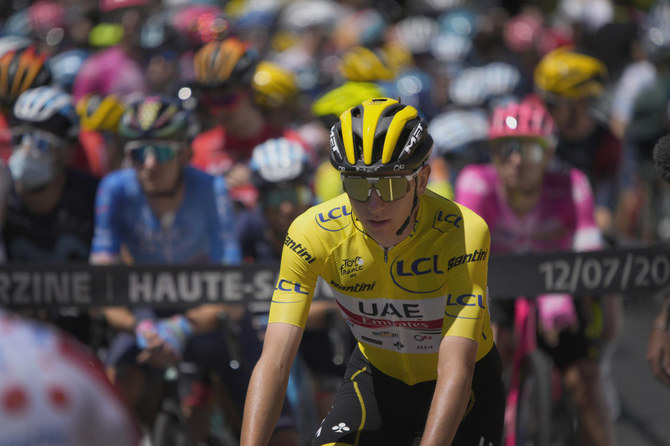
MEGÈVE, France: Tour de France leader Tadej Pogacar lost a second UAE Emirates teammate ahead of stage 10 on Tuesday as New Zealander George Bennett was withdrawn.
Vegard Stake Laengen of the UAE team pulled out on Saturday and Bennett’s loss means Pogacar has only five teammates left with 12 stages remaining.
With three days in the Alps coming up and sizzling temperatures expected, Pogacar’s rivals will take the news as a boost to their chances.
“George displayed some symptoms on Monday night and tested positive,” team doctor Adrien Rottuno said.
Rotunno revealed last Saturday the extreme measures the team have gone to in order to avoid infection.
“All the riders have their own room, when normally they would share. They also all have their own masseur,” he said.
Just ahead of the Tour, Matteo Trentin, a key member of Pogacar’s team, also pulled out of the race with COVID-19.
Pogacar leads the race by 39sec from Jonas Vingegaard with Ineos rider Geraint Thomas third, 1min 17sec behind, but big changes are expected over the next three stages.
Bennett is the fifth rider so far to pull out due to COVID-19 following Australian rider Luke Durbridge of the Bike Exchange who also withdrew on Tuesday.
French riders Geoffrey Bouchard and Guillaume Martin have also been forced out of the race by the virus.
Half a dozen riders had to be replaced prior to the start of the Tour after testing positive for COVID-19.
There have also been casualties in the backroom staff of the teams with Quick-Step on their third sporting director since it began in Copenhagen on July 1.

UAE’s Tadej Pogacar loses second teammate to COVID-19 at Tour de France
https://arab.news/j3dp9
UAE’s Tadej Pogacar loses second teammate to COVID-19 at Tour de France
- Vegard Stake Laengen of the UAE team pulled out on Saturday
- George Bennett was withdrawn ahead of stage 10 on Tuesday
Most women’s national team players earn less than $20,000, FIFPRO study shows
- Some 66 percent of players earn below $20,000 annually from football
- Nearly one-third of respondents reported earning between $0 and $4,999 from football
MANCHESTER: Two-thirds of women’s national team players earn less than $20,000 annually, according to a new FIFPRO survey that highlights persistent financial insecurity and structural gaps in the women’s game.
The global players union and affiliated national players unions surveyed 407 footballers from 41 nations who participated in the UEFA Women’s Euros, Copa America Femenina, the Women’s Africa Cup of Nations and the OFC Women’s Nations Cup.
Some 66 percent of players earn below $20,000 annually from football and nearly one-third of respondents reported earning between $0 and $4,999 from football, while only a small minority reached higher income brackets.
Professional clubs remain the main source of income, followed by national team payments, yet one in four players still rely on jobs outside football to make ends meet.
“Financial stability is a cornerstone of any career,” said FIFPRO’s Director of Women’s Football Alex Culvin. “The data is very clear: most players are earning insufficient income to ensure secure careers within the game.
“It is a risk to the sustainability of the sport because players will be inclined to leave football early to make ends meet.”
The survey, conducted between August and October, also revealed short-term contracts remain common: 33 percent of players were signed for one year or less, and 22 percent had no contract at all.
International competition schedules continue to strain players, with 58 percent saying pre-match rest was inadequate and 57 percent reporting insufficient recovery after games.
Travel conditions are also an issue, with three-quarters of players flying economy class during tournaments, with only 11 percent in premium economy or business.
While FIFPRO noted improvements since their 2022 survey – including increased prize money and a player-dedicated share at the Women’s Euros – similar reforms have not been replicated across other confederations.
Culvin said stakeholders must “continue to raise standards to support the increased professionalization of the women’s game.”