

Saudi Arabia’s Q1 current account hits 8-year high thanks to oil sales

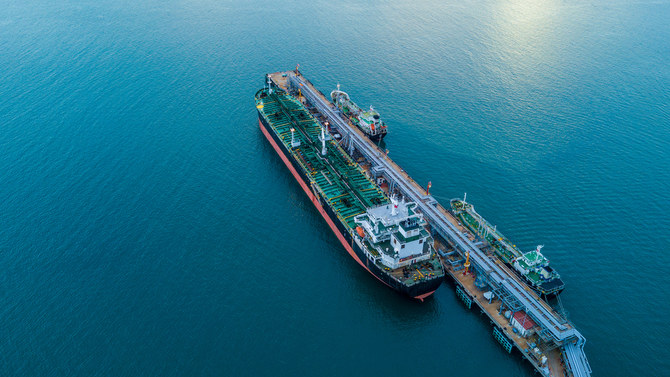
The surge in the current account balance is attributed to a $37.1 billion increase in oil exports (Shutterstock)
Short Url
Updated 17 July 2022
Follow

Saudi Arabia’s Q1 current account hits 8-year high thanks to oil sales

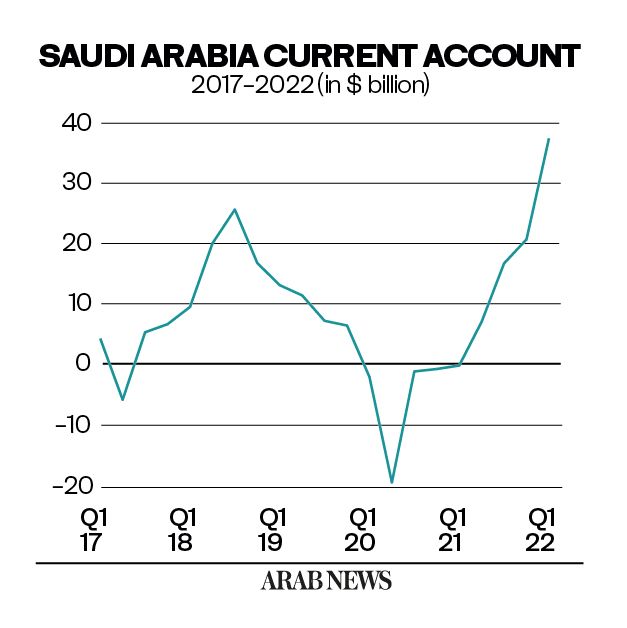
CAIRO & MOSCOW: Oil exports have skyrocketed Saudi Arabia’s current account balance to $37.4 billion in the first quarter of 2022, according to preliminary data on the Kingdom’s balance of payments published by Saudi Central Bank.

The figure for the first quarter compares with a deficit of $169 million and a surplus of $20.7 billion recorded in the first and fourth quarters of 2021, respectively. 

The growth rate in the current account surplus compared to the fourth quarter of 2021 translates to an almost 81 percent increase.

The surge in the current account balance is attributed to a $37.1 billion increase in oil exports which hit $76.6 billion in the first quarter of 2022 compared to $39.4 billion in the same quarter a year ago. 

The inflows from non-oil exports also increased noticeably by almost $5 billion to $20.7 billion from $15.7 billion in the first quarter of 2021.
The outflows in the general merchandise account increased by only $4.8 billion as goods imports rose relatively modestly to $38 billion in the first quarter of 2022. This includes a positive effect from the re-exports, which reduced the imports account number by $3.1 billion.

As a result, the general merchandise account posted a year-on-year increase of $37.3 billion, hitting $59.4 billion compared to $22.1 billion in the first quarter of 2021.

The Kingdom’s current account turned positive in the second quarter of 2021 after it recorded a deficit in the five preceding quarters from the first quarter of 2020 through the first quarter of 2021.

It’s worth mentioning that the Kingdom’s current account turned positive in 2021 at $44.3 billion, following the $22.8 billion deficit in 2020.

Similarly, the service sector account showed an 18.3 percent decrease in deficit from $14.7 billion to $12 billion, easing decreases in the current account balance. 

The improvement resulted mainly from a $2.4 billion reduction deficit in the “other business services” account, which posted a shortfall of $1.64 billion in the first quarter of 2022 compared to $4 billion in the first quarter of 2021.

Moving on to the personal transfers account, worker remittances, the outflow recorded an annual increase of 14.9 percent from $9.3 billion in the first quarter of 2021 to $10.7 billion in the first quarter of 2022.

Separately, looking at other parts of the balance of payments – beyond the current account – the net foreign direct investment showed an inflow of $1.97 billion in the first quarter of 2022, a 1.7 percent increase quarter-on-quarter. This compares with an 11.9 percent increase in its transition from the third quarter to the fourth quarter of 2021.

The net foreign portfolio investment showed an inflow of $7.54 billion in the first quarter of 2022 compared to the $1.4 billion outflows in the fourth quarter of 2021 and an influx of $7.8 billion in the first quarter of 2021.


PIF-backed AviLease achieves revenue of $664m and 19% growth in 2025

Updated 27 February 2026
Follow

PIF-backed AviLease achieves revenue of $664m and 19% growth in 2025

RIYADH: Saudi Arabia’s Public Investment Fund-backed AviLease achieved exceptional performance and sustainable business growth during 2025, supported by the strategic expansion of its global platform.

According to its financial results for 2025, AviLease recorded total revenues of $664 million, an annual increase of 19 percent, driven by disciplined growth in its asset portfolio and strong performance in aircraft remarketing amid sustained global demand for modern, fuel-efficient aircraft, the Saudi Press Agency reported.

Profit before tax doubled compared to the previous year, reaching $122 million. The year witnessed an expansion in AviLease’s portfolio, reaching 202 owned and managed aircraft, leased to over 50 airline companies in more than 30 countries. 

The total value of the company’s assets stabilized at $9.3 billion. AviLease maintained a 100 percent fleet utilization rate, reflecting the resilience of its business model, the efficiency of its asset management, and the strength of its strategic relationships with airlines around the world.

AviLease concluded purchase agreements for aircraft from Airbus, including the A320neo family and A350F, and Boeing 737 aircraft, aiming to enhance its future asset portfolio with modern, fuel-efficient aircraft. This step will contribute to supporting future growth and meeting increasing customer demand for the latest aircraft, aligning with the Kingdom’s ambitions to become a leading global aviation hub.

AviLease strengthened its prestigious credit standing by obtaining a strong Baa2 credit ratings from Moody’s and BBB from Fitch, reflecting its financial solidity, managerial discipline, and efficiency in managing leverage. The company also successfully issued senior unsecured bonds worth $850 million last November under Regulation 144A/RegS. This issuance contributed to diversifying its funding sources and enhancing its financial flexibility.

Commenting on the results, AviLease CEO Edward O’Byrne said: “This exceptional performance reflects the quality of the company’s investment portfolio, the strength of its partnerships with airlines, and its strategic focus on responsibly deploying capital into highly sought-after, efficient, modern aircraft assets.”

He added: “As aviation markets continue to grow, AviLease is strategically positioned to continue its expansion plans and deliver sustainable long-term value for shareholders, contributing to the Kingdom’s ambitions.”

Throughout 2025, AviLease continued to play a pivotal role in the Kingdom’s growing aviation sector and contributed directly to the launch and scaling of the new national carrier, Riyadh Air, by completing a sale and leaseback transaction for a Boeing 787-9 aircraft, which thereby became the first aircraft to join the airline’s fleet.

AviLease also established a strategic partnership with Hassana Investment Co. This partnership aims to provide an opportunity for local and international investors to enter the aircraft financing asset class and benefit from AviLease’s technical expertise and operational capabilities to support partnership growth and enhance performance. 

Hassana Investment Co. has agreed to acquire an initial portfolio of 10 modern aircraft from AviLease.