

OPEC forecasts slower oil demand growth in 2023

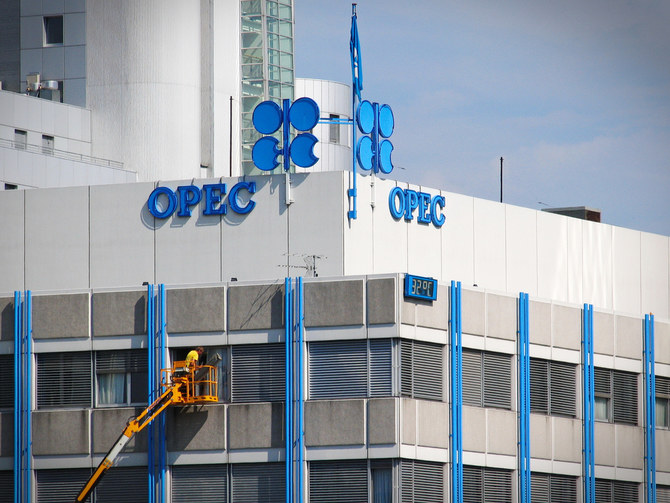
 OPEC expects world oil demand to rise by 2.7 million barrels per day in 2023 (Shutterstock)
Short Url
Updated 12 July 2022
Follow

OPEC forecasts slower oil demand growth in 2023

RIYADH: The Organization of the Petroleum Exporting Countries has forecast that world oil demand will rise further next year, but at a slightly slower rate than in 2022, with consumption supported by better containment of the COVID-19 pandemic and still-robust global economic growth.

In a monthly report, the OPEC said it expects world oil demand to rise by 2.7 million barrels per day in 2023. This year’s growth forecast was left unchanged at 3.36 million bpd.

Oil use has rebounded from the pandemic-induced slump in 2020 and is set to exceed 2019 levels this year even as prices hit record highs. However, high crude prices and Chinese coronavirus outbreaks have eaten into 2022 growth projections.

“In 2023 expectations for healthy global economic growth amidst improvements in geopolitical developments, combined with expected improvements in the containment of COVID-19 in China, are expected to boost consumption of oil,” OPEC said in the report.

OPEC said its 2023 forecasts assume there will be no escalation of the war in Ukraine and that risks such as rising inflation do not take a heavy toll on global economic growth.

The group and its allies including Russia, known collectively as OPEC+, are ramping up output after record cuts put in place as the pandemic took hold in 2020.

In recent months OPEC+ has been undershooting targeted production increases owing to underinvestment in oilfields by some OPEC members and by losses in Russian output.

The report showed OPEC output bucked that trend in June, rising by 234,000 bpd to 28.72 million bpd.


Fitch reaffirms Saudi Arabia at A+ on fiscal, external strength 

Updated 18 January 2026
Follow

Fitch reaffirms Saudi Arabia at A+ on fiscal, external strength 

RIYADH: Saudi Arabia’s sovereign credit rating was affirmed at A+ with a stable outlook by Fitch Ratings, reflecting the Kingdom’s strong fiscal and external balance sheets.  

In its latest report, Fitch said Saudi Arabia continues to benefit from large sovereign net foreign assets and substantial fiscal buffers, including government deposits and other public-sector holdings.  

These strengths place the Kingdom well above both “A” and “AA” peers on key balance-sheet metrics, the agency said. 

The latest rating action comes as the Kingdom continues to navigate the impact of lower oil prices while advancing its economic diversification agenda. 

Underscoring the strength of Saudi Arabia’s economic growth, the World Bank earlier this month said the Kingdom’s gross domestic product is expected to expand by 4.3 percent in 2026 and 4.4 percent in 2027, up from an expected 3.8 percent in 2025. 

In its latest report, Fitch stated: “Oil dependence, World Bank Governance Indicators and vulnerability to geopolitical shocks have improved but remain weaknesses.”  

It added: “Deep and broad social and economic reforms implemented under Vision 2030 are diversifying economic activity, albeit at a meaningful cost to the balance sheets.”  

The US-based agency added that Saudi Arabia’s reserves are projected at 11.6 months of current external payments in 2026, well above the peer median of 1.9 months. 

The Kingdom’s sovereign net foreign assets are expected to decline due to higher borrowing but will remain a clear credit strength, at 41.2 percent of GDP at end-2026, compared with a peer median of 3.6 percent. 

Fitch also forecast a widening of the current account deficit to 4.3 percent of GDP in 2026 from an estimated 3 percent in 2025, reflecting the cost of imported inputs linked to high domestic spending and a small increase in oil export receipts. 

“The deficit should narrow slightly in 2027 as revenues benefit from higher oil export volumes, new export facilities coming on stream and higher tourism inflows, supported by slower import growth from lower project spending,” it said, adding that external borrowing and a further reorientation of public assets to domestic from foreign investments should keep reserves stable.  

Fiscal deficit to narrow 

Saudi Arabia’s fiscal deficit is expected to narrow to 3.6 percent of GDP by 2027 after lower oil revenues and overspending pushed it to an estimated 5 percent in 2025. 

Oil revenues are expected to rise from 2025 as higher production offsets the impact of lower prices. 

“Non-oil revenues will continue to benefit from buoyant economic activity and improved collection techniques. Fitch assumes spending growth will be low, as capex has likely peaked and measures are in place to contain current spending,” added the report.  

Solid growth and reform momentum  

According to the report, Saudi Arabia’s economy is expected to expand by 4.8 percent in 2026, following an estimated 4.6 percent growth in 2025. 

This expansion will be driven by higher oil production, reflecting OPEC+-related output increases over 2025, as well as robust growth in the non-hydrocarbon sector. 

“Prospects for the non-oil sector remain healthy, underpinned by reform, high levels of government and GRE (government-related entities) spending, new projects coming on stream and buoyant consumer spending,” said the report.  

Earlier this month, a separate analysis by Standard Chartered echoed similar expectations, forecasting the Kingdom’s GDP to expand by 4.5 percent in 2026, outperforming the projected global growth average of 3.4 percent, supported by momentum in both hydrocarbon and non-oil sectors. 

In October, the International Monetary Fund said Saudi Arabia’s economy is projected to expand by 4 percent in both 2025 and 2026. 

Fitch added that reform momentum remains strong, citing recent steps including a new investment law and a greater opening of the real estate and stock markets to foreign investors. 

“A removal of fees on some expat workers in the industrial sector highlights an understanding of the need to ease near-term bottlenecks. Nonetheless, the resilience of non-oil growth to a period of lower government and GRE spending remains to be tested,” said Fitch.  

The report also underscored the health of Saudi Arabia’s banking system, noting that credit growth and high net interest margins have supported profitability. 

Over the first three quarters of 2025, capital adequacy edged up to 20 percent, while non-performing loans fell to an all-time low of 1.1 percent. 

“Credit growth is slowing owing to macroprudential measures, but should remain just above nominal non-oil GDP growth,” Fitch said, adding that lending growth has continued to outpace deposit growth, leading to a further deterioration in the sector’s net foreign asset position. “However, this remains relatively small compared to total assets of the banking sector and is in stable forms,” it added.  

Potential rating sensitivities  

Fitch said greater non-oil revenue generation or rationalisation of expenditure, while maintaining the strength of the wider public-sector balance sheet, could support an upgrade of Saudi Arabia’s rating. 

A continuation of economic reforms that underpin strong non-oil growth, combined with higher oil prices, could also improve the Kingdom’s credit profile. 

On the downside, a deterioration in public finances or a major escalation of geopolitical tensions could lead to a downgrade. 

In March 2025, S&P Global also raised Saudi Arabia’s rating to ‘A+’ from ‘A’ with a stable outlook, citing the Kingdom’s ongoing social and economic transformation. 

In December, the Public Investment Fund secured an inaugural A-1 short-term credit rating with a stable outlook from S&P Global Ratings, marking a milestone for the sovereign wealth fund as it strengthens its global financial standing. 

S&P said the rating reflects PIF’s “robust balance sheet, strong liquidity position, and disciplined financial management,” and aligns with Saudi Arabia’s own short-term sovereign rating.