



COLOMBO: Sri Lanka’s embattled president was flown to an air base near the main international airport Monday, officials said, raising speculation he will escape into exile abroad.
Gotabaya Rajapaksa fled the presidential palace in Colombo under naval protection on Saturday, shortly before tens of thousands of protesters overran the compound.
Hours later, the parliamentary speaker announced Rajapaksa would resign on Wednesday to allow a “peaceful transition of power.”
The 73-year-old leader had taken refuge at a navy facility in the island’s northeast, a top defense official said, adding that he was brought to the Katunayake air base adjoining the country’s main international airport.
“He and his entourage were flown back to Colombo in two Bell 412 choppers,” the official added.
There was no official word from the president’s office about his whereabouts, and several local media reports speculated he was set to leave for Dubai later Monday.
But four commercial flights subsequently took off for Middle Eastern destinations without him, airport officials said.
Immigration officers were refusing to go to the VIP suite to stamp his passport, while he insisted he would not go through the public facilities, they added — a humiliating stand-off for the leader once known as ‘The Terminator’.
A military source said Rajapaksa, who remains the commander-in-chief of the armed forces, had the option of traveling in an air force aircraft.
Prime Minister Ranil Wickremesinghe’s office said Rajapaksa had officially informed him of the president’s intention to resign, without specifying a date.
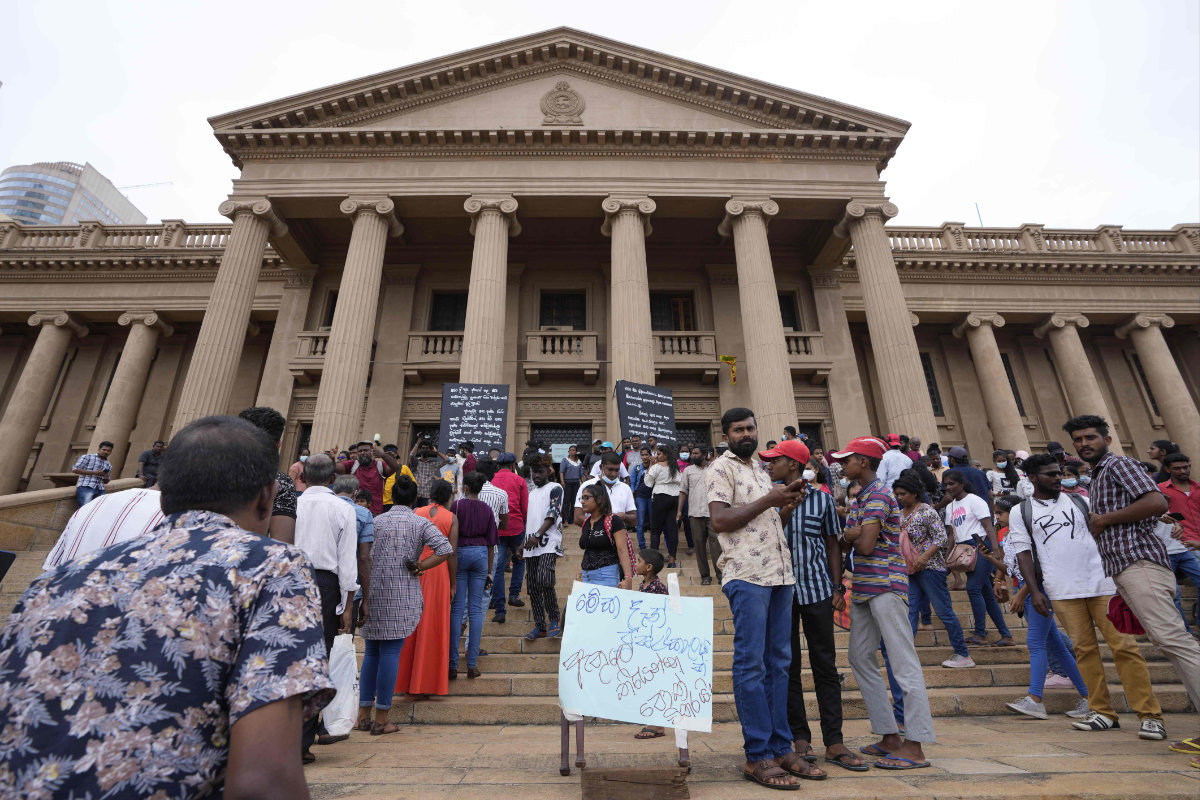
Sri Lankans queue up to visit President Rajapaksa's office in Colombo for the second day on July 11, 2022 after angry protesters forced him to flee. (AP)
Earlier in the day, 17.85 million rupees (about $50,000) in cash that Rajapaksa had left behind at the presidential palace was handed over to a court after being turned in by protesters, police said.
Official sources said a suitcase full of documents had also been left behind at the stately mansion.
Rajapaksa took up residence at the two-century-old building after he was driven out of his private home on March 31 when protesters tried to storm it.
If Rajapaksa steps down as promised, Wickremesinghe will automatically become acting president until parliament elects an MP to serve out the presidential term, which ends in November 2024.
But Wickremesinghe has himself announced his willingness to step down if consensus is reached on forming a unity government.
The succession process could take between three days — the minimum time taken to convene parliament — and a maximum of 30 days allowed under the statute. If Rajapaksa does step down on Wednesday, the vote would take place on July 20, the parliamentary speaker said.
The main opposition party Samagi Jana Balawegaya (SJB) held talks with smaller political groups Monday to secure support for their leader Sajith Premadasa.
An SJB official said they reached a tentative agreement with dissidents in Rajapaksa’s SLPP to support 55-year-old Premadasa, who lost the 2019 presidential election.
Premadasa is the son of former president Ranasinghe Premadasa, who was assassinated in a Tamil rebel suicide bombing in May 1993.
Former Rajapaksa loyalist Dullas Alahapperuma, 63, an ex-media minister, was tipped to be the new prime minister, an SJB legislator involved in the talks told AFP.
Five ministers resigned over the weekend, and Wickremesinghe’s office said the cabinet had agreed on Monday to resign en masse once an agreement was reached on an “all-party government.”
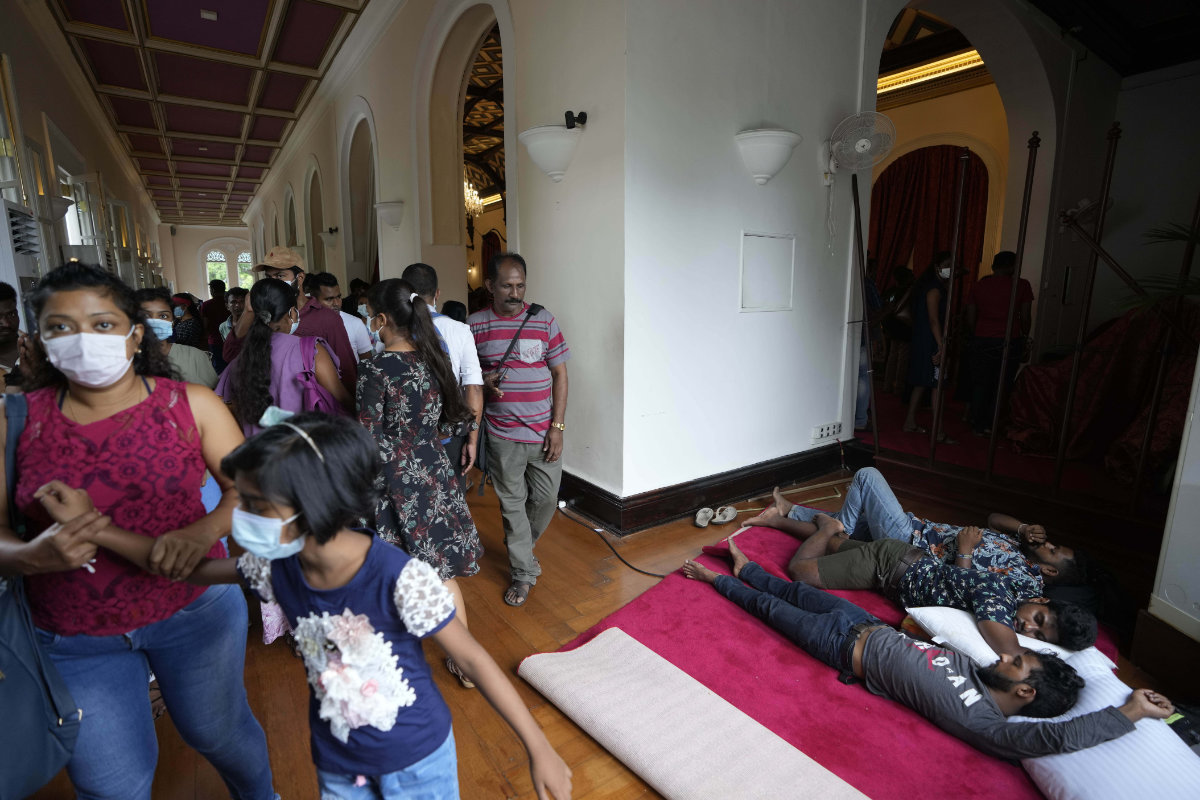
After weeks in the streets, tired protesters take a rest at Sri Lankan President Gotabaya Rajapaksa's official residence in Colombo on July 11, 2022, a day after the disgraced leader fled. (AP)
On Monday, huge queues formed to visit the palace — a line longer than some of the petrol queues snaking their way through the city.
Protesters say they will not leave until Rajapaksa formally quits.
“The demand is very clear, people are still asking for the resignation (of Rajapaksa), and full resignation, in a written confirmation,” said protester Dela Peiris.
“So hopefully we will have this resignation from the government including the prime minister and president in the coming days.”
The premier’s private home in Colombo was also set on fire on Saturday night.
Demonstrators had been camping outside the president’s office for more than three months, demanding he quit over the country’s unprecedented economic crisis.
Rajapaksa is accused of mismanaging the economy to a point where the country has run out of foreign exchange to finance even the most essential imports, leading to severe hardships for the 22 million population.
Wickremesinghe, an opposition legislator, was made premier in May to try to lead the country out of its economic crisis — the sixth time he has been appointed to the post.
Sri Lanka defaulted on its $51-billion foreign debt in April and is in talks with the IMF for a possible bailout.
The island has nearly exhausted its already scarce supplies of petrol. The government has ordered the closure of non-essential offices and schools to reduce commuting and save fuel.


