As Hajj concludes, Pakistani pilgrims recount special moments in Makkah

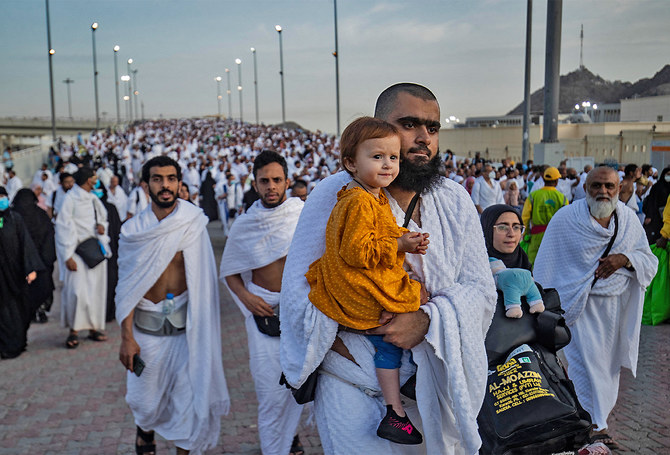
Thousands of Muslim pilgrims make their way across the valley of Mina, in western Saudi Arabia, to perform the "stoning of the devil" ritual on July 9, 2022. (AFP)
Short Url
Updated 12 July 2022
Follow

As Hajj concludes, Pakistani pilgrims recount special moments in Makkah

  • One pilgrim who got separated from his group spent the night moving, praying with strangers 
  • As the last day of Hajj comes to a close, Pakistani pilgrims will leave Mina in the evening

MAKKAH: Pakistani pilgrim Muhammad Shoaib experienced the true spirit of Islam while performing Hajj rituals last week, he said on Monday, when surrounded by a million people, he was separated from his group. 

Shoaib, who hails from Islamabad, was traveling to Muzdalifah to spend the night under a starry sky on Friday when he lost himself in the crowd and joined a group of pilgrims from another country.

“I didn’t know anyone around me,” he told Arab News on Monday. “I could not contact members of my own group since there were no Internet signals. I spent over an hour with unfamiliar faces and said my prayers with them.”

Shoaib said that night in Muzdalifah removed all differences of caste, color and country between the pilgrims. 

“We were all the same,” he said. “We were all one.”

“While every moment of Hajj is memorable,” he added, “this has got to be the highlight of my spiritual journey.”

The Pakistani pilgrim from Islamabad was not the only person who shared sentimental memories on the last day of Hajj.

Fiaz Mahmood, a pilgrim from Pakpattan, spoke about the memorable decision to walk from Mina to Arafat at night to sit in the front rows of the Nimrah Mosque and attend the Hajj sermon.

“People were also taking buses to the mosque,” he said. “However, my friends and I started walking toward our destination at midnight. We were surrounded by the vast expanse of the desert and it took us two hours to reach the mosque. I can never forget how we felt when we saw the minarets of the building from a distance. It was as if we were no longer tired. We only had a strong sense of gratitude after performing that journey.”

Chaudhary Hammad from Wah Cantt praised Saudi authorities for trying to provide the best possible services for pilgrims.

“I was among the pilgrims who benefited from the Makkah Route Initiative,” he told Arab News, referring to a Saudi facility under which pilgrims from Pakistan, Malaysia, Indonesia, Morocco and Bangladesh were allowed to go through the immigration process at their airport of origin.

“Since a large number of flights arrive in Saudi Arabia ahead of Hajj, it can get extremely crowded at airports,” Hammad said.

“But this initiative made things extremely comfortable. We walked out of the airport shortly after our arrival, though the immigration in Jeddah would have otherwise taken at least a few hours.”

As the last day of Hajj comes to a close, Pakistani pilgrims will leave Mina in the evening, Ibrar Mirza, the director-general of the country’s Hajj mission in Makkah, told Arab News.

He said his team was busy with last-minute arrangements for the pilgrims who would soon arrive to their respective accommodations in Makkah.

“Pilgrims performing Hajj under the government scheme, who have yet to go to Madinah, will travel to that city on Saturday,” he said. “Until then, they will continue to stay in Makkah.”


Pakistan, global crypto exchange discuss modernizing digital payments, creating job prospects 

Updated 05 December 2025
Follow

Pakistan, global crypto exchange discuss modernizing digital payments, creating job prospects 

  • Pakistani officials, Binance team discuss coordination between Islamabad, local banks and global exchanges
  • Pakistan has attempted to tap into growing crypto market to curb illicit transactions, improve oversight

ISLAMABAD: Pakistan’s finance officials and the team of a global cryptocurrency exchange on Friday held discussions aimed at modernizing the country’s digital payments system and building local talent pipelines to meet rising demand for blockchain and Web3 skills, the finance ministry said.

The development took place during a high-level meeting between Finance Minister Muhammad Aurangzeb, Pakistan Virtual Assets Regulatory Authority (PVARA) Chairman Bilal bin Saqib, domestic bank presidents and a Binance team led by Global CEO Richard Teng. The meeting was held to advance work on Pakistan’s National Digital Asset Framework, a regulatory setup to govern Pakistan’s digital assets.

Pakistan has been moving to regulate its fast-growing crypto and digital assets market by bringing virtual asset service providers (VASPs) under a formal licensing regime. Officials say the push is aimed at curbing illicit transactions, improving oversight, and encouraging innovation in blockchain-based financial services.

“Participants reviewed opportunities to modernize Pakistan’s digital payments landscape, noting that blockchain-based systems could significantly reduce costs from the country’s $38 billion annual remittance flows,” the finance ministry said in a statement. 

“Discussions also emphasized building local talent pipelines to meet rising global demand for blockchain and Web3 skills, creating high-value employment prospects for Pakistani youth.”

Blockchain is a type of digital database that is shared, transparent and tamper-resistant. Instead of being stored on one computer, the data is kept on a distributed network of computers, making it very hard to alter or hack.

Web3 refers to the next generation of the Internet built using blockchain, focusing on giving users more control over their data, identity and digital assets rather than big tech companies controlling it.

Participants of the meeting also discussed sovereign debt tokenization, which is the process of converting a country’s debt such as government bonds, into digital tokens on a blockchain, the ministry said. 

Aurangzeb called for close coordination between the government, domestic banks and global exchanges to modernize Pakistan’s payment landscape.

Participants of the meeting also discussed considering a “time-bound amnesty” to encourage users to move assets onto regulated platforms, stressing the need for stronger verifications and a risk-mitigation system.

Pakistan has attempted in recent months to tap into the country’s growing crypto market, crack down on money laundering and terror financing, and promote responsible innovation — a move analysts say could bring an estimated $25 billion in virtual assets into the tax net.

In September, Islamabad invited international crypto exchanges and other VASPs to apply for licenses to operate in the country, a step aimed at formalizing and regulating its fast-growing digital market.