

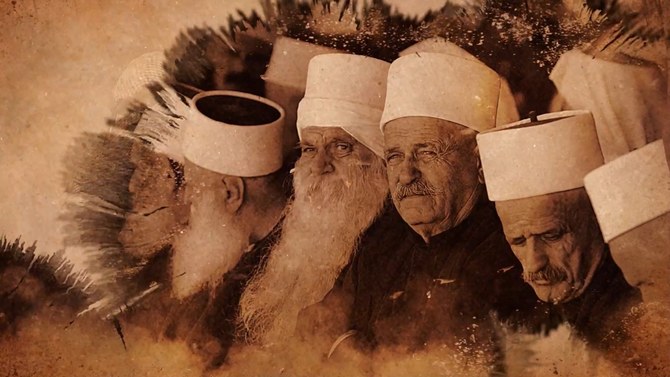

LONDON: In the latest in its series of in-depth multimedia features under the Minority Report banner, Arab News tells the riveting story of the “Druze: The great survivors,” one of the most mysterious and misunderstood faiths of the Middle East.
The series has so far featured “The Coptic Miracle,” “The Forgotten Arabs of Iran,” and the “Jews of Lebanon”. All these, along with other Deep Dives, can be viewed here.
The histories unearthed by these stories are always fascinating. Equally important, however, they show how many communities living in tension today have often lived in harmony with their neighbors in the past, and offer a valuable insight into communities that too often are misunderstood.
Take the Druze. The faith, which is rooted in Islam but draws inspiration from numerous sources, including the Qur’an, originated in Cairo in the early 11th century, during the reign of the sixth Ismaili Shiite Fatimid caliph, Al-Hakim Bi-Amr Allah.
At first, the faith was open to newcomers, its followers spreading the word freely and openly seeking converts. But with the mysterious disappearance of Al-Hakim in 1021, the Fatimid caliphate turned against the Druze, who were forced underground and scattered across the region.
In 1043, facing widespread persecution, the Druze closed their ranks to outsiders forever, abandoning proselytization and instead embracing secrecy for the sake of survival.

The Druze faith is rooted in Islam but draws inspiration from numerous sources. (AFP/File)
This secrecy is maintained to this day, even among the faithful, most of whom are denied access to the innermost scriptures and practices of the faith.
Today, the Druze can be found in their traditional mountain strongholds in Lebanon, Syria and Palestine — the very places where their ancestors sought sanctuary a thousand years ago.
Although they have successfully blended in with and offered their loyalty to any country in which they have settled, even as the map of the Middle East has been withdrawn around them by wars, the Druze face an uncertain future.
As a minority, they are particularly vulnerable to the political and social upheavals that have come to characterize much of the modern Middle East.
Meanwhile, as a faith closed to newcomers, and one seeing more and more of its number emigrating to seek new lives in the West, where many marry outside the faith, there is a fear that Druze numbers will fall to the point where the faith is no longer sustainable.

The Druze can be found in their traditional mountain strongholds in Lebanon, Syria and Palestine. (AFP/File)
Reaction to the Deep Dive report among the Druze community and Arab News readers has been positive, with many remarking on the emerging culture of openness and religious tolerance that its publication suggests.
“The world has changed,” one commentator remarked on Twitter after the publication of the Druze report.
“The Saudi English-speaking media are making a series of documentaries about various sects and groups … and there is an episode about the Druze. Completely unthinkable in the old days.”
Another, a Lebanese, commented that “this is a well-written, thorough introduction to the Druze. It provides a good overview of where they came from, the challenges they faced over the centuries, and the uncertain future that awaits them. Highly recommended.”
Hussein Ibish, senior resident scholar at the Arab Gulf States Institute in Washington, tweeted: “Excellent article ‘Druze: The great survivors’ in Arab News. One wouldn’t have seen an article like this in a Saudi newspaper, even in English, until the last couple of years. It’s another small example of a very big and rapid transformation.”
During a recent visit to the Arab News Riyadh bureau, Deborah Lipstadt, US special envoy to monitor and combat antisemitism, lauded the Minority Report series.
With the rank of ambassador, Lipstadt leads US diplomatic efforts to counter antisemitism throughout the world.
Taking part in a roundtable with Arab News journalists and editors on staff, she was briefed on the newspaper’s own efforts in combating hate speech and promoting religious tolerance.
“I've seen some of the work you’ve done (at Arab News), the covers, the Minority Report: The Jews of Lebanon. You’re putting the Hebrew greeting for the new year ‘Shana Tova’ on your front page. That's unimaginable,” she said.
“My country is not perfect; your country is not perfect. We have a long way to go, but what I’ve seen here certainly at Arab News is a great beginning.”
“The Jews of Lebanon,” published in 2020, took an in-depth look at one of the religious and ethnic groups that contribute to the rich cultural tapestry of the Middle East.
Praising the Minority Report, Lipstadt said: “The way in which hatred of one group morphs into hatred of another group, that the same operating principles in every prejudice, whether it’s racism, whether it’s antisemitism, whether it’s hatred of Muslims, whatever it might be, that it operates the same way.”

A Lebanese Jewish family gathered at a wedding in Beirut. (Lebanese Jewish Community).
It was precisely to counter such prejudices, by telling the true and frequently inspirational stories of the region’s minorities, that Arab News launched the Minority Report series in 2019.
The series has been making waves, in the region and beyond. It also reflects the claim by Arab News, which was founded in 1975, to be “the voice of a changing region.”
“The Jews of Lebanon” looked at how the country’s once thriving Jewish community all but vanished following the Six-Day War in 1967, when an alliance of Arab states, including Syria, Jordan and Egypt, were defeated by Israel.
As Arab News reported, “in the 1950s and 1960s there were 16 synagogues in Lebanon, and they were always full.” In fact, the only place in the Arab world where the number of Jews increased after Israel’s declaration of independence, and the subsequent first Arab-Israeli war in 1948, was Lebanon.
“But the 1967 war and the gruesome civil war that followed gradually drove Lebanese Jews away.”
On the eve of the war, there were an estimated 7,000 Jews in Lebanon. By 2020, as Arab News reported, there were fewer than 30.
Featuring interviews with Jews whose families had once lived in Lebanon, the Minority Report recalled how the Jewish neighborhood of Beirut had been established in 1800 by the Levy family, who had come from Baghdad.
In January, Arab News published a Minority Report feature on the Ahwazi Arabs of Iran, a community who have experienced persecution and cultural descrimination over the century since losing their autonomy.
For centuries, Arab tribes had ruled a large tract of land in today’s western Iran. Al-Ahwaz, as their descendants know it today, extended north over 600 km along the east bank of the Shatt Al-Arab, and down the entire eastern littoral of the Gulf, as far south as the Strait of Hormuz.

The Arabs of Ahwaz remain Iran’s most persecuted minority. (Supplied)
But, after losing the support of the British Empire, which had initially courted its leaders in pursuit of access to its vast untapped oil resources, the Arab region quickly fell under the yolk of Tehran.
Within a decade, the name Arabistan had been wiped from the map, and the Ahwazi Arabs of Iran had fallen victim to a brutal oppression that continues to this day.
In April, Arab News published another Minority Report Deep Dive, this time focused on Egypt’s Coptic Christian community.
“The Coptic Miracle” told the story of how Egypt’s historic Christian church not only survived but thrived, at home and abroad.
It focused on the extraordinary story of the Coptic Orthodox Church of Alexandria, which parted company with the rest of Christendom in the fifth century after a fundamental disagreement over the nature of Christ’s divinity.
Founded in the great city of Alexandria by Mark the Evangelist in about A.D. 60, the church and its followers have undergone centuries of turmoil.
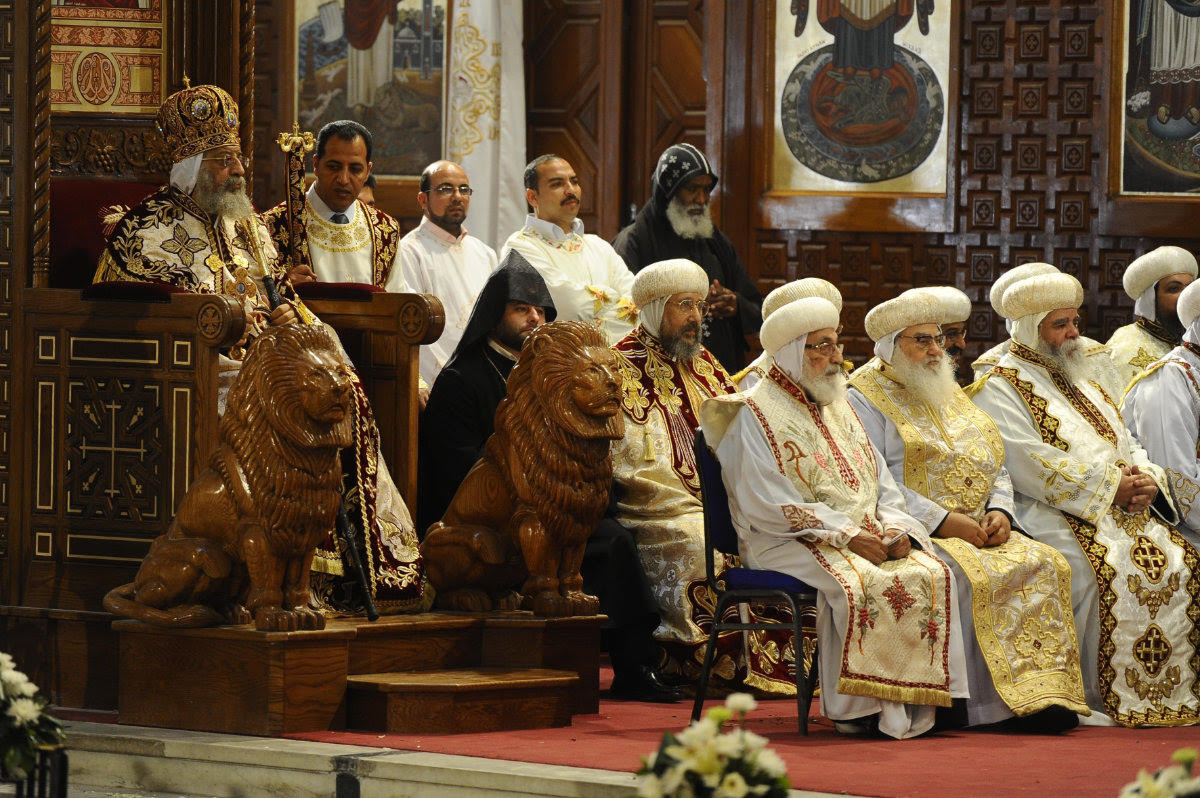
Coptic Orthodox Pope Tawadros II, left, leads the Easter mass at St. Mark's Cathedral in Cairo, Egypt on April 11, 2015. (Anadolu Agency/Getty Images)
After the rise of Islam and the conquest of Egypt in the seventh century, although there were isolated periods of persecution, over the centuries the Copts were treated well enough.
Since the 1970s, many Copts, driven either by fear or economic pressures, have emigrated to seek new futures in the West, mainly in the US, Canada, Australia and the UK.
Wherever they have put down roots, Coptic communities and their churches have blossomed, and maintain close links with Egypt and the faith.

keywords

keywords

keywords

keywords


