



KARACHI: Prime Minister Shehbaz Sharif on Monday offered “every possible support” to the government of the Pakistani province of Sindh, as heavy rains battered the provincial capital, Karachi, on Monday, killing at least 11 people, and leaving large parts of the city under water and without power on the second day of Eid Al-Adha.
Dr. Sumaiyya Syed, police surgeon of Karachi, told Arab News 11 deaths from rain-related accidents had been reported at three government hospitals of the city in the last 24 hours. Citizens complained of prolonged power outages and said water, standing for hours on roads, was entering their homes, as #KarachiRain trended on Twitter. There were also traffic jams reported across the city, with many main thoroughfares closed for vehicles.
Intense floods have killed dozens and left hundreds homeless across Pakistan since monsoon downpours began in mid-June, with the death toll from rain-related incidents rising past 150 by Monday.
Heavy rains over the Eid holiday brought to the fore memories of August 2020, when record-breaking heavy rain in Karachi killed over 100 people and disrupted the lives of many of the city’s more than 15 million residents as water flooded main roads and homes.
“A total of 11 rain-related deaths have been reported in the medico-legal sections of JPMC [Jinnah Post Graduate Medical Center]. CHK [Civil Hospital Karachi] and ASH [Abbas Shaheed Hospital] during last 24 hours,” Syed said.
PM Sharif meanwhile offered all necessary help to the Sindh government.
“Deeply saddened by the tragic losses due to torrential rains in Karachi. I am confident that Sindh govt will rise to the occasion & bring life back to normal under the able leadership of CM Sindh. Have offered to extend every possible support,” Sharif tweeted.
A statement from the PM House said Sharif had directed provincial governments and the National Disaster Management Authority (NDMA) to ensure protection of people and prevention of losses.
“The federal government should provide full support to the provincial governments and institutions,” the PM said.
“People in endangered areas should be shifted to safer places. Provision of temporary shelter and food to the affected people should be ensured. Medical teams to be mobilized for emergency medical aid and prevention of epidemic diseases.”
Meanwhile, Karachi Commissioner Muhammad Iqbal Memon urged Karachi residents not to leave their homes unnecessarily and stay away from electricity poles, drains and manholes. He also shared emergency contact details:
Speaking to Arab News, Met Office director Sardar Sarfraz said Karachi’s DHA Phase 2 alone had received up to 126 millimeters of rain on Monday morning.
“Heavy downpours have created urban flooding and the situation may further aggravate with light to heavy rains expected in different parts of the city in the evening,” Sarfaraz said, adding that more heavy rains should be expected as a new weather system entered Karachi on July 14 and lasted up to five days.
He said intermittent rain with thunder was also expected in Mirpurkhas, Umerkot and Tando Mohammad Khan and warned of a risk of flooding in low-lying areas in Karachi, Badin, Thatta, Mirpurkhas and Umerkot.
Video footage widely shared by Karachi residents on Twitter showed rainwater inside houses in different parts of Karachi.
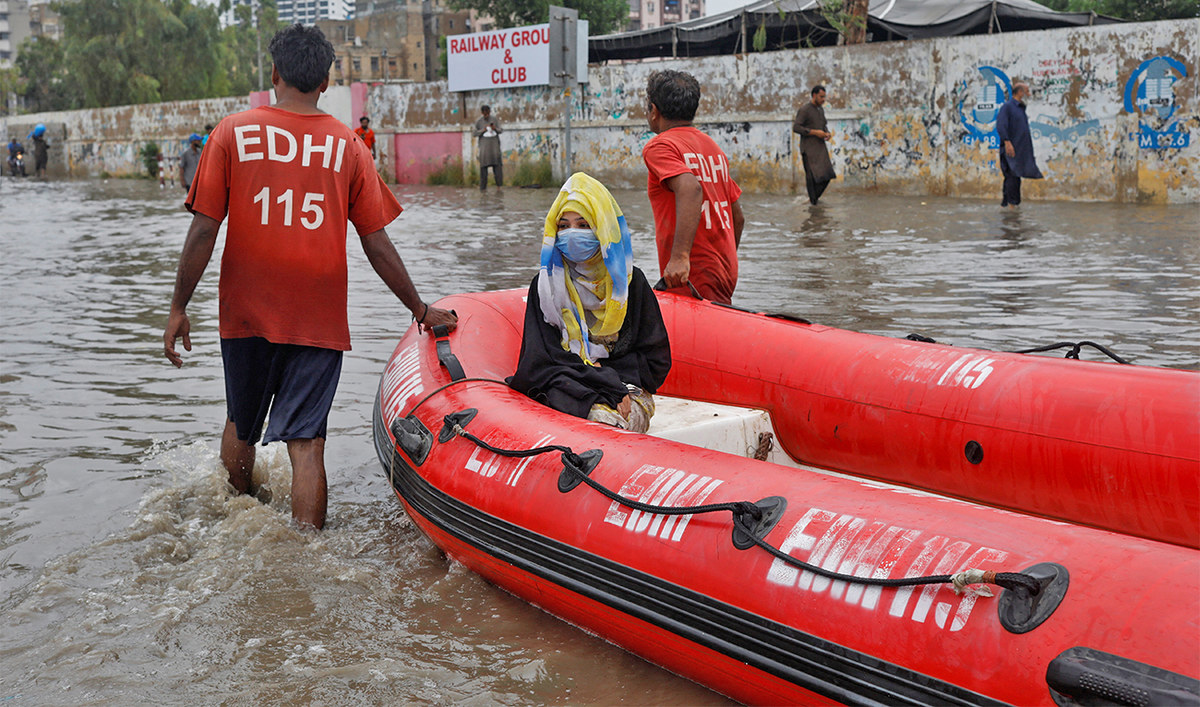
A woman sits in a rubber boat as volunteers pull through a flooded road during the monsoon season in Karachi, Pakistan, on July 9, 2022. (REUTERS)
Chief minister Sindh, Syed Murad Ali Shah, and city administrator Murtaza Wahab, on Monday visited different areas of the city and instructed municipal authorities to drain water, Rasheed Channa, a spokesperson for the chief minister, said.
“Chief minister went to Pir Sibghatullah Rasheed road, Islamia college and other areas of district east with rainwater and directed the water board and deputy commissioner to pump the water out,” Channa said.
In an update shared on Twitter around 2:30am, a spokesperson for K-Electric said the power supply system within its territory was stable.
“Most areas of the city continue to receive power from more than 1,770 feeders out of 1,900,” the Twitter post said, adding that around 130 feeders were closed as a precautionary measure due to reports of power theft or the accumulation of rain water.
Rain wreaked havoc in other parts of Pakistan also on Monday.
Bilal Ahmed, a spokesperson for Rescue 1122 services in the northwestern province of Khyber Pakhtunkhwa, said floods caused by heavy rain had killed five people there.
“Some villages of KP, including Kund Mor, Ambaar, Zakeria Sheikh, Chhota Lahore and Merghoz, are seriously affected by the rains but reports of submerging of entire villages under rainwater are untrue,” Ahmed told Arab News, adding that people were being moved to safe locations.


