

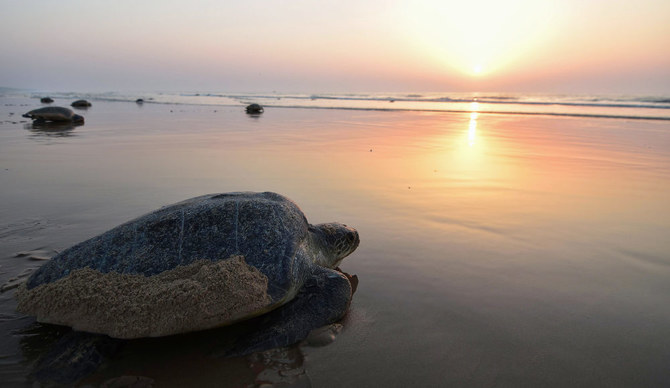
Qatari children help give endangered turtles second chance

The nests are moved from under the sand on the main beach and placed under an awning to protect them from tides and predators. (AFP)
Short Url
Updated 10 July 2022
Follow

Qatari children help give endangered turtles second chance

  • The Qatari program was launched as far back as 2003, and in the last five years has sent some 30,000 hatchlings into the sea, including 9,000 in 2020 when the pandemic cleared the waters of their human visitors

DOHA: On a beach in northeastern Qatar, six-year-old Lolwa waves goodbye to two baby hawksbill turtles — a species that has a one in a thousand chance of surviving to adulthood.
Predators, climate change, fishing nets and marine pollution all contributed to the classification of these narrow-beaked creatures as “critically endangered” in 1996.
But a conservation program in Qatar is hoping to revive the dwindling species, releasing thousands of hatchlings into the sea each year, now with the help of young children.
“As adults we are kind of beyond hope,” said Clara Lim, a representative of the Dadu children’s museum that organized the initiative for youngsters.

FASTFACT

The Qatari program was launched as far back as 2003, and in the last five years has sent some 30,000 hatchlings into the sea, including 9,000 in 2020 when the pandemic cleared the waters of their human visitors.

“But children have the power to really internalize all these things that they are learning ... and they make these habits part of their life.”
The Qatari program was launched as far back as 2003, and in the last five years has sent some 30,000 hatchlings into the sea, including 9,000 in 2020 when the pandemic cleared the waters of their human visitors.
Between April and June, Qatari environmentalists watch for female hawksbills that have arrived at Fuwairit beach to give birth, measuring them, providing care if needed, and sometimes attaching tracking devices.
The nests are moved from under the sand on the main beach and placed under an awning to protect them from tides and predators.
Sixty days later, at the time of hatching, “the good and healthy ones ... we release to the sea,” said Mohamed Seyd Ahmed, a wildlife expert at the Qatari Environment Ministry.
“Other small or tired ones ... we release in a pool” to allow them to grow stronger first, he added.
The turtles “act as a vacuum (cleaner),” Ahmed explained, consuming jellyfish and seagrass, so their decline has an effect “on all marine life.”
On an evening in June, young Lolwa is joined by eight-year-old Shaikha and nine-year-old Abdullah to release the baby turtles out to sea.
Close contact with the turtles has created a bond between them and the children, who have affectionately given the creatures names like Sassa and Blueberry.
As hoped, attitudes are already changing in this young generation.
“We cannot throw plastic in the sea because they (the turtles) will get caught in the plastic,” says Shaikha.
Poaching and a lack of space also threaten these animals that reach adulthood at 25 and live for an average of 50 years.
Since turtles instinctively return to lay eggs on the beaches where they were born, it will be possible to measure the success of the program, but not until 2028, when the first hatchlings released in 2003 come back to lay their eggs.
But with 97 nests — each containing between 80 and 120 eggs — on Fuwairit beach this year compared to 15 in 2012, there is already cause for optimism.
“The statistics show that there are more turtles coming to breed here,” says Thierry Lesales, president of the Qatar Natural History Group.


Cambodia takes back looted historic artifacts handled by British art dealer

Updated 28 February 2026
Follow

Cambodia takes back looted historic artifacts handled by British art dealer

  • The objects were returned under a 2020 agreement between the Ministry of Culture and Fine Arts and the family of the late Douglas Latchford, a British art collector and dealer who allegedly had the items smuggled out of Cambodia

PHNOM PENH, Cambodia: Cambodian officials on Friday received more than six dozen historic artifacts described as part of the country’s cultural heritage that had been looted during decades of war and instability.
At a ceremony attended by Deputy Prime Minister Hun Many, the 74 items were unveiled at the National Museum in Phnom Penh after their repatriation from the United Kingdom.
The objects were returned under a 2020 agreement between the Ministry of Culture and Fine Arts and the family of the late Douglas Latchford, a British art collector and dealer who allegedly had the items smuggled out of Cambodia.
“This substantial restitution represents one of the most important returns of Khmer cultural heritage in recent years, following major repatriations in 2021 and 2023 from the same collection,” the Culture Ministry said in a statement. “It marks a significant step forward in Cambodia’s continued efforts to recover, preserve, and restore its ancestral legacy for future generations.”
The artifacts were described as dating from the pre-Angkorian period through the height of the Angkor Empire, including “monumental sandstone sculptures, refined bronze works, and significant ritual objects.” The Angkor Empire, which extended from the ninth to the 15th century, is best known for the Angkor Wat archaeological site, the nation’s biggest tourist attraction.
Latchford was a prominent antiquities dealer who allegedly orchestrated an operation to sell looted Cambodian sculptures on the international market.
From 1970 to the 1980s, during Cambodia’s civil wars and the communist Khmer Rouge ‘s brutal reign, organized looting networks sent artifacts to Latchford, who then sold them to Western collectors, dealers, and institutions. These pieces were often physically damaged, having been pried off temple walls or other structures by the looters.
Latchford was indicted in a New York federal court in 2019 on charges including wire fraud and conspiracy. He died in 2020, aged 88, before he could be extradited to face charges.
Cambodia, like neighboring Thailand, has benefited from a trend in recent decades involving the repatriation of art and archaeological treasures. These include ancient Asian artworks as well as pieces lost or stolen during turmoil in places such as Syria, Iraq and Nazi-occupied Europe. New York’s Metropolitan Museum of Art is one of the prominent institutions that has been returning illegally smuggled art, including to Cambodia.
“The ancient artifacts created and preserved by our ancestors are now being returned to Cambodia, bringing warmth and joy, following the country’s return to peace,” said Hun Many, who is the younger brother of Prime Minister Hun Manet.