

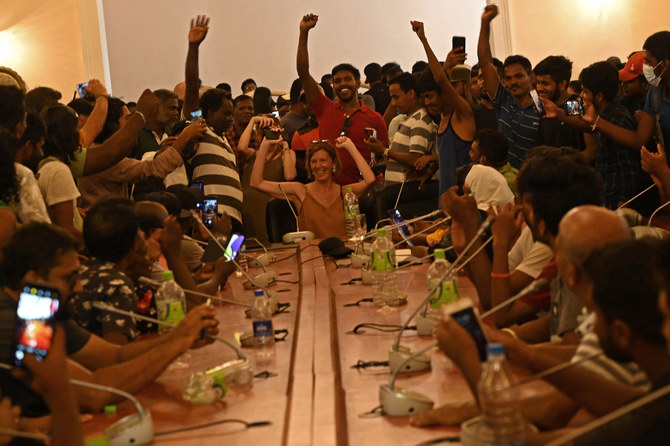

COLOMBO: Sri Lanka President Gotabaya Rajapaksa’s announcement that he would resign on July 13 has failed to appease the public, as calls for him to step down immediately continued on Sunday, a day after protesters stormed the presidential palace and thousands of people descended on the capital Colombo.
The island nation of 22 million people is facing its worst economic crisis in memory, triggered by a severe shortage of foreign reserves that has stalled essential imports. Sri Lankans have suffered through months of food and fuel shortages that forced schools to shut and led to record inflation, reaching 54.6 percent in June.
Nationwide protests have rippled amid the devastation, with many campaigning outside the president’s office since March to demand Rajapaksa’s resignation. Many hold the leader responsible for the country’s economic meltdown.
The demonstrations reached new heights on Saturday, when thousands of people marched to Colombo and hundreds of others stormed into the presidential complex and later the premier’s house, forcing Rajapaksa and Prime Minister Ranil Wickremesinghe to announce their resignations.
Rajapaksa’s resignation was announced by parliamentary speaker Mahinda Yapa Abeywardena.
“He asked me to inform the country that he will make his resignation on Wednesday the 13th, because there is a need to hand over power peacefully,” Abeywardena said in a televised statement on Saturday.
Wickremesinghe had announced his own impending resignation but said that he would not step down until a new government was formed.
Doubts lingered among Sri Lankans following the announcements, as many continued their calls for the country’s leadership to resign immediately.
“They have done enough damage. They should resign immediately,” Nuzly Hameem, a 28-year-old engineer and activist who took part in Saturday’s protests, told Arab News.
“Protesters won’t fall for these tricks played by the politicians.”
Mohammed Nivad, a Colombo-based executive, told Arab News that he is also expecting “political tricks” to come into play.
“Seeing what has been going on in the country from the time the president was appointed and how he was appointed, we can expect more tricks until he is finally sent off,” Nivad said.
Rajapaksa, whose family has dominated Sri Lankan politics for much of the past two decades, has previously resisted calls to resign. The country’s downward spiral had forced members of the ruling dynasty to give up their seats in the government, including his brother and former prime minister Mahinda Rajapaksa, who was replaced by Wickremesinghe in May.
Both Wickremesinghe and Rajapaksa must resign together, according to Shreen Saroor, a women’s rights activist based in Colombo.
“The country and its people have been suffering for too long from the clutches of Rajapaksas. Corruption and nepotism have become the norm of their rule and that made people who voted for them to chase them from power,” Saroor told Arab News.
Though the fuel crisis made travel challenging for many, protesters crowded onto buses and trains, and some made their way on bicycles and on foot over the weekend to travel to the capital, as discontent swelled over the government’s inability to address the devastating economic crisis.
“People’s commitment to the struggle is very impressive,” human rights activist Muheed Jeeran told Arab News. “People are frustrated about the hardship they are going through now.”
Mujibur Rahman, an opposition lawmaker from the Samagi Jana Balawegaya party, estimated that more than half a million protesters were in Colombo on Saturday and said that the process of forming a new government is underway.
“We are already in the process of forming an all-party conference to form a new government with a new prime minister and a new president, which can give a new lease of life to this dying government,” Rahman told Arab News.
“The president and prime minister have to resign in response to the public outcry, and we hope for the best.”


