

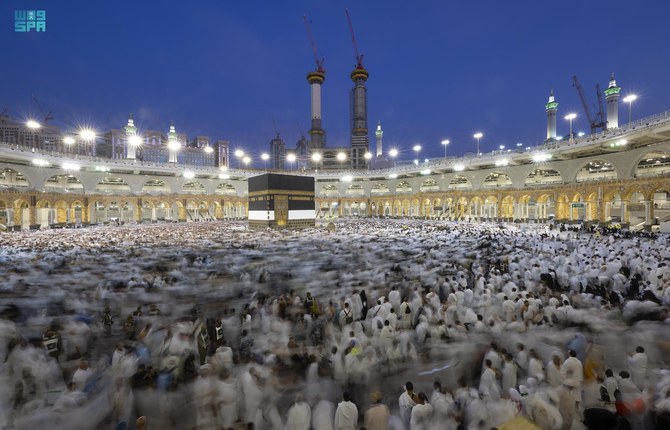
Saudi virtual hospital assists Hajj pilgrims

Saudi officials confirm pilgrimage process going smoothly amid advanced security and health services. (File/SPA)
Short Url
Updated 28 August 2022
Follow

Saudi virtual hospital assists Hajj pilgrims

  • Patients of the virtual hospital can consult specialized physicians without having to travel to different parts of the Kingdom

RIYADH: Saudi Arabia’s Seha Virtual Hospital, which claims to be the largest network of its kind in the world, is helping to address the healthcare needs of Hajj pilgrims from across the world.

The hospital was launched in February this year as part of the Kingdom’s efforts to digitalize its healthcare sector. Patients of the virtual hospital no longer need to travel to different parts of the Kingdom to be seen by specialized physicians, and are not limited to regular clinic hours.

Connected to 152 hospitals and covering more than 34 subspecialties throughout Saudi Arabia, Seha Virtual Hospital claims to be the largest of its kind in the world and the first in the Middle East and North Africa region.

Seha’s chief operating officer Dr. Hani Al-Harbi said that Seha’s still-expanding network connects 13 hospitals in Makkah and Madinah alone to answer the needs of Hajj pilgrims, focusing on four main areas: Stroke, intensive care, radiology, and medical consultations.

Earlier, another official told Arab News that patients can now receive second and third medical opinions from the same consulting room, as the virtual hospital allows patients to visit their local hospital and attend a real-time clinical video session with top specialists from across the Kingdom. During the session, vitals signs can be monitored and shared, while tests and X-rays can also be taken and shared with the network of specialists.

Emergency interventions can be provided round the clock, and real-time consultations with top specialists will guide local staff in dealing with complex cases.


Over 4.8m captagon pills found hidden in Jeddah charcoal shipment

Updated 09 January 2026
Follow

Over 4.8m captagon pills found hidden in Jeddah charcoal shipment

  • Captagon is an addictive, amphetamine-type stimulant that is mass-produced in illicit factories

RIYADH: Saudi Arabia’s Zakat, Tax and Customs Authority foiled an attempt to smuggle more than 4.8 million captagon pills through Jeddah’s port, hidden inside a shipment of charcoal.

The authority’s spokesperson Hamoud Al-Harbi said that a shipment arrived at the port, which, after being assessed by customs authorities, was found to contain a large amount of the illicit drug, hidden inside charcoal bags, the Saudi Press Agency reported.

After the pills were seized, the authority coordinated with the General Directorate of Narcotics Control to ensure that the intended recipients were arrested.

Al-Harbi added that ZATCA is working to tighten customs control on Saudi imports and exports and stands ready to combat smuggling.

He called on members of the public to contribute to the fight against smuggling.

ZATCA may be contacted for security reports by phone from inside the Kingdom at 1910, outside the Kingdom at +9661910, or by email at [email protected].

The authority receives reports related to smuggling crimes and violations of the customs system in complete confidentiality and offers financial rewards to any reports that are accurate.

Captagon is an addictive, amphetamine-type stimulant that is mass-produced in illicit factories.

It is simple to produce compared to other narcotics, and drug smugglers have found a market for the substance in the Gulf states.

Syria under Bashar Assad was one of the largest producers of captagon in the region.

When his government was overthrown in December 2024, one of the first steps taken by the new President Ahmed Al-Sharaa was to crack down on the production of captagon in Syria.