

Health status of pilgrims in Arafat is reassuring: Saudi Health Minister

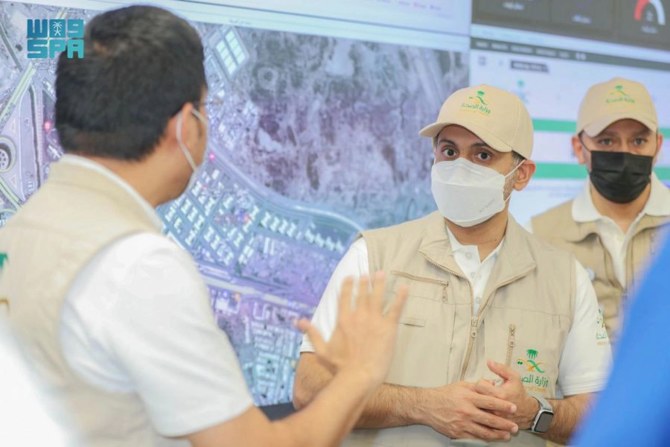
Saudi Arabia's Health Minister Fahd Al-Jalajel on Friday affirmed that the health status of pilgrims in Arafat is reassuring. (SPA)
Short Url
Updated 08 July 2022
Follow

Health status of pilgrims in Arafat is reassuring: Saudi Health Minister

  • MOH committed to protect pilgrims' health, control of communicable, infectious diseases is done according to a strict control system

RIYADH: Saudi Arabia's Health Minister Fahd Al-Jalajel on Friday affirmed that the health status of pilgrims in Arafat is reassuring, stressing that health services are provided at full capacity in this Hajj season, the biggest pilgrimage since the coronavirus pandemic forced drastic cuts in numbers two years in a row.

He pointed out that adherence to health requirements and raising awareness of the use of umbrellas is a helpful factor, disclosing that three cases of heatstroke were recorded among pilgrims.

Al-Jalajel affirmed that the ministry's early preparations and infrastructure readiness, in addition to applying requirements, early examination, monitoring and investigation processes have an effective factor in maintaining the health safety of pilgrims.

The Health Ministry, committed to protect pilgrims' health during the Hajj, is fully prepared to ensure health facilities of excellent standards.

Dr. Hani Jokhdar, Undersecretary of the Ministry of Health for Public Health, who is also chairman of the Hajj Preparatory Committees, confirmed: "Control of epidemiological, communicable and infectious diseases is done according to a strict control system, designed to monitor and spot the first point of the disease through an early warning system that prompts speedy intervention and control its possible spread among pilgrim crowds under direct and round-the-clock leadership and control operation room, considered among the strongest and most efficient in this field in the world."

"The central operation room, based in the headquarters of the ministry is equipped with state-of-the-art means to control all activities run by health facilities operating in the sacred places, the holy capital of Makkah, Al-Madinah Al-Munawarah, Jeddah, Taif, and Al-Baha and provide necessary advice," said Dr. Jokhdar.

"This year, the ministry introduced the virtual medicine program using virtual clinics serving needy patients based outside Makkah," he said.

He pointed out that heat stress is the most popular complaint from pilgrims, followed by injuries, respiratory diseases, sun strokes, diabetes, blood pressure, and asthma.

He stated that this year the ministry has provided nine hospitals, including a field hospital and a mobile one, more than 1000 beds, 210 ICU beds, more than 175 beds for stroke-hit patients, 75 isolation rooms, 93 health centers in the sacred sites, as well as medical services for emergency and dangerous diseases, including heart diseases, to transfer them to specialized hospitals inside Makkah.

Earlier, Al-Jalajil has inspected hospitals and other health facilities in Makkah and the holy sites ahead of the Arafat day on Friday to ensure they are up to standard for the pilgrims.

Crowds in Ihram (white robed Muslim pilgrims) prayed on Mount Arafat in Makkah on Friday, the climax of the biggest Hajj pilgrimage since the coronavirus pandemic forced drastic cuts in numbers two years in a row.

Prayers on Mount Arafat, also known as the “Mount of Mercy,” are the highlight of the pilgrimage, capped this year at one million people including 850,000 from abroad after COVID19 greatly reduced numbers over 2020 and 2021.

Earlier, pilgrims had moved to the tent city og Mina on Thursday to perform their Hajj rites.


Absher Hackathon finalists highlight scale of Saudi tech talent

Updated 14 December 2025
Follow

Absher Hackathon finalists highlight scale of Saudi tech talent

  • World’s largest hackathon underscores growing national enthusiasm for tech innovation

RIYADH: Saudi Arabia’s push to position itself as a global hub for digital innovation was on display this weekend as the Absher Tuwaiq Hackathon 2025 — billed as the world’s largest hackathon — concluded with the announcement of finalist teams competing for prizes totaling SR1 million ($266,000). 

The three-day hackathon, organized by the Ministry of Interior in partnership with Tuwaiq Academy, brought together innovators from across the Kingdom to develop digital solutions aligned with the ministry’s digital transformation goals. 

The finalist teams recognized for their projects were: Shadow, Wusool, Watheeq , Tanabbah, HRS, Ikhlaa, Amal, Mustabiq, Al‑Dahna, Inspire, Saqour Al‑Watan, Thaqib, Sawt Al‑Mustaqbal, Manee, and YS Advance International. 

The finalists were announced at the end of the three-day Absher Tuwaiq Hackathon organized by the Ministry of Interior in partnership with Tuwaiq Academy. (AN photo/Supplied)

In addition to cash prizes, the competition offered SR450,000 in support from the National Technology Development Program, along with incubation opportunities at Invi Lab to help teams turn prototypes into market-ready products.   

Tariq Al‑Hamid, official spokesperson for the Absher Conference, told Arab News that the hackathon has generated strong momentum nationwide.  

This year’s event included more than 4,000 participants from all regions of the Kingdom — “a reflection of the growing national enthusiasm for digital innovation,” he said. 

HIGHLIGHT

The Absher Tuwaiq Hackathon brought together innovators from across the Kingdom to develop digital solutions aligned with the ministry’s digital transformation goals. 

According to Al‑Hamid, the 2025 event was structured around four specialized tracks: digital identity and security applications; artificial intelligence for predictive and proactive security; Internet of Things applications supporting field operations; and innovations to enhance or expand services on the Absher Platform. 

Tariq Al-Hamid (center) said that the hackathon’s impact extends beyond prize money. (Supplied)

He added that this focused approach allowed participants “to present high‑quality ideas and advanced prototypes at levels comparable to international competitions.” 

Participants also took part in more than 80 training programs delivered by global partners including Google Cloud, Meta, NVIDIA, and Huawei, an experience Al-Hamid said significantly strengthened both the competition and participants’ skills. 

Al-Hamid said that the hackathon’s impact extends beyond prize money. “More important than the cash reward is the opportunity to turn creative ideas into real products that make an impact on citizens, residents, and visitors.” 

Standout participants often attract the attention of leading national technology companies seeking new talent, he added. 

Participation was open to individuals and teams from across Saudi Arabia, from high school students to industry professionals, highlighting the inclusivity of the event and the breadth of the Kingdom’s innovation ecosystem.  

The hackathon forms part of the wider Absher Tuwaiq initiative, a core pillar of the upcoming Absher Conference 2025, which will empower more than 100,000 participants across seven technical tracks in 16 cities, in partnership with 20 local and international organizations. 

The conference, organized by the Ministry of Interior and Tuwaiq Academy, sponsored by Elm Company and held in strategic partnership with the Saudi Data and Artificial Intelligence Authority, will take place in Riyadh from Dec. 17 -19. 

The event will showcase national digital innovations and reinforce Saudi Arabia’s role in global technology.