

Al-Issa urges Muslims to glorify Allah in Arafat Day sermon

1 / 4
Muslim World League head Sheikh Dr. Muhammad bin Abdul Karim Al-Issa gives Arafat sermon at Nimrah Mosque in Makkah during Hajj. (SPA)
2 / 4
Hajj pilgrims were urged to take advantage of their time at the holy sites to supplicate and seek forgiveness from Allah. (SPA)
3 / 4
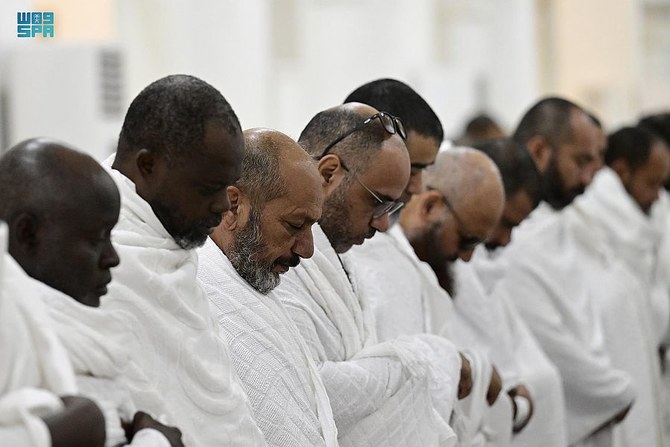
Pilgrims gathered at Mount Arafat on Friday and prayed at Nimrah Mosque. (SPA)
4 / 4
Pilgrims at Mount Arafat listened to the sermon by Sheikh Dr. Muhammad bin Abdul Karim Al-Issa. (SPA)
Short Url
Updated 08 July 2022
Follow

Al-Issa urges Muslims to glorify Allah in Arafat Day sermon

  • Love and compassion are key tenets of the faith, says MWL leader
  • Believers must avoid actions causing hatred and division

MINA: Muslims should praise the Almighty and become ambassadors for Islam by always following its precepts on good behavior, said Sheikh Dr. Muhammad bin Abdul Karim Al-Issa, secretary-general of the Muslim World League and member of the Council of Senior Scholars, during the Arafat Day sermon delivered at Namirah Mosque on Friday.

Addressing the pilgrims and Muslims around the world, he said good deeds would guarantee happiness in this life and ensure Allah’s rewards in the hereafter.

Al-Issa reminded Muslims that the main injunction of Islam was to only worship Allah.

“Allah has sent down the divine books and sent prophets and messengers as teachers to their nations, calling (them) to monotheism and singling out Allah in worship. All the prophets told their people to worship Allah, and no one else,” he said in his sermon.

Al-Issa, who delivered the Arafat sermon for the first time, emphasized the importance of Islam’s five pillars of faith.

Addressing the pilgrims, he said Allah has honored them with the opportunity to perform Hajj this year, and urged them to follow the guidance of Prophet Mohammed when completing their rituals.

He also urged Muslims to continue to carry out good deeds and treat others well, including those of other beliefs.

“All people, whether Muslims or not, respect those with good manners, for sound conduct is a high human value,” he said.

He urged the faithful to distance themselves from actions that can cause disharmony, hatred and division.

“Love and compassion should prevail in our dealings, and it is part of our faith that we all together unite,” he said, adding that cooperation can preserve the Muslim community’s cohesion.

“This proves the fact that Islam is an all-encompassing spirit that includes goodness to all humanity. Our Prophet has said: ‘The best people are those who are the most beneficial to people.’”

He concluded by urging the pilgrims to take advantage of their time at the holy sites to supplicate and seek forgiveness from Allah for their sins.


Saudi Arabia, Estonia strengthen cyber defense cooperation

Updated 5 sec ago
Follow

Saudi Arabia, Estonia strengthen cyber defense cooperation

  • Renowned for its leadership in digital governance, Estonia sees cybersecurity as central to its partnership potential with Saudi Arabia, building on years of regional engagement through its technology firms

RIYADH: Estonia aims to deepen defense, cybersecurity, and artificial intelligence cooperation with Saudi Arabia as both nations look to advance technology‑driven defense and cybersecurity capabilities.

Hanno Pevkur, Estonia’s minister of defense, told Arab News at the World Defense Show in Riyadh on Monday that Estonia’s defense industry is eager to contribute to the Kingdom’s fast‑growing defense ecosystem.

“In the modern world, cooperation built on trust and technology is the best defense,” he said. “It is important for us to be here because we clearly see there is a possibility to increase cooperation, not only bilaterally between Saudi Arabia and Estonia, but across the region.”

At Estonia’s pavilion, a cooperation agreement was signed between an Estonian company and a Saudi firm during the show, he noted.

Pevkur also said Estonia’s defense sector has expanded rapidly in recent years, driven by technological innovation and partnership.

“Our defense industry is growing very rapidly, and we continue to see strong momentum,” he said.

He said Estonia’s strengths lie in digital and smart‑system integration rather than large‑scale weapons production.

“We will not build airplanes or tanks, but what we can do is integrate robotics, automation and drones to make existing systems smarter,” he said.

The minister said effective defense collaboration must link businesses and governments to achieve meaningful results.

“When we want to have real cooperation, we need it on all levels,” he said. “The biggest client for any defense company is the government, so we must treat this as one ecosystem where the public and private sectors work hand in hand.”

Renowned for its leadership in digital governance, Estonia sees cybersecurity as central to its partnership potential with Saudi Arabia, building on years of regional engagement through its technology firms.

Pevkur said several Estonian companies, including Nortal, have already assisted Gulf governments in developing open IT and digital‑service systems.

“As the most digitalized nation in the world, almost every service in Estonia can be done online, except getting married,” he said. “But with such digitalization, we also need strong cyberdefense.”

He said data protection and digital resilience are treated as matters of national sovereignty in Tallinn, the capital of Estonia.

“Data is what we own. When someone steals that data, it becomes a serious threat,” he added. “That is why cyberdefense is not just about technology, it is about trust, sovereignty and protection.”

Pevkur said Saudi Arabia’s advances in AI offer promising opportunities for collaboration.

“I know that Saudi Arabia is doing great work when it comes to AI,” he said. “For us, as a small country with limited human resources, AI is essential not just for defense but for everyday life.”

Pevkur added that Estonia has launched a national AI strategy to promote responsible development and closer coordination between government and industry. One Estonian company, he said, has developed a system that allows a single operator to control hundreds of drones through AI.

“It is quite easy to put a weapon into the hands of a robot, but we also need to define who is accountable for its actions,” he said.

“The big question for the future is whether we can allow a war to be fought entirely by AI, or if humans must always make the final ethical decisions.”

He said in his conclusion that governments must reach a common understanding on how AI will be used and regulated on the battlefield.