

Women don colorful robes at guardian-free Hajj

Muslim pilgrims circumambulate the Kaaba at the Grand Mosque, in Saudi Arabia's holy city of Makkah on July 6, 2022. (AFP)
Short Url
Updated 08 July 2022
Follow

Women don colorful robes at guardian-free Hajj

  • Requirement of male guardian was shelved last year, bringing a whole new dimension to the annual pilgrimage
  • Many women abandoned black robes traditionally preferred by Hajj organizers, reds, greens, oranges, blues dotted crowds 

MAKKAH: With her husband back at home in Tunisia and draped in a national flag, Laila Al-Qarni urges all Muslim women to attend Saudi Arabia’s Hajj without a male guardian, after the requirement was shelved last year.

The Saudi authorities’ move has brought a whole new dimension to the annual pilgrimage.

“Why do women have to be accompanied by a male anyway? Why?” she said, speaking near the Grand Mosque in Makkah, Islam’s holiest city, in western Saudi Arabia.

“Women are capable of handling themselves. I encourage every woman to come here without a male guardian,” the 60-year-old added.


Muslim pilgrims arrive outside the Grand Mosque in Saudi Arabia's holy city of Makkah on July 5, 2022. (AFP)

This year’s Hajj, the first large-scale edition since the guardian requirement was dropped in 2021 amid Covid-19, has taken on a different hue with thousands of unaccompanied women joining the rituals.

Many of them have abandoned the black robes traditionally preferred by Hajj organizers, adding a dash of color with reds, greens, oranges and blues dotted around the crowds.

Arab women should be “courageous and able to adapt” to different circumstances, said Al-Qarni’s sister, Hayat Abdul Malek.

“A woman is worth 100 men,” said the mother of three, who managed 1,400 employees at the company where she worked before retiring.

Last year, the Saudi Hajj ministry allowed women of all ages to make the pilgrimage without a male relative, known as a “mehrem,” on the condition that they go in a group.


emale Muslim pilgrims pray in the shade, to escape the heat, during the annual hajj pilgrimage in the Saudi holy city of Makkah, on July 6, 2022. (AFP)

Authorities previously stipulated a male guardian for any female pilgrim under the age of 45, preventing many women around the world from performing one of the five pillars of Islam.

Al-Qarni’s husband could not attend because he is over the maximum age of 65.

The new ruling has also encouraged women over 45 who had been hesitant to attend without their brothers, sons, fathers or husbands.

One million people, including 850,000 from abroad, are allowed at this year’s Hajj after just tens of thousands could attend over the last two years, due to pandemic restrictions.

On Saturday, the local women of Makkah are expected to celebrate the first day of Eid Al-Adha, which marks the end of the Hajj, in traditional, colorful Saudi dresses that were abandoned for decades before recent moves to modernize the conservative country.

The decision to drop the “mehrem” is part of the social reforms rolled out by Crown Prince Mohammed bin Salman, who is trying to shake off the kingdom’s austere image and open up its oil-reliant economy.

Since his rise to power in 2017, women have been allowed to drive and to travel abroad without a male guardian.

Suhail Mohammed, an Egyptian pilgrim and mother of three, has worked as a manager in a department of the ministry of defense for more than three decades.

“Come and don’t be scared,” she said, encouraging other women to make the trip without male relatives.

“It gave me confidence... It empowered me and made me stronger,” she said of tackling the five-day pilgrimage.

“Women who stay at home are the ones who can feel afraid” of performing rituals such as the Hajj, which requires mental and physical resilience, she added.
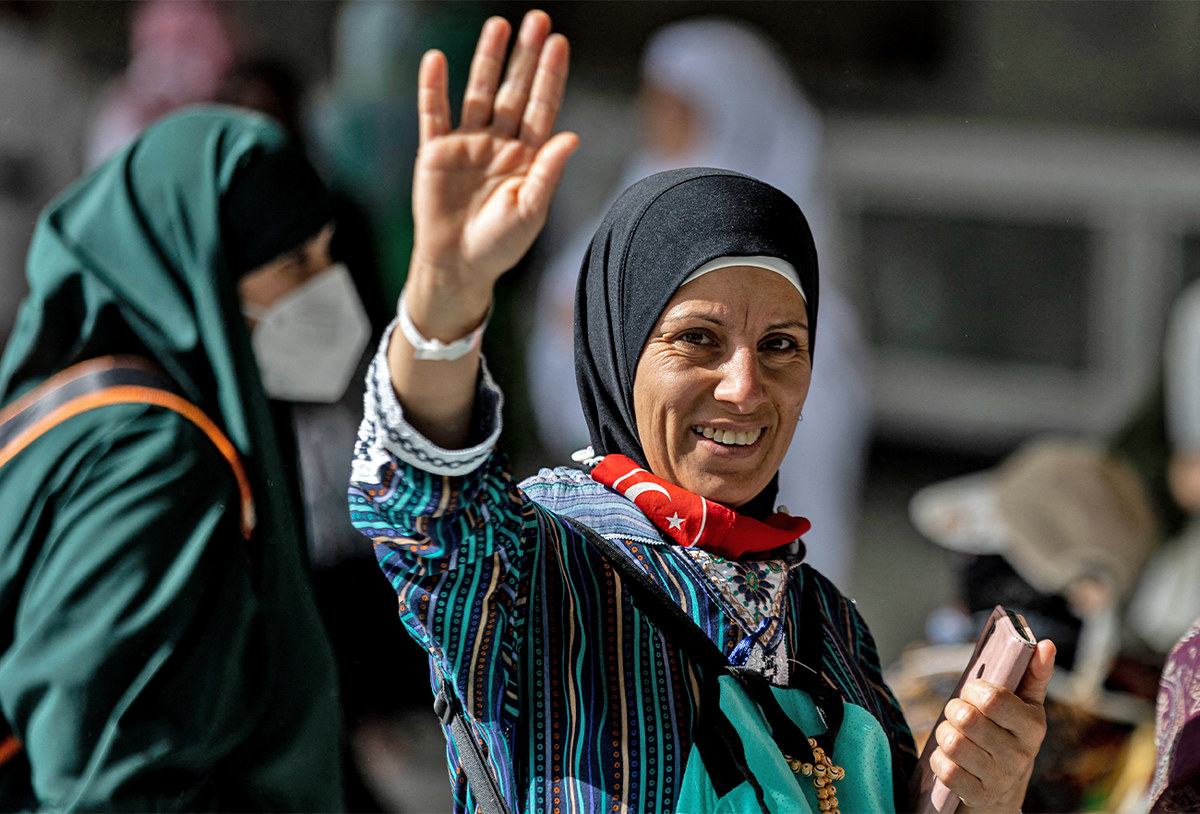


A Muslim worshipper wearing a scarf showing the flag of Turkey waves at the Grand Mosque in Saudi Arabia's holy city of Makkah on July 6, 2022. (AFP)

The Arab region ranks the “lowest in the world in terms of women’s rights, with a gender gap that needs 153 years to close,” a Middle East Institute study said in October.

But despite hardships, women in countries such as Tunisia and Lebanon enjoy more social freedoms than others.

Things are also changing in the Gulf region, with more women entering the workforce and some going into politics, holding cabinet positions in the United Arab Emirates and parliament seats in Kuwait.

In Makkah’s Grand Mosque, many women this week performed the opening Hajj rituals alone.

Some of them video-called their relatives back home, and others read long prayers from electronic tablets.

“For those (women) who are able to (perform the Hajj), don’t lose the opportunity,” even if it means going without a male guardian, said retired Egyptian financial expert Faten Abdel Moneim, 65.

“This is a spiritual joy that cannot be described. You are in the house of God, what more could you ask for?“


Ramadan ‘Basta’ stalls blend heritage, community and entrepreneurship in Jeddah

Updated 7 sec ago
Follow

Ramadan ‘Basta’ stalls blend heritage, community and entrepreneurship in Jeddah

  • Spread across the city, these stalls form a vibrant social and cultural scene that reflects the identity of the community and the depth of its heritage
  • Stalls are no longer limited to Jeddah’s historic district or set up outside homes selling simple snacks such as French fries. Instead, they have evolved into a concept embraced by many aspiring entrepreneurs

JEDDAH: During Ramadan, the city of Jeddah takes on a different spirit. Neighborhoods and house entrances are decorated with bastat (street stalls) that recall the charm of traditional markets and the authentic character of Hijazi culture.

Spread across the city, these stalls form a vibrant social and cultural scene that reflects the identity of the community and the depth of its heritage.

This Ramadan season, however, has seen a new wave of creativity in the world of bastat. The stalls are no longer limited to Jeddah’s historic district or set up outside homes selling simple snacks such as French fries. Instead, they have evolved into a concept embraced by many aspiring entrepreneurs.

One example this year was the stalls at Batterjee Medical College, which attracted large crowds from across Jeddah. The gathering began after the Isha prayer and continued until about 3 a.m.

Another popular gathering took place in the Al-Zahra district, where several stalls came together in a unified and neatly designed setting.

Visitors could sample a wide range of foods, including balila (spiced chickpeas), fries, liver sandwiches, satay, cookies and many other treats.

These stalls have helped revive neighborhoods in Al-Balad and have become popular attractions for residents and visitors from diverse backgrounds.

They have created seasonal job opportunities for young men and women, and for many, the initiative reflects a growing spirit of local entrepreneurship.

Dina Al-Bakri, a visitor who came to enjoy the food and support stall owners, told Arab News that the experience also benefits the vendors themselves.

“Stall owners feel a strong sense of independence and confidence,” she said. “The work gives them the opportunity to prove their abilities and take on responsibility.

“Interacting directly with visitors also strengthens their sense of belonging and pride in their cultural heritage, especially when they see how much people appreciate the quality and authenticity of their products.”

Al-Bakri said: “These stalls allow vendors to unleash their creativity in front of the public, helping them develop their skills and potentially take the next step in turning their ideas into real businesses.”

Ahmed Al-Johani, who lives in Makkah but studies at King Abdulaziz University in Jeddah, is the owner of a stall called “Tatto,” a nickname he has carried since childhood. He said this year marks his second consecutive participation.

“The land next to Batterjee Medical College and Land of Happiness Resort is quite large, but its owner has dedicated it as a charitable endowment during Ramadan so residents of the area who want to sell and earn income through these stalls can benefit from it,” he said.

“The procedures to obtain a permit from Jeddah Municipality were simple, costing no more than SR200 ($53), to make it easier for participants.”

Al-Johani sells french fries with his developed recipe, liver sandwiches and juices.

“The one thing we are careful about is maintaining the cleanliness of the place,” he said. “It is our source of income, and it represents us and helps us gain the trust of visitors.”

During an Arab News tour of the area, 8-year-old Sama Al-Maghribi offered a sample of lemonade from behind her stall, called “Little Star Lemonade.”

Her mother, Dalia Al-Maghribi, said the idea had been postponed for a long time.

“Sama had always wanted to have a small project of her own, but we couldn’t find a suitable place to set up the stall she dreamed of,” she said. “When we found this nearby location, we decided to give it a try.”

The idea originally came from Sama herself. She wanted something of her own and knew she could earn money from it.

“At first she used to do simple tasks at home, like cleaning the kitchen floor after we finished or organizing things,” her mother said.

“Sometimes she would volunteer to do tasks that weren’t even required, but she would say: ‘I’ll do this, but you have to give me five or 10 riyals in return’.”

From there, the idea began to develop.

“She said: Why don’t I have something that I can sell and earn money from?”

Her mother encouraged her to think creatively rather than relying only on small household tasks to save money.

Sama now sells lemonade and Rice Krispies bars at her stall. She had initially planned to set it up in front of their home, but realized the area did not have enough foot traffic.

“With the start of Ramadan, she said: Why don’t you let me open a stall near the mall?” her mother said. “That’s how the idea started. The location was actually her suggestion from the beginning.”

Stalls in Al-Balad tell the story of a city that is proud of its history.

This year, many of the stalls had vendors chanting inspired by traditional Hijazi street calls from the western region.

The chant, titled “Ya Halawa Ya Tarawa,” loosely translates to “Oh sweetness, oh freshness,” and reflects the joy of vendors welcoming customers during the unusually cool Ramadan weather.

The pleasant temperatures helped boost visitor numbers compared with previous years, drawing crowds eager to explore the stalls and sample the wide variety of foods on offer.

Nuha Batoubara, one of the visitors to Al-Balad, said: “Every Ramadan season surprises us with excellent organization and a level of variety that you won’t find anywhere else, along with the authentic Ramadan atmosphere.”

She added: “The concept of buying food from an outdoor stall and waiting in line creates an exciting atmosphere that makes the experience even more enjoyable.”

Another new development this year was the participation of several well-known Jeddah restaurants, which took advantage of outdoor spaces to set up stalls representing their brands.

These stalls offered the restaurants’ signature dishes in a more street food style, often at lower prices and with different menu options.

Fine dining restaurants also took part, setting up stalls next to their main locations. Arab News visited the stall of Yashi, an Asian cuisine restaurant owned by renowned Saudi chef Sama Jad, which sells dumplings and fried potatoes with a distinctive Japanese-inspired flavor.

The trend has even spread beyond the western region to Riyadh, where fried potato stalls have begun appearing more frequently than usual.

Some vendors have adopted the traditional Hijazi-style chants used by western-region sellers, sparking humorous comparisons and playful debates on social media about the different selling styles behind the stalls.