

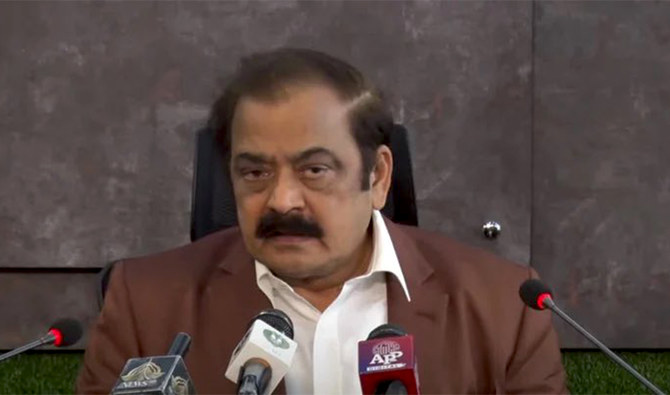

ISLAMABAD: A day after Pakistan set up a parliamentary committee to oversee talks with the local Taliban, Interior Minister Rana Sanaullah said on Wednesday the government’s negotiations with the outlawed group were in the “pre-dialogue” phase.
The Pakistani Taliban — known as the Tehreek-e-Taliban Pakistan (TTP) — has carried out some of the bloodiest attacks inside Pakistan since 2007, including a 2014 assault on a school in which 134 students were killed. The group is not directly affiliated with the Afghan Taliban, but pledges allegiance to them.
Pakistan has since 2007 carried out a number of military operations against the TTP, but, despite reducing the militant group’s footprint, with most fighters fleeing to neighboring Afghanistan, it has not been able to fully stop attacks, which had begun to rise again along its western border in recent months.
On June 4, the TTP extended a cease-fire with the government for an indefinite period, after two-day talks with a delegation of Pakistani tribal elders facilitated by the Afghan Taliban, who head the government in Kabul since US-led forces withdrew last year.
On Tuesday, Prime Minister Shehbaz Sharif chaired a meeting of over 100 lawmakers and officials to deliberate on talks with the Pakistani Taliban. The Parliamentary Committee on National Security subsequently gave its formal approval to hold the talks and also set up a parliamentary committee to oversee the process and ensure it was carried out within the ambit of the constitution.
Sanaullah told reporters on Tuesday talks with the TTP were in the “pre-dialogue” phase and it was still under discussion what the nature of the dialogue should be.
He said the parliamentary committee to oversee talks would comprise not only interior ministry and other government officials but “all political party representatives.”
He warned that the exercise of building political consensus around the talks should not be viewed as a “weakness” on the part of the state.
“Consensus should not be seen as a sign of weakness,” Sanaullah said.
Pakistani media has widely reported that at the heart of talks is an offer to accommodate the TTP with a safe passage back to Pakistan from Afghanistan in exchange for the group agreeing to a long-term cease-fire, dissolving its organization and possibly even joining mainstream politics.
The TTP’s main demands include compensation for losses caused to them during military operations, and for Pakistan to scrap a 2018 law that did away with the semi-independent status of the former tribal regions, FATA, that dates back to British colonial rule.
The TTP also wants a substantial reduction of Pakistani military forces from the former tribal areas, which border Afghanistan and where the group was mostly harboring before being driven out through military operations.


