Pakistan climbing season reaches new heights as 1,400 foreign mountaineers arrive

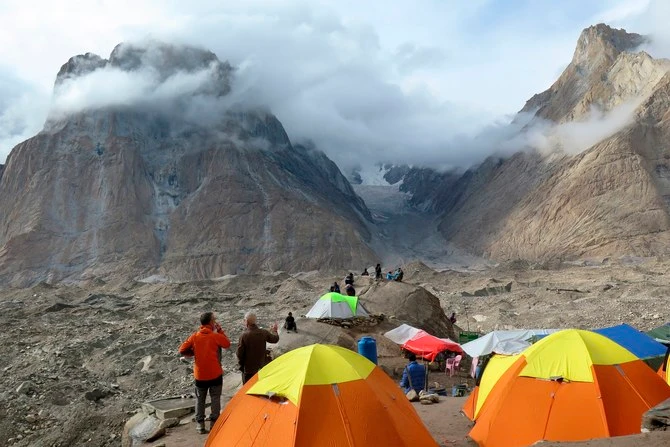
In this picture taken on August 12, 2019 foreign tourists and porters rest at a camping site above Baltoro glacier in the Karakoram range of Pakistan's mountain northern Gilgit region. (AFP/File)
Short Url
Updated 06 July 2022
Follow

Pakistan climbing season reaches new heights as 1,400 foreign mountaineers arrive

  • The country is home to five of the world’s 14 mountains higher than 8,000 meters
  • 57 expeditions planned for 23 Pakistan peaks this season, with 370 climbers climbing K2

SKARDU: Pakistan is enjoying a bumper climbing season with around 1,400 foreign mountaineers bidding to scale its lofty peaks — including hundreds on the 8,611-meter (28,251-feet) K2, the world’s second-highest.

The country is home to five of the world’s 14 mountains higher than 8,000 meters, and climbing them all is considered the ultimate achievement of any mountaineer.
“It is a record number,” Raja Nasir Ali Khan, tourism minister of Gilgit-Baltistan region, told AFP about the number of foreign climbers this year.
Karrar Haidri, secretary of the Alpine Club of Pakistan, told AFP there were 57 expeditions planned for 23 Pakistan peaks this season — with 370 climbers having a crack at K2, known as “the savage mountain.”
Besides being far more technically difficult to climb than Everest, weather conditions are notoriously fickle on K2, which has only being scaled by 425 people since 1954.
More than 6,000 people have climbed Everest since Edmund Hillary and Tenzing Norgay first reached the top in 1953 — some of them multiple times.
Haidri said climbers this year include 90 women — including at least two Pakistanis aiming to become the country’s first to scale K2.
Russian Oxana Morneva is leading a team on the mountain, having failed in her own attempt in 2012 when she was forced back after injuring her knee.
“My rope was broken by falling rocks,” she told AFP.
She said she had no apprehension about returning.
“When we go to the mountain we have to be peaceful inside, and we have to know what we are doing,” she added.
Around 200 climbers will attempt to scale the 8,051-meter Broad Peak, while similar numbers will try Gasherbrum-I (8,080 meters) and Gasherbrum-II (8,035 meters).
A 36-year-old Norwegian climber, Kristin Harila, is also aiming to reach the world’s 14 highest mountain summits in record time.
Having already climbed seven peaks of over 8,000 meters, Harila hopes to match, if not beat, Nepali adventurer Nirmal Purja’s ambitious six months and six days record.
The summer climbing season that started in early June lasts until late August.

Pakistan highlights Gwadar transshipment role as shipping routes face disruption over regional tensions

Updated 7 sec ago
Follow

Pakistan highlights Gwadar transshipment role as shipping routes face disruption over regional tensions

  • Pakistani ports possess “untapped potential” to attract global shipping lines for transshipment operations, says minister
  • Pakistan eyes leveraging Gwadar as regional transshipment hub as Iran’s closure of Strait of Hormuz disrupts global maritime trade

KARACHI: Pakistan’s Maritime Affairs Minister Junaid Anwar Chaudhry on Thursday highlighted the importance of the port city of Gwadar’s transshipment role as major shipping routes, including the Strait of Hormuz, face disruption due to Iran’s ongoing conflict with the US and Israel in the Gulf. 

The meeting takes place as Iran has effectively closed the Strait of Hormuz, a strategic waterway that lies between it and Oman. It is one of the world’s most critical oil transit routes, with roughly 20 percent of global oil supplies passing through it. Iran has vowed it will attack any ship that enters the strait, causing energy prices to rise sharply on Monday amid disruptions to tanker traffic in the waterway.

Gwadar is a deep-sea port in Pakistan’s southwestern Balochistan province that lies close to the Strait of Hormuz. Pakistani officials have in the past highlighted Gwadar’s geostrategic position as the shortest trade route to the Gulf and Central Asia, stressing that it has the potential to become a regional transshipment hub.

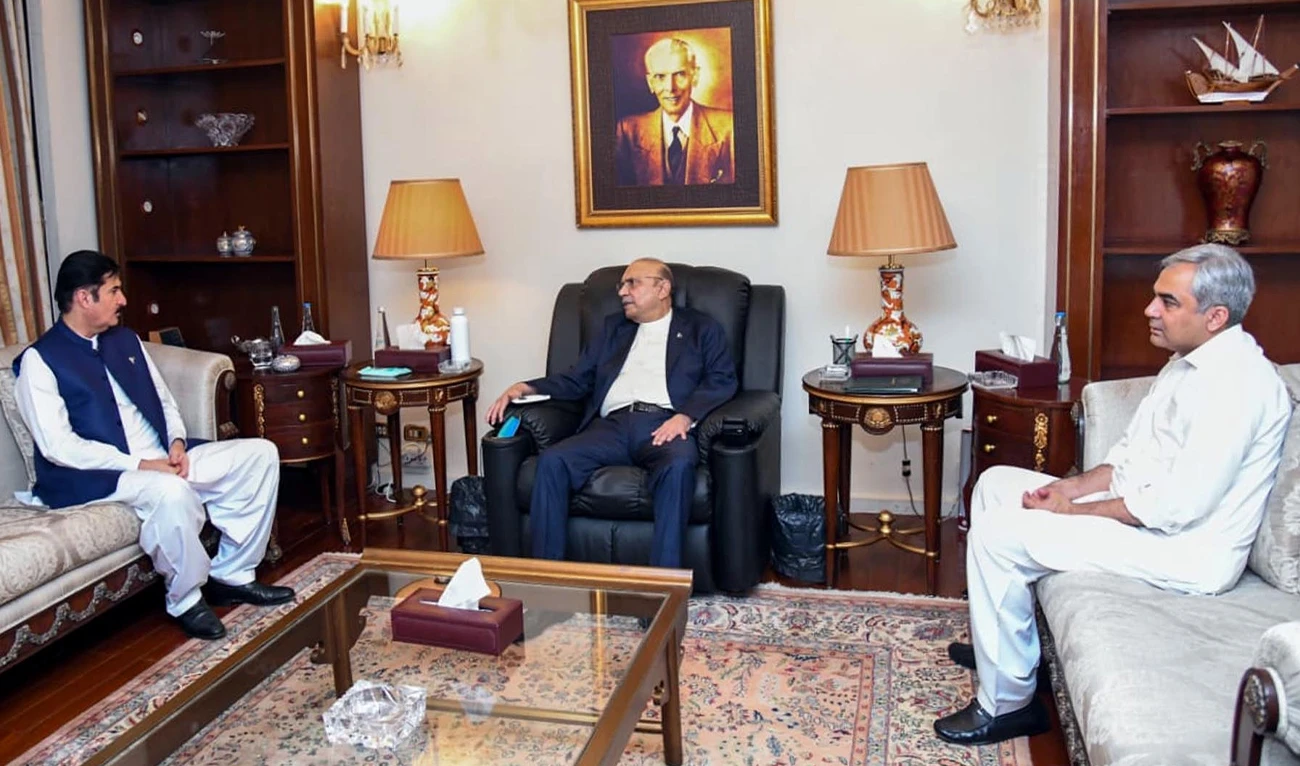
Chaudhry chaired a high-level meeting of government officials to assess emerging logistical challenges facing Pakistan’s trade, particularly in the energy sector, amid tensions in the Gulf. 

“Special focus was placed on fully leveraging the potential of Gwadar Port as a regional transshipment hub and positioning it as an alternative of regional instability,” Pakistan’s maritime affairs ministry said in a statement. 

The minister said Pakistani ports possessed “significant untapped potential” to attract international shipping lines for transshipment operations, noting that it could also ensure long-term sustainability and growth of the country’s maritime sector.

Participants of the meeting discussed measures to strengthen Pakistan’s position as a viable alternative transit and transshipment destination, as key waterways are affected by the disruption. 

The committee also reviewed proposals to amend relevant rules and regulations to facilitate international transshipment operations through on-dock and off-dock terminals.

The chairmen of the Port Qasim Authority, Karachi Port Trust and Gwadar Port Authority attended the meeting, briefing committee members on the current operational readiness of their ports. They spoke about the available capacity for container transshipment, bulk cargo handling and refueling services at Pakistani ports. 

The port in Gwadar is a central part of the China-Pakistan Economic Corridor (CPEC), under which Beijing has funneled tens of billions of dollars into massive transport, energy and infrastructure projects in Pakistan.

Pakistan has long eyed the deep-sea port as a key asset that can help boost its trade with Central Asian states, the Gulf region and ensure the country earns valuable foreign exchange.