Russian foreign minister Lavrov says Putin-Macron call leak breached ‘diplomatic etiquette’

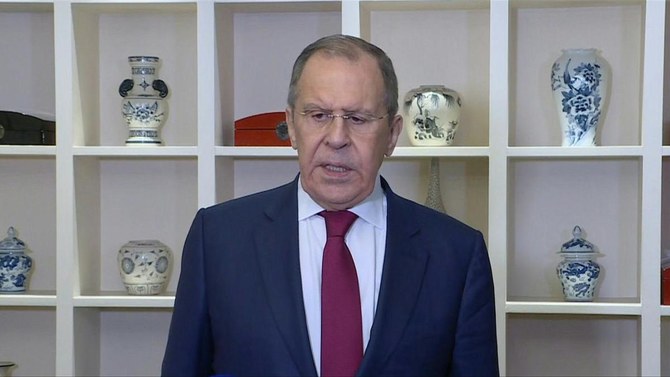
Russian Foreign Minister Sergei Lavrov said Moscow had nothing to be ashamed of from the content of the conversation between the two leaders. (AFP)
Short Url
Updated 06 July 2022
Follow

Russian foreign minister Lavrov says Putin-Macron call leak breached ‘diplomatic etiquette’

  • ‘Diplomatic etiquette does not provide for unilateral leaks of (such) recordings’
  • Sergei Lavrov: Moscow had nothing to be ashamed of from the content of the conversation between the two leaders

HANOI: Russian Foreign Minister Sergei Lavrov said Wednesday that the publication of a call between President Emmanuel Macron and Russian leader Vladimir Putin was a breach of “diplomatic etiquette.”
“Diplomatic etiquette does not provide for unilateral leaks of (such) recordings,” Lavrov said on a trip to Vietnam.
The details of the confidential call days before Moscow’s military operation in Ukraine were revealed by the broadcaster France 2 in a documentary on the French president’s handling of the conflict.
Lavrov said Russia had nothing to be ashamed of from the content of the conversation between the two leaders.
“We in principle lead negotiations in such a way that we never have anything to be ashamed of. We always say what we think and are ready to answer for these words and explain our position,” he said.
Lavrov is on a two-day visit to Vietnam, on the tenth anniversary of the two nations’ “comprehensive strategic partnership.”
Vietnam, historically close to Moscow, has so far declined to outright condemn Russia’s military intervention in Ukraine.


In South Africa’s affluent Western Cape, farmers lose cattle to drought

Updated 2 sec ago
Follow

In South Africa’s affluent Western Cape, farmers lose cattle to drought

  • Drought in country’s south follows flooding ‌in north
  • Farmers try to adapt but lose livestock
KNYSNA: In South Africa’s most visited and affluent province, Western Cape, one of the worst droughts in living memory is drying up dams, scorching grass and killing livestock, prompting the government to declare a national emergency this month.
Scientists say climate change is causing worsening droughts in the province, which draws tourists to ‌its vineyards, ‌beaches and the lush slopes of ​Table ‌Mountain ⁠above ​Cape Town, ⁠but lies on the edge of the advancing semi-desert Karoo. In 2015, a drought almost dried up the taps in the city; farmers say this one has been even more brutal than a decade ago.
Over the weekend, mixed-race couple Christian and Ilze Pienaar were ⁠distributing feed to keep their hungry cattle alive. ‌One cow had recently ‌starved to death, its bones ​visible through its skin.
“The drought ‌before wasn’t this bad because there was still ... ‌grazing,” Ilze, 40, told Reuters. “Now there’s nothing, the dams are dry ... (and) we’re spending all our money on feed.”
She said she’d lost 16 cattle and 13 sheep since January alone.
The ‌drought, which has also ravaged parts of Eastern Cape and Northern Cape, comes weeks ⁠after ⁠floods blamed on climate change and cyclical La Niña weather washed out the northeastern part of South Africa and killed 200 people across the region.
“The intensity and duration of both droughts and floods in this corner of the world is increasing,” Anton Cartwright, an economist with the African Center for Cities, said.
“Farmers (here) are very good at adapting to weather (but) ... the weather is just becoming much less predictable,” ​he said. “Seasons aren’t occurring, starting, ​ending at the same time of the year. It’s probably going to get worse.”
(Writing by Tim Cocks; editing by ​Philippa Fletcher)