

Egypt family keeps alive tradition behind Hajj centerpiece

An embroiderer sews with gold thread a verse from the Holy Koran, Islam's holy book, onto a replica of the Kiswa, the cloth used to cover the Kaaba at the Grand Mosque in the Muslim holy city of Makkah. (AFP)
Short Url
Updated 06 July 2022
Follow

Egypt family keeps alive tradition behind Hajj centerpiece

  • From the 13th century, Egyptian artisans made the giant cloth in sections, which authorities transported to Makkah with great ceremony

CAIRO, Egypt: Under the steady hum of a ceiling fan, Ahmed Othman weaves golden threads through black fabric, creating Qur'anic verses, a century after his grandfather’s work adorned the Kaaba in Makkah’s Grand Mosque.
A ceremonial hanging of the kiswa, huge pieces of black silk embroidered with gold patterns, over the cubic structure that is the centerpiece of the Grand Mosque symbolizes the launch of the Hajj annual pilgrimage, which starts this week.


In this file photo taken on April 4, 2021 the keys of the Kaaba (box), Islam's holiest shrine at the Grand Mosque in Makkah, and a fragment of the black-clothed Kiswa (wall) which is used to cover the Kaaba, the final one provided by Egypt (in 1961) during the administration of President Gamal Abdel Nasser, are displayed at the Museum of Egyptian Civilisation (NMEC), in the Fustat district of Old Cairo. (AFP)

Othman’s family used to be honored with the task of producing the kiswa.
His family’s creations would be despatched in a camel caravan to Islam’s holiest site in western Saudi Arabia toward which Muslims across the world turn to pray.
Now, Othman keeps the tradition alive in a small workshop, tucked above the labyrinthine Khan Al-Khalili bazaar in central Cairo, where mass-produced souvenirs line the alleys.
The area is historically home to Egypt’s traditional handicrafts, but artisans face growing challenges.
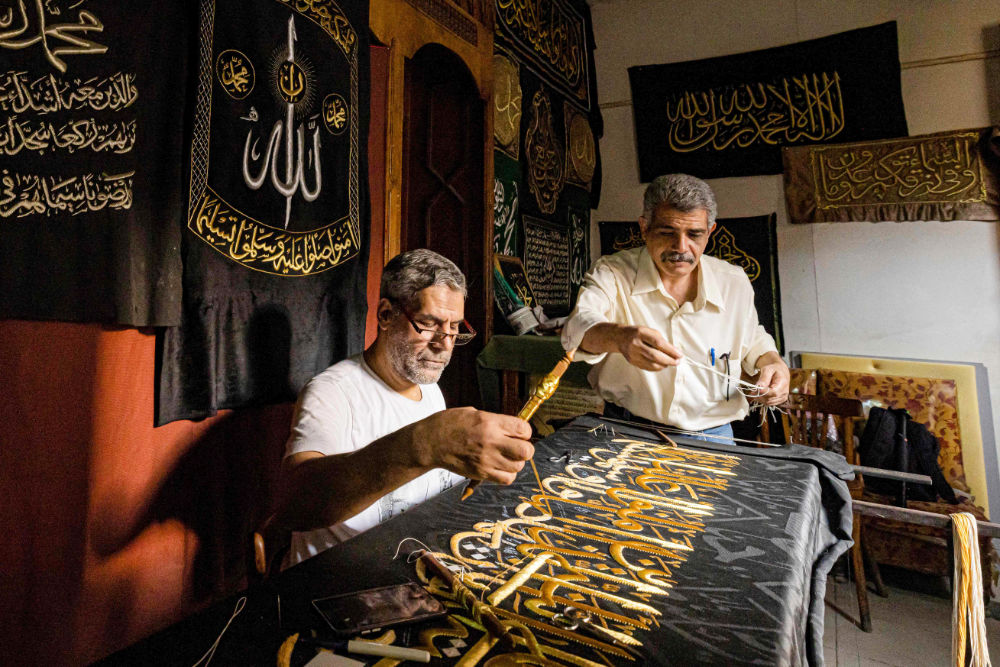


Egyptian embroiderer Ahmed Othman el-Kassabgy (R), whose family was traditionally responsible for used to be honoured with the task of producing the Kiswa, the cloth used to cover the Kaaba at the Grand Mosque in the Muslim holy city of Makkah, supervises as another employee (L) sews with gold thread a verse from the Holy Koran, Islam's holy book, onto a replica drape to be sold as a souvenir for tourists visiting the historic district of al-Hussein of Islamic Cairo in Egypt's capital on June 15, 2022. (AFP)

Materials, mostly imported, have become expensive, particularly as Egypt faces economic woes and a devalued currency.
Plummeting purchasing power makes high quality hand-crafted goods inaccessible to the average Egyptian, while master craftspeople find it hard to hand down their skills as young people turn to more lucrative jobs.
This wouldn’t be the case “if there was good money in the craft,” Othman sighed, hunched over one of the many tapestries that fill his workshop.
Sheets of black and brown felt are covered in verses and prayers, delicately embroidered in silver and gold.
Every stitch echoes the “sacred ritual” Othman’s grandfather was entrusted with in 1924.
“For a whole year, 10 craftsmen” would work on the kiswa that covers the Kaaba which pilgrims circumambulate, using silver thread in a lengthy labor of love.
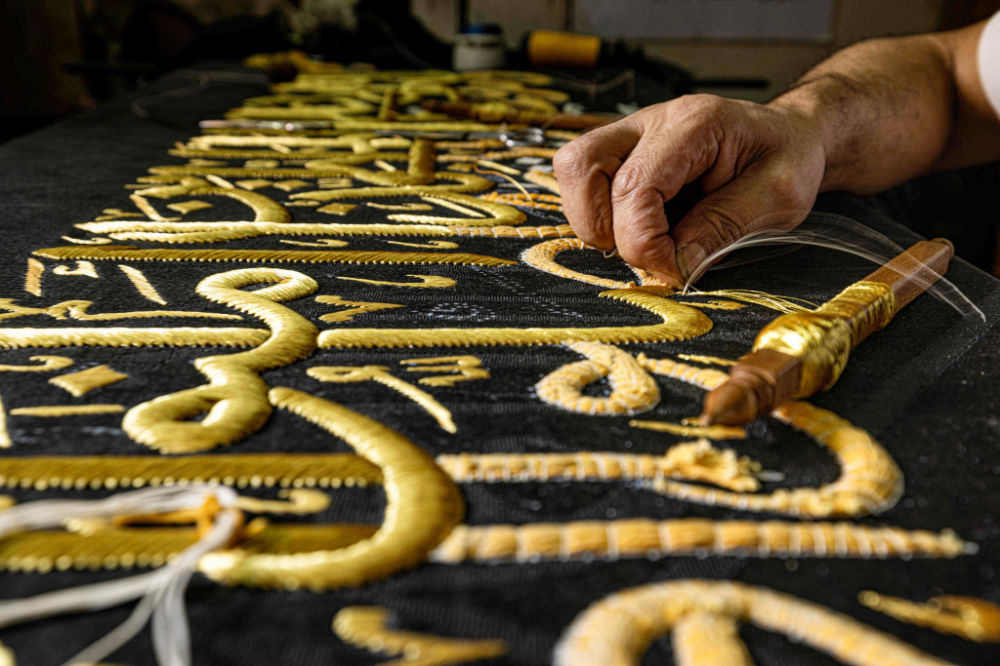


An embroiderer sews with gold thread a verse from the Holy Koran, Islam's holy book, onto a replica of the Kiswa, the cloth used to cover the Kaaba at the Grand Mosque in the Muslim holy city of Makkah, to be sold as a souvenir for tourists visiting the historic district of al-Hussein of Islamic Cairo in Egypt's capital on June 15, 2022. (AFP)

From the 13th century, Egyptian artisans made the giant cloth in sections, which authorities transported to Makkah with great ceremony.
Celebrations would mark the processions through cities, flanked by guards and clergymen as Egyptians sprinkled rosewater from balconies above.
Othman’s grandfather, Othman Abdelhamid, was the last to supervise a fully Egyptian-made kiswa in 1926.
From 1927, manufacturing began to move to Makkah in the nascent Kingdom of Saudi Arabia, which would fully take over production of the kiswa in 1962.
The family went on to embroider military regalia for Egyptian and foreign dignitaries, including former presidents Gamal Abdel Nasser and Anwar Sadat.
“In addition to our work with military rank embroideries, my father started embroidering Qur'anic verses on tapestries,” and then reproducing whole sections of the kiswa.
Clients began flooding in for “exact replicas of the kiswa, down to the last detail.”
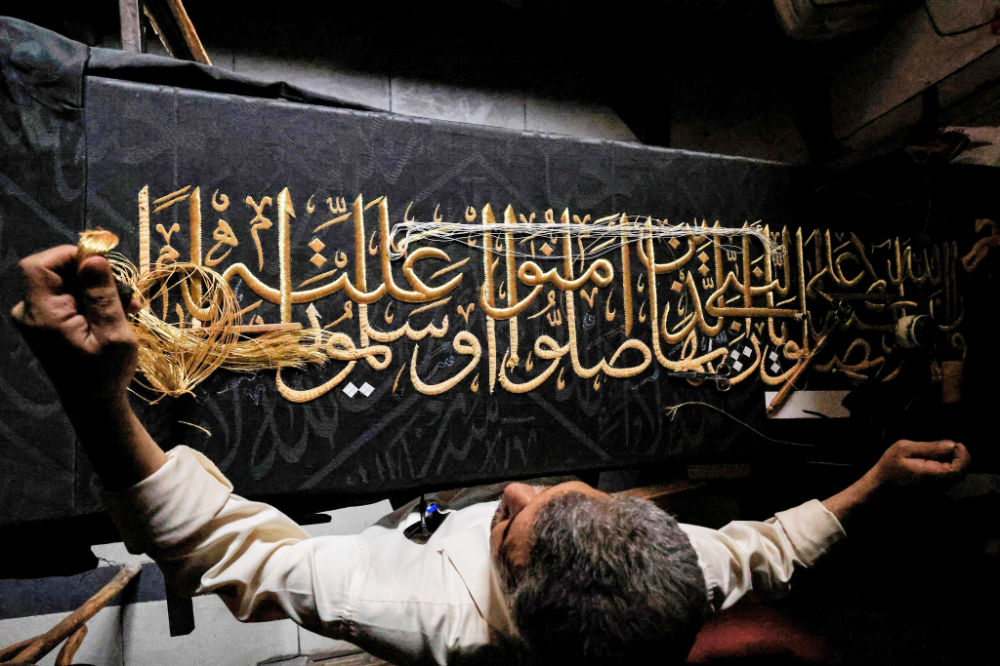


Egyptian embroiderer Ahmed Othman el-Kassabgy, whose family was traditionally responsible for used to be honoured with the task of producing the Kiswa, the cloth used to cover the Kaaba at the Grand Mosque in the Muslim holy city of Makkah, sews with gold thread a verse from the Holy Koran, Islam's holy book, onto a replica drape to be sold as a souvenir for tourists visiting the historic district of al-Hussein of Islamic Cairo in Egypt's capital on June 15, 2022. (AFP)

Though today they offer small tableaus for as little as 100 Egyptian pounds (about $5), massive customised orders go for several thousand dollars, such as replicas of the Kaaba door, which Othman proudly claims are indistinguishable from the originals in Makkah.

But the family has not been immune to the economic turbulence that began with the coronavirus pandemic, which decimated small businesses and craftsmanship in Egypt.
Since early 2020, they have sold around “two pieces per month,” whereas before they would sell at least one tapestry a day.
Othman worries that a sense of “worldwide austerity” makes business unlikely to bounce back.
Today, there might only be a dozen or so craftsmen whose work he considers authentic, with many artisans leaving the craft for quicker cash flows.
“They can make 200 to 300 pounds a day,” ($10-$16) driving a tuktuk motorized rickshaw, or a minibus, Othman said. “They’re not going to sit on a loom breaking their backs all day.”
But still, a century and a half after his great grandfather left his native Turkey and brought the craft with him to Egypt, Othman says he has stayed loyal to techniques learnt as a child when he would duck out of school to watch his father work.
“It’s on us to uphold the craft the same way we learned it, so it’s authentic to the legacy we inherited,” he said.


UN Security Council urged to put pressure on UAE to stop arming Sudanese paramilitary

Updated 8 sec ago
Follow

UN Security Council urged to put pressure on UAE to stop arming Sudanese paramilitary

  • Activist accuses Rapid Support Forces and its allies of widespread conflict-related sexual violence during war, calls for action against faction’s powerful international backers
  • Plea comes amid growing warnings of genocide in Sudan, ‘unchecked external interference’ that is allowing atrocities to continue, and the risk of further regional destabilization

NEW YORK CITY: The UN Security Council faced calls on Thursday to put pressure on the UAE to stop arming the Rapid Support Forces, one of the warring military factions in Sudan, amid warnings that atrocities bearing “the hallmarks of genocide” were spreading and the situation in the country risks causing further regional destabilization.

Sudanese activist Hala Alkarib said that “unchecked external interference” was allowing atrocities to continue. She cited the documentation by a UN panel of experts and international nongovernmental organizations of weapons and military equipment being shipped into Darfur, “including by the United Arab Emirates, in violation of this Council’s arms embargo.”

She told council members: “You can stop the violence by pressuring the RSF’s powerful backers with economic, political and criminal consequences.”

The council also heard warnings from Alkarib and senior UN officials that after more than 1,000 days of war, civilians face renewed risks of mass atrocities in Darfur and Kordofan.

Earlier on Thursday, the International Independent Fact-Finding Mission for Sudan issued a report that described atrocities committed by the RSF in and around El-Fasher in late October last year as “indicators of a genocidal path.”

Alkarib, regional director of the Strategic Initiative for Women in the Horn of Africa, told the Security Council that she had lost family members and her home in the conflict between the RSF and the Sudanese Armed Forces, which began in April 2023.

“To be here a third time, only to report that the situation is even worse, is an indictment not just of the warring parties but of this council’s inability to stop the bloodshed,” she said.

“Over 1,000 days since the start of the war, despite repeated warnings, this council has failed to act. Every red line — siege, forced displacement, man-made famine, genocide, mass rape — has been crossed.”

She warned that the kinds of atrocities seen in El-Geneina and El-Fasher now risk being repeated in Greater Kordofan and Blue Nile, where drone attacks by all sides are killing civilians and destroying hospitals, schools and markets.

“Unless you act now, you will have more blood on your hands,” Alkarib said.

Her organization has documented more than 1,294 cases of conflict-related sexual violence against women and girls since the war began, she said, “perpetrated primarily by the RSF and their allies.”

She accused RSF forces in Darfur of deliberately targeting women and girls from the Fur, Masalit, Berti, Zaghawa and Tunjur communities on the basis of ethnicity.

“As the UN Fact-Finding Mission confirmed in a report today, this is part of a strategy of genocide aimed at eradicating native African communities,” Alkarib said.

Sexual violence, arbitrary detention and enforced disappearances in RSF-controlled areas remain severely underdocumented due to access restrictions, communications blackouts and retaliation, she added.

Thousands of women and children have been detained in villages including Garny, Tura and Tabit in North Darfur, she said, and hospitals and schools have been turned into detention centers. Forced marriages, including child marriages, to RSF soldiers are frequently linked to abductions and enforced disappearances.

Alkarib called for an immediate end to hostilities, the release of civilians held by the warring parties, “particularly women held by the RSF in conditions amounting to sexual slavery,” and the deployment of a mission with a clear mandate to protect civilians across Sudan in collaboration with the African Union.

She also urged the Security Council to expand the arms embargo to the whole of Sudan; impose targeted sanctions on violators; demand safe and sustained humanitarian access; condemn attacks on aid convoys, including a recent strike on a World Food Programme convoy in North Kordofan; support Sudanese women-led organizations; and back efforts to ensure accountability, including the work of the International Criminal Court.

“None of this will stop without immediate action from you, the international community,” Alkarib added.

The UN’s political affairs chief, Rosemary DiCarlo, said: “Sudan reached a horrific milestone: 1,000 days of a brutal war that has nearly destroyed the third-largest country in Africa. 1,000 days of total impunity for the perpetrators of a long list of atrocities and war crimes.”

She warned that “the risk of regionalization of the conflict is a matter of urgent concern,” citing in particular the movement of armed groups across the border between Sudan and South Sudan “in both directions,” and reports that weapons continue to transit through neighboring states.

“The horrific events in El-Fasher in October 2025 were preventable,” DiCarlo said. During the time the city was under siege, more than a year, the UN’s Human Rights Office “repeatedly sounded the alarm about the risk of mass atrocities. But the warnings were not heeded.”

The UN high commissioner for human rights, Volker Turk, had also alerted the international community to the possibility of similar crimes in Kordofan, where civilians are once again at risk of “summary executions, sexual violence, arbitrary detention and family separation,” she added.

“During the final offensive of the RSF on El-Fasher, reports indicate that sexual violence against women and girls was widespread,” DiCarlo said. “The time to act to prevent a repeat of atrocities elsewhere in the country is now.”

She welcomed progress in an initiative to secure a humanitarian truce, led by Egypt, Saudi Arabia, the UAE and the US.

“These efforts offer a critical opportunity for immediate and much-needed deescalation and could pave the way for a sustainable cessation of hostilities,” she said. “We call on both parties to the conflict to engage with this initiative in good faith and without preconditions.”

But she stressed that unity among Sudan’s partners was essential.

“This entails ensuring that the flow of weapons to the warring parties is cut off,” DiCarlo said. “The war has gone on this long and been this deadly in large part because of the support the parties have received from abroad.”

Speaking on behalf of UN humanitarian chief Tom Fletcher, Edem Wosornu, the director of the crisis response division at the Office for the Coordination of Humanitarian Affairs, said violence continues to spread “relentlessly.”

“Nearly three years have passed since this war began — humanitarian needs have deepened and countless civilian lives have been shattered,” she added.

Since the start of this year, she said, conditions in much of Kordofan and Darfur have deteriorated and drone attacks across the three states in Kordofan have escalated, resulting in civilian casualties and displacement. More than 1 million people are now displaced in the region.

In North Kordofan, fighting around the state capital, El-Obeid, was restricting the delivery of humanitarian and commercial supplies, Wosornu said. In South Kordofan, there has been intensified fighting and aerial attacks in and around Kadugli and Dilling, where an assessment by the Integrated Food Security Phase Classification indicates famine conditions may be prevalent.

Despite recent announcements that sieges had been broken and convoys could move between El-Obeid to Kadugli and Dilling, “humanitarian access along these key supply lines remains unpredictable,” Wosornu added.

In December, rates of acute malnutrition in Um Baru and Kernoi in North Darfur exceeded the threshold for famine, she said, and more than 1,000 newly displaced people recently arrived in Tawila, joining 600,000 who were already living there “in dire conditions.”

She continued: “For over 12 million women and girls, this is a crisis within a crisis. Violence against women and girls in Sudan has reached catastrophic levels. Sexual violence against women and girls has reached horrific levels. Documented cases have nearly tripled – yet this is but a fraction of the real scale.”

Wosornu also warned that 4.2 million children and pregnant and breastfeeding women face acute malnutrition.

She urged the council to work together “in pursuit of an immediate stop to the fighting, to stem the flow of weapons into Sudan, and to press for the lasting, inclusive peace that is so desperately needed.”

The UK is chairing the Security Council this month, with British Foreign Minister Yvette Cooper serving as president of the council for February.